The horseshoe crab is the hinge. Triassic survivor, pharmaceutical donor, architectural ancestor: Hannah Levy turns her first institutional solo show in Italy on this single creature, staging a congregation of silicone, stainless steel, and cobalt glass inside the former communal washhouse of Orani, Sardinia, now Museo Nivola.
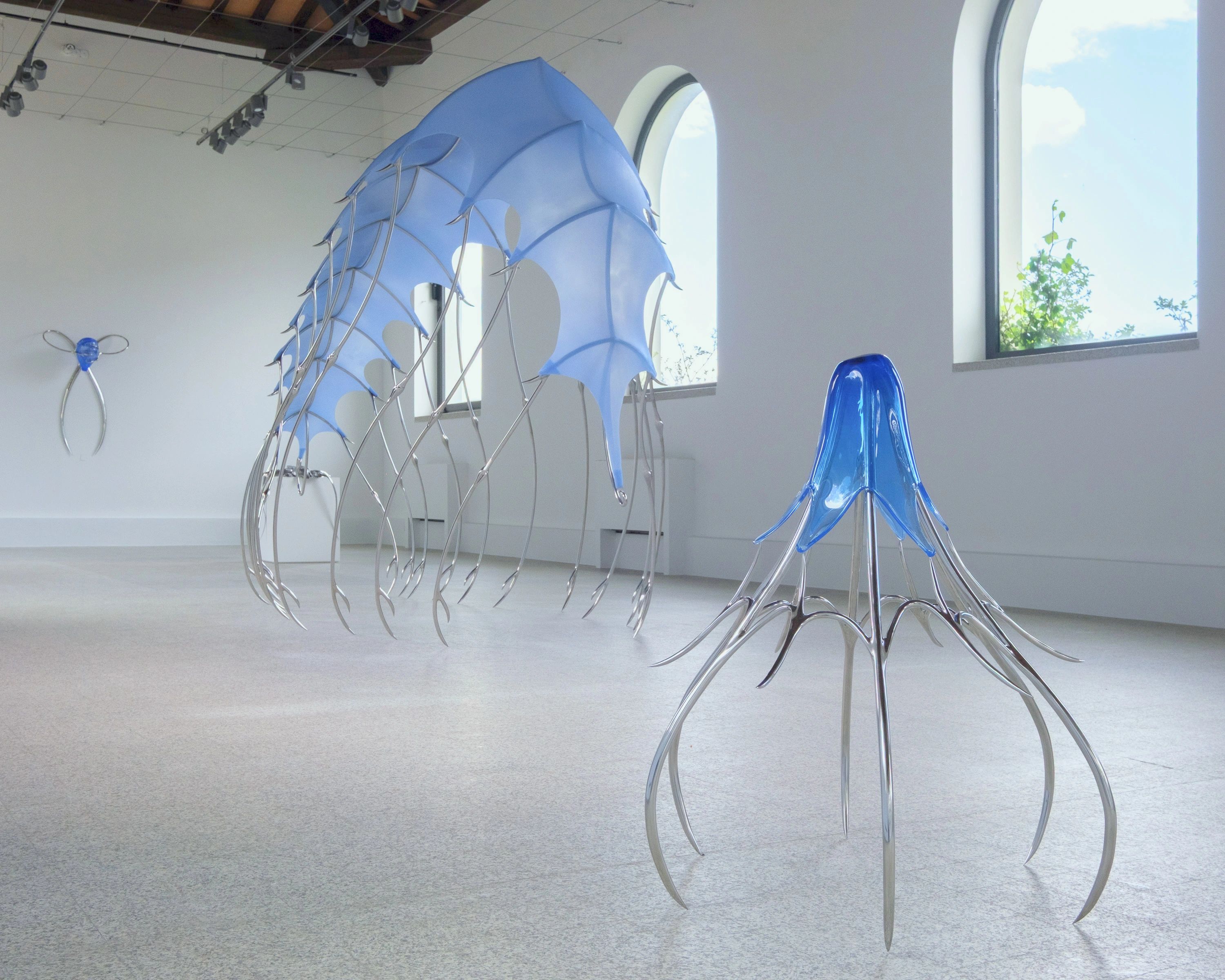
The nave is long and narrow. Its exposed wooden beams read as a rib cage. Its arched windows pull the Nuorese hills onto the gallery floor. Into this anatomical architecture, Levy introduces a congregation of creatures that are neither alive nor dead: fossilised, pharmaceutical, laboratory-grown.
The centrepiece hovers between beach shelter and natural-history specimen. A pale blue silicone canopy, spined and chevroned like the underside of a limulus, stretches across a forest of slender chrome legs that end in curling barbs. Seen head-on it is a pavilion. Seen from the side it becomes a creature walking on tiptoes, suspended in the nave like, in the curators’ phrase, “a presence suspended between refuge and relic.”

Nearby, a family of smaller standing works stalks the floor. Each is a blown glass bell, cobalt deepening to indigo, cradled inside a cage of splayed stainless steel limbs. The glass still carries the memory of its molten state, swollen where it met gravity, folded where it met the metal. The chrome legs grip it the way forceps grip tissue, the way a laboratory clamp grips a specimen slide.
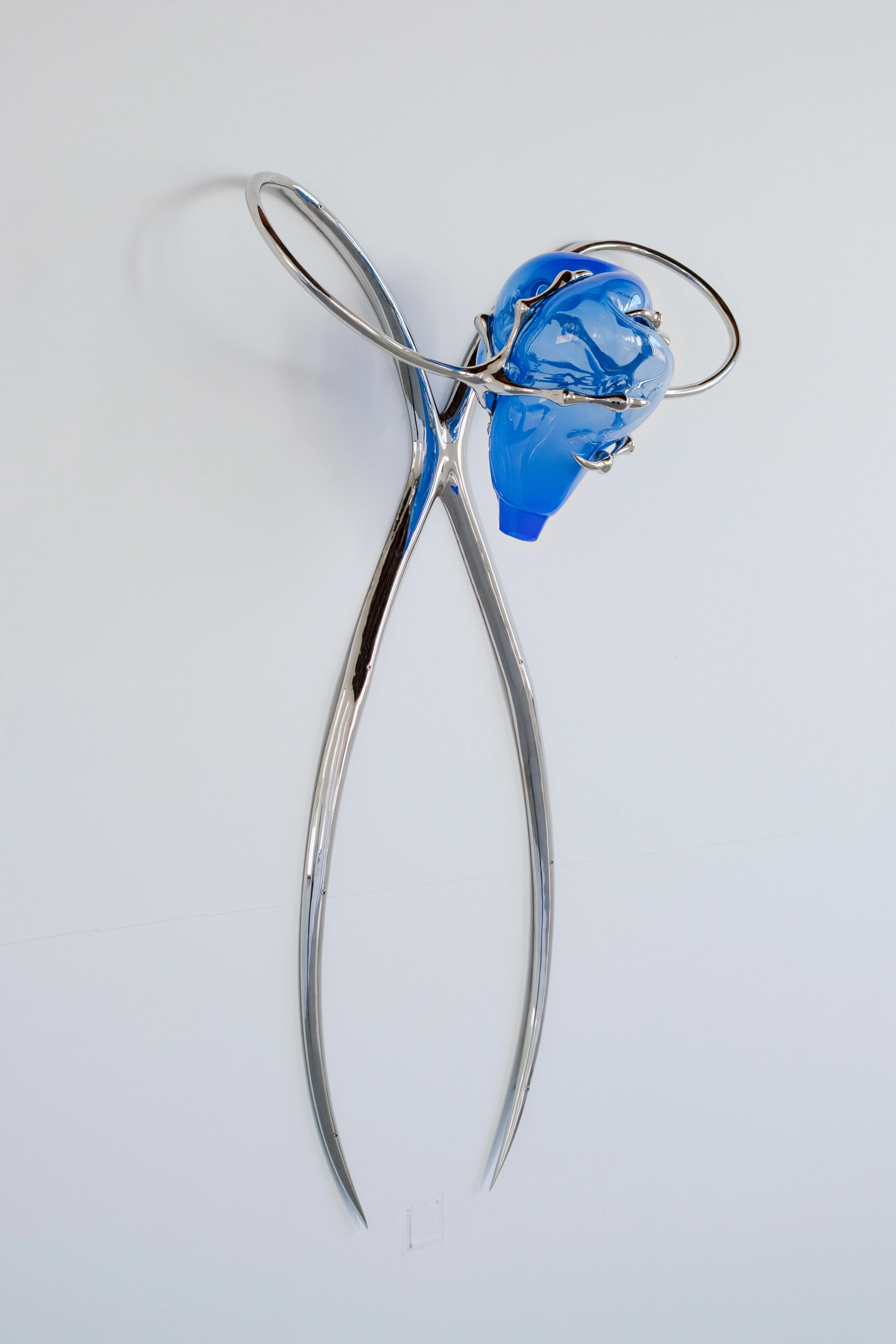
On the walls, pincers. Pairs of polished stainless steel arcs (silicone-smooth, surgically curved) close around misshapen orbs of blown blue glass. These are Levy’s sconces, her liturgical objects, imbuing the room with what the press text calls an “ambiguous, faintly disquieting sensuality.” The pincer is the show's governing gesture: the grip that extracts, that restrains, that keeps the living thing still long enough to be read. Not a healing instrument but its cold double.
In a corner, a plinth becomes an altar. A pile of cast aluminium shells, lost-wax impressions taken from actual horseshoe crab exoskeletons collected on the Long Island shore, spills toward the edge. One carapace slumps over the lip; its exaggerated tail, mirror-polished, dangles into the room like a drop of mercury that refuses to fall. Another lies overturned, its interior filled with blown blue glass revealing the soft anatomy of the underside. Ancient artisanal processes collide with prehistoric imagination.

The coincidence underneath all this is not incidental. Costantino Nivola, the Sardinian sculptor to whom the museum is devoted, developed his signature sandcasting technique on the beach at Springs, Long Island, while playing with his children in the 1950s. That same coastline is where Levy, two generations later, collected the horseshoe crabs whose bodies anchor this exhibition. One artist's childhood beach becomes another's research site. The show threads itself quietly through that genealogy: the beach as studio, the fossil as inheritance, the washhouse as field site.
Levy has long worked in the seam opened by Meret Oppenheim, Louise Bourgeois, and Robert Gober: industrial materials forced into anatomical confession. Blue Blooded tightens the screw. The horseshoe crab is not metaphor here; it is a donor. Thousands are captured each year, bled for their limulus amebocyte lysate, and returned to the sea. This is the invisible prerequisite for every vaccine, every implant, every injectable drug trial cleared in the United States. In 2020 the European Union approved a synthetic substitute. The United States has not. As the curators put it, the practice “prompts urgent questions about the moral limits of exploiting natural resources and about human responsibility toward species on which our own survival depends.” The species our survival has been leaning on is treated, still, as infrastructure, not as subject, but as fulcrum.

That is the tension the sculptures hold. The silicone skin is medical-grade. The glass is surgical-blue. The chrome is the colour of the forceps tray. Everything is beautiful in the way a clean hospital is beautiful, and everything is haunted by the blood that is not pictured, only implied. The work does not denounce the practice. It crystallises it. Makes it visible as a rite.
Not an exhibition about extinction, but about extraction. Not a eulogy for the limulus, but a liturgy for the pact: Triassic deep-time bled into the fluorescent aisle of the hospital, and back again.