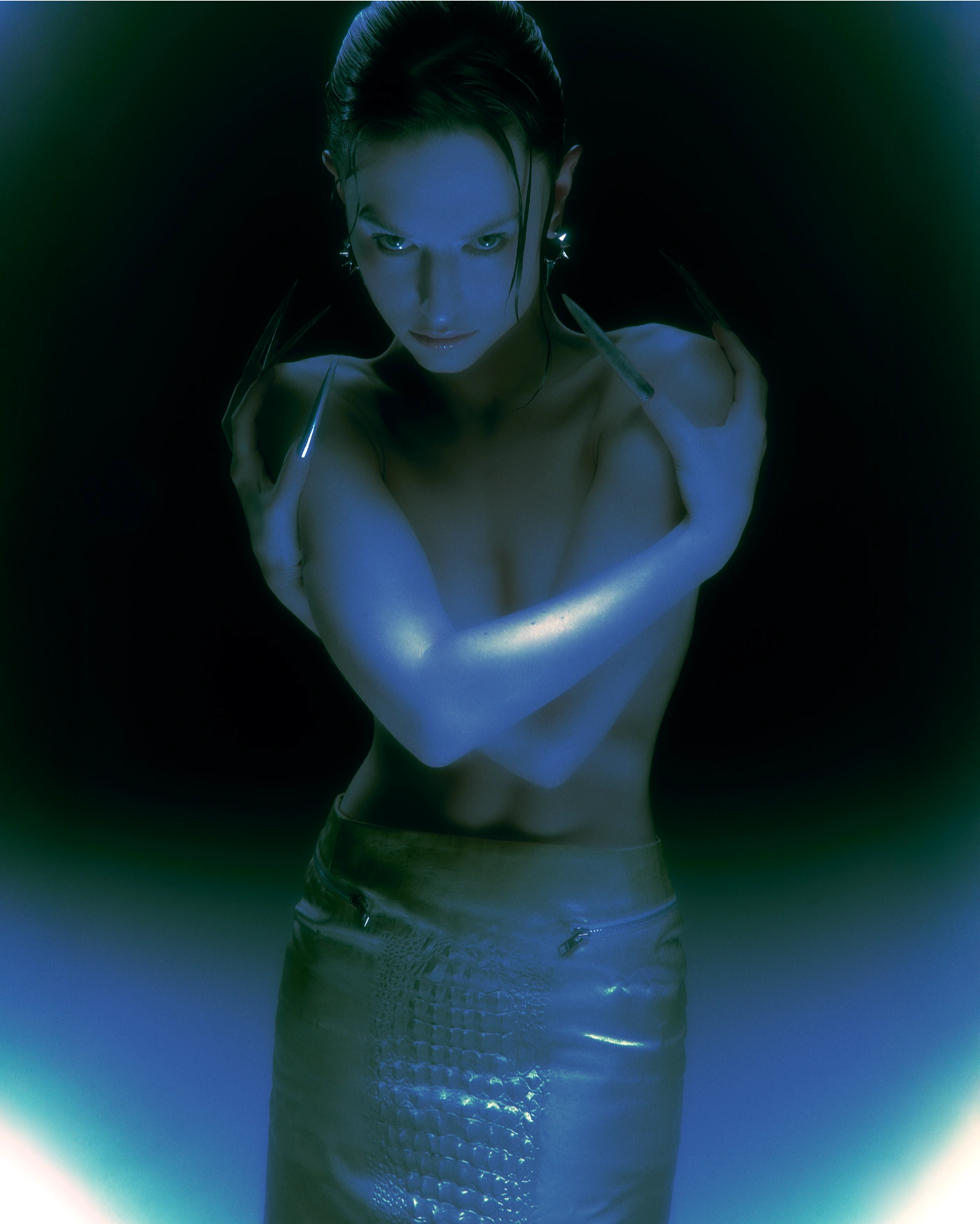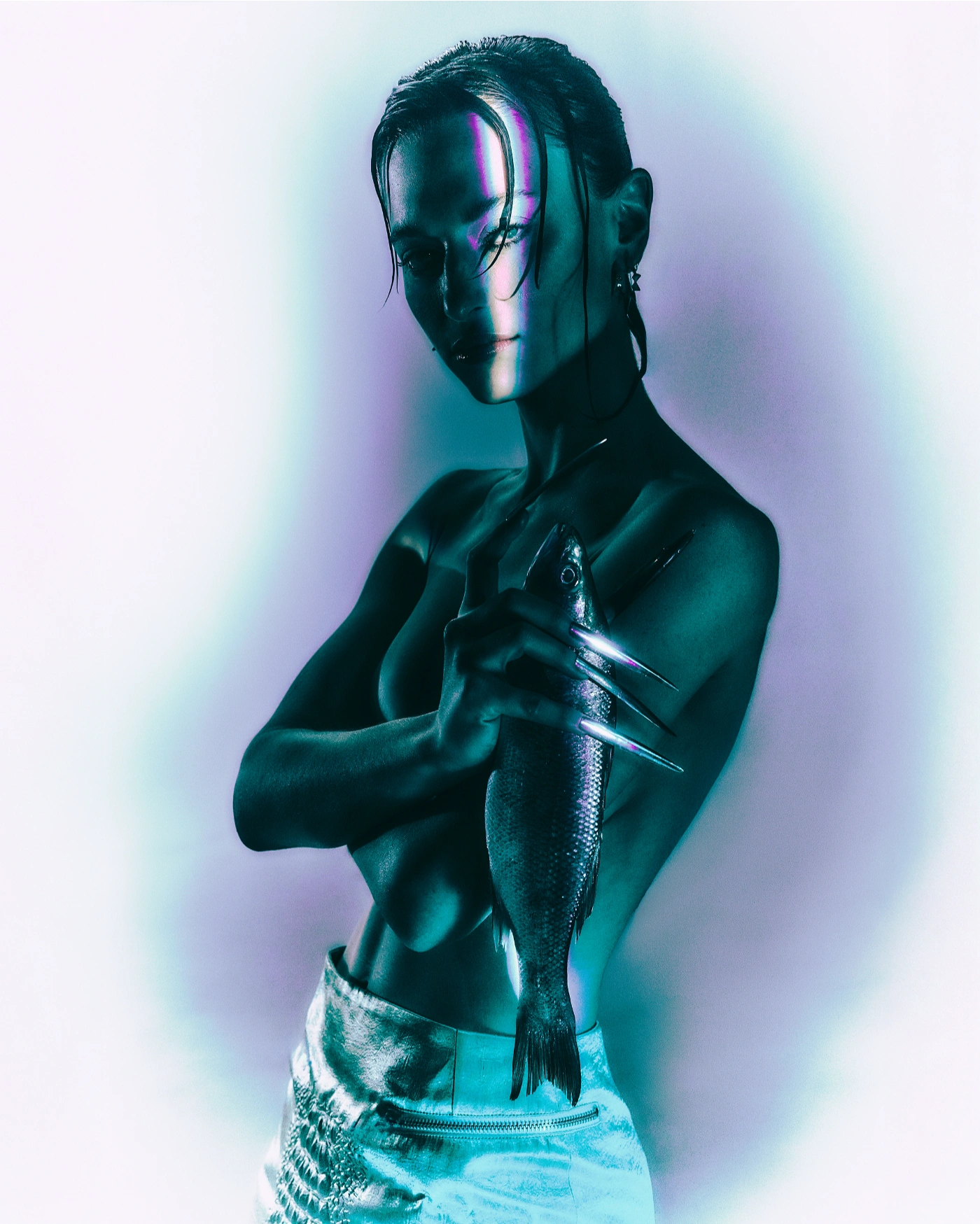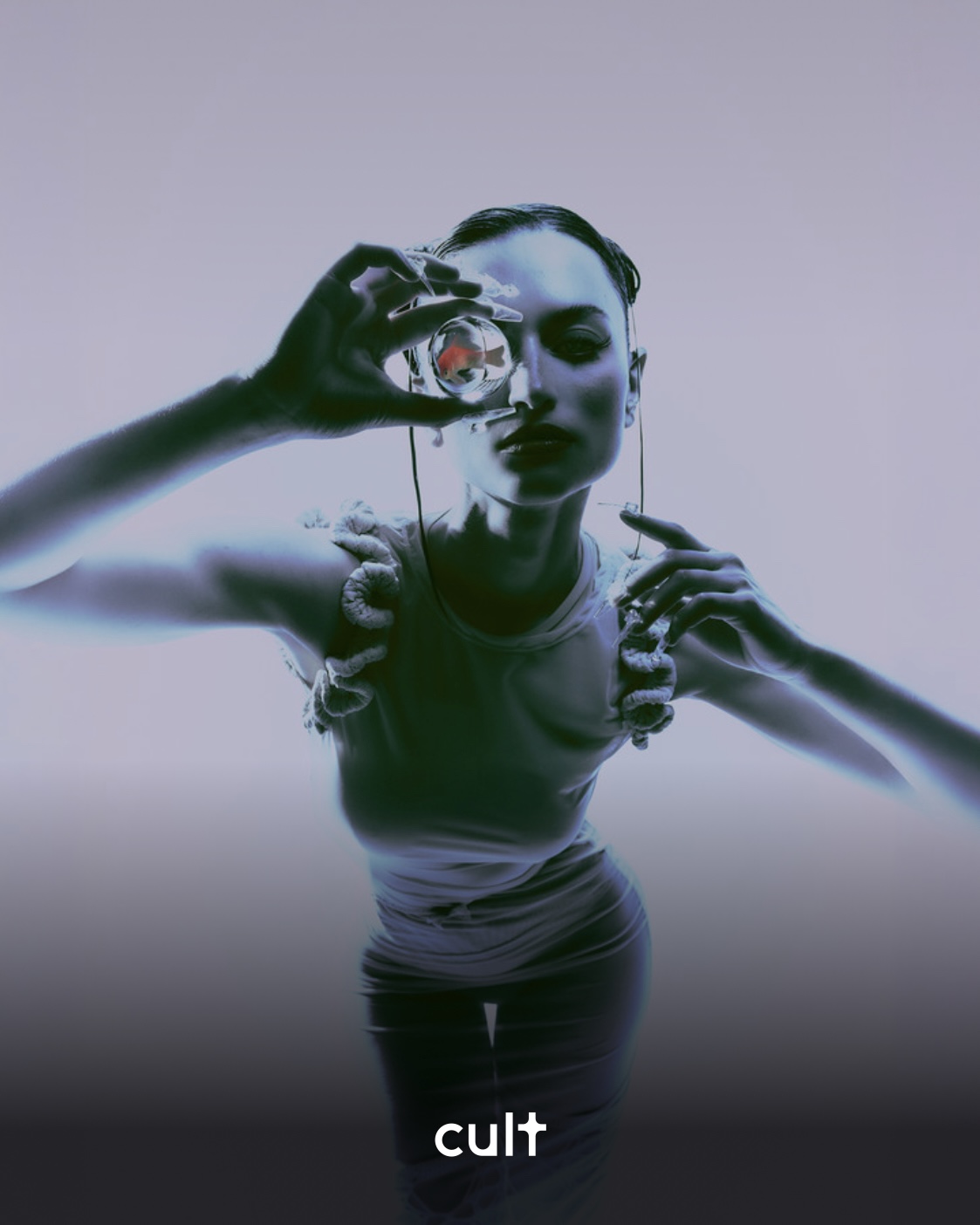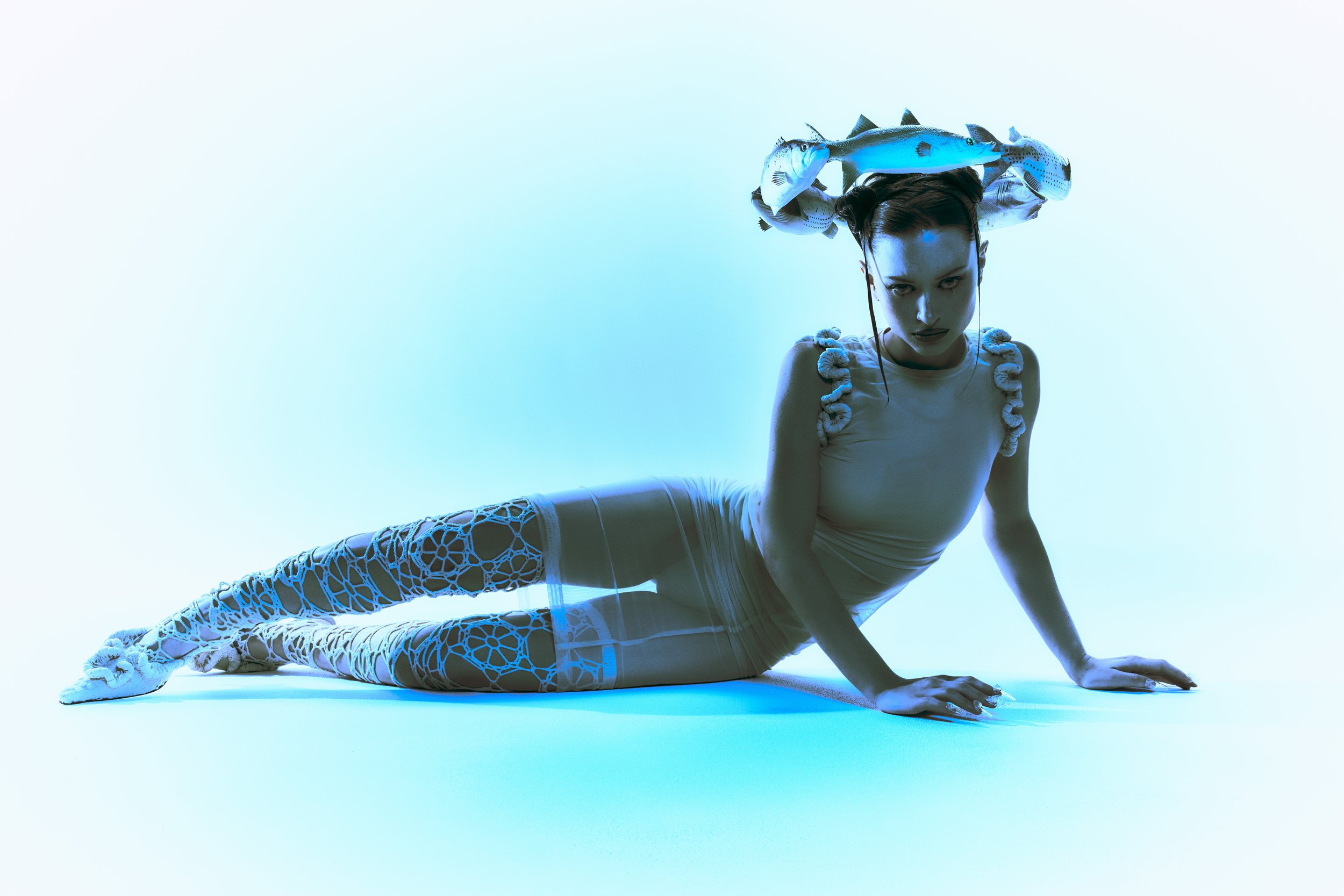
There’s a particular kind of girl on the internet right now: terminally online, terminally submerged. She is alone in her room, lights off, hunched over a laptop, headphones with a cord, composing worlds no one asked for and everyone suddenly needs. Oxis lives there permanently—7,000 feet below the surface, as she jokingly claims—but the joke has teeth.
Her world begins with a mispronunciation. Valentina became “Valentuna” in a Rhode Island accent, then simply “Tuna,” a nickname that lasted through childhood like a second skin. Later she discovers Auxis, the Latin name for a type of tuna, and folds it into the project that will carry her out of, and deeper into, herself. “Oxis is the most vulnerable part of myself,” she says. It’s less a stage name than a pressure zone: the part of her psyche that can only exist underwater.
The marine obsession is not cute branding; it’s structure. Track titles read like a field guide. She hoards images of “tiny fish” from Google for covers, trying to find the smallest one each time—“just being a tiny fish in the big sea. That's what a lot of us feel like.” The ocean here isn’t a wellness metaphor; it’s a scale problem. Oxis writes from the perspective of the micro-organism, not the mermaid.
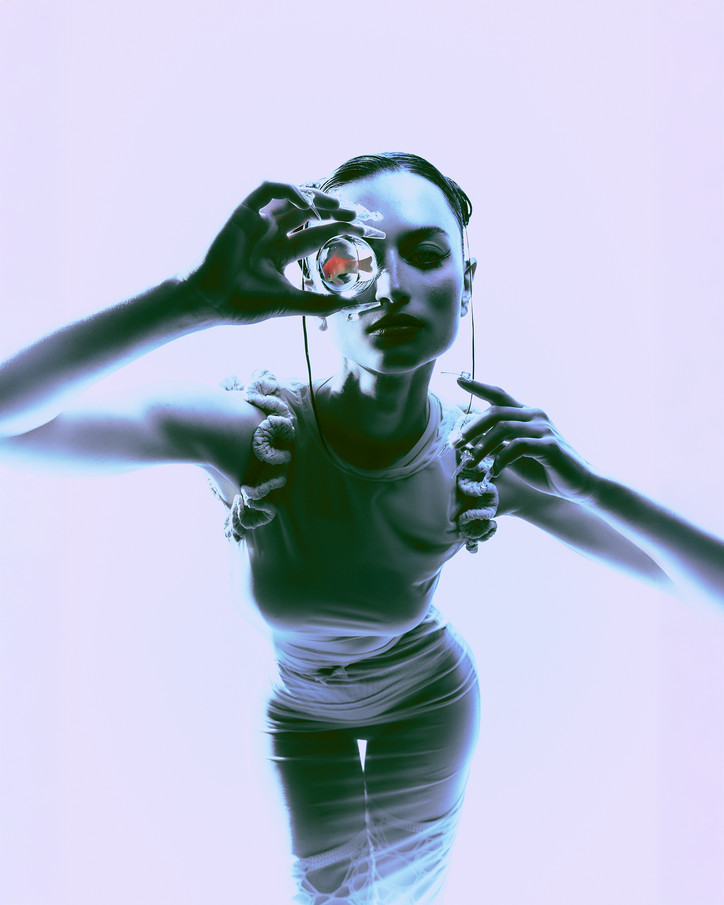
The music itself feels like digital bathymetry: jagged peaks, sudden drops, light scattering off particulate. She describes her sound as a kind of emotional regurgitation—songs often finished in a single day, in what she calls a blackout state, “just a regurgitation of something in my head.” Classical training—piano, jazz band, vocal technique, band camp—sits somewhere in the sediment, but she now uses it like scrap material rather than doctrine. Theory is a tool she half-remembers and deliberately refuses to worship.
What emerges is a kind of oceanic electronica that feels less like club fodder and more like a world-building exercise: digital surrealism as coping mechanism. The production is “choppy,” “jagged,” never quite smooth, as if the songs were spliced together under turbulent pressure. They sound, as Sam Gellaitry notes, “very soundtrack,” like they belong in a late-2000s indie film where teenagers bleed feelings in the rain. Oxis cites Skins as a formative text—Effy-era, obviously—the televisual equivalent of emotional sunburn. That lineage matters: these are songs for people whose adolescence was shaped by Tumblr moodboards, not guitar bands.
The contradiction at the heart of Oxis is her battle between perfectionism and feeling. “I like perfection and being emotional is the antithesis of being a perfectionist,” she admits. The solution is volume, not restraint: make more, release more, keep pouring until the shape appears. It’s an economy of output closer to fan fiction than to studio-album mythologies—except here the fandom is pointed inward, towards her own, un-therapized psyche. “The only time I feel like my true form is at my computer,” she says. The studio replaces the clinic. Ableton is confession.

Visually, her world mutates further. Falling down a rabbit hole of TouchDesigner tutorials, she starts building motion- and audio-reactive “blobs” and line-based abstractions. It’s creative coding as self-portrait: “a perfect representation of this sporadic analytical data… mixed with the messiness of an old camera.” The blobs are not cute mascots; they read as nervous systems exposed, data trails of someone whose brain won’t stop running simulations. In an era of infinitely polished 3D avatars, Oxis’s visuals feel glitchy, half-finished, slightly ill—appropriate for someone who admits she has “never done therapy” but spends months indoors mapping her feelings to generative systems.
Initially she wanted to be fully anonymous, in the tradition of Mid-Air Thief and other faceless auteurs. She even crocheted a mask. Of course, the first unmasked video went viral. Exposure here is not framed as a triumphant unmasking but as a reluctant surfacing, a tiny fish dragged into the shallows by the algorithm. Yet she leans into it, building a small, fervent community around fish jokes, melancholy, and oceanic melodrama.
Live, she talks about feeling like “a little lab scientist,” triggering loops and bleeps on stage, constantly aware that everything could go wrong. That panic is part of the dramaturgy: the opposite of the perfectly quantized DJ set. She has performed only a handful of times, including an early show opening for Julian Casablancas in front of a thousand people, armed with a looper and the willingness to drown publicly.
If there’s a politics here, it’s quiet but sharp. Growing up in Los Angeles, she describes her work as “my little rebellion to everything that I knew,” a rejection of the glossy, major-label pipeline that briefly swallowed and spat her out. In 2023, freshly dropped and “absolutely void of happiness and drive,” she started making the strangest electronic music she could, not as a career pivot but as survival. The result is a project that feels less like a product and more like a pressure leak: a way of staying alive in a culture that insists on surface.
Oxis’s world is not utopian, but it’s hospitable. She imagines the ideal listening space as a closet, door closed, lights off, “shitty headphones. Anything with a string.” It’s anti-spectacle: music for people hiding, for those who also feel like unstable data, like ghosts in Effy-era bedrooms. Oceanic electronica for landlocked kids who don’t trust daylight.
The trench is deep, but the signal carries. Tiny fish, big sea—sure. But also: tiny producer, massive emotional weather system. Down there, pressure doesn’t crush; it crystallizes.