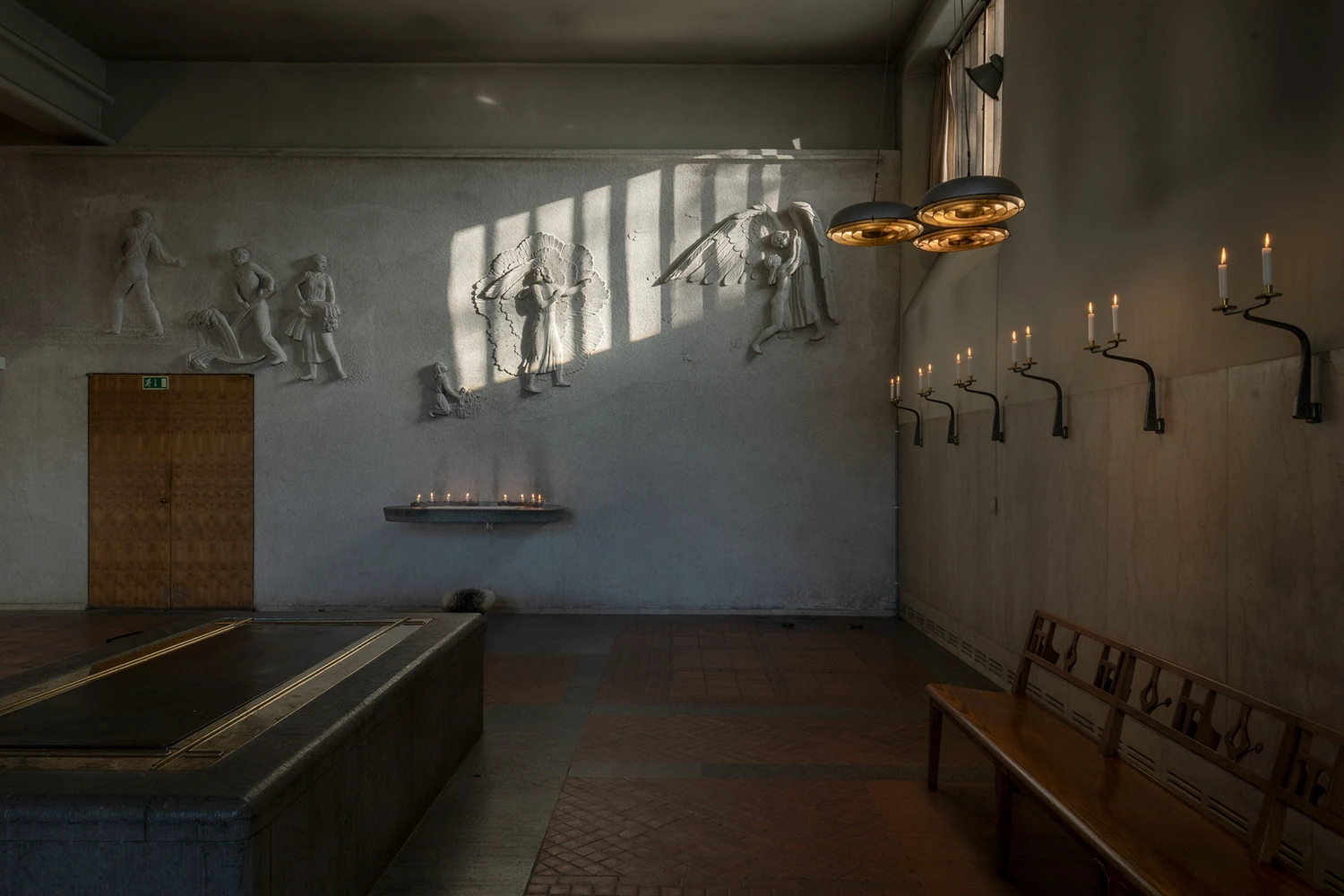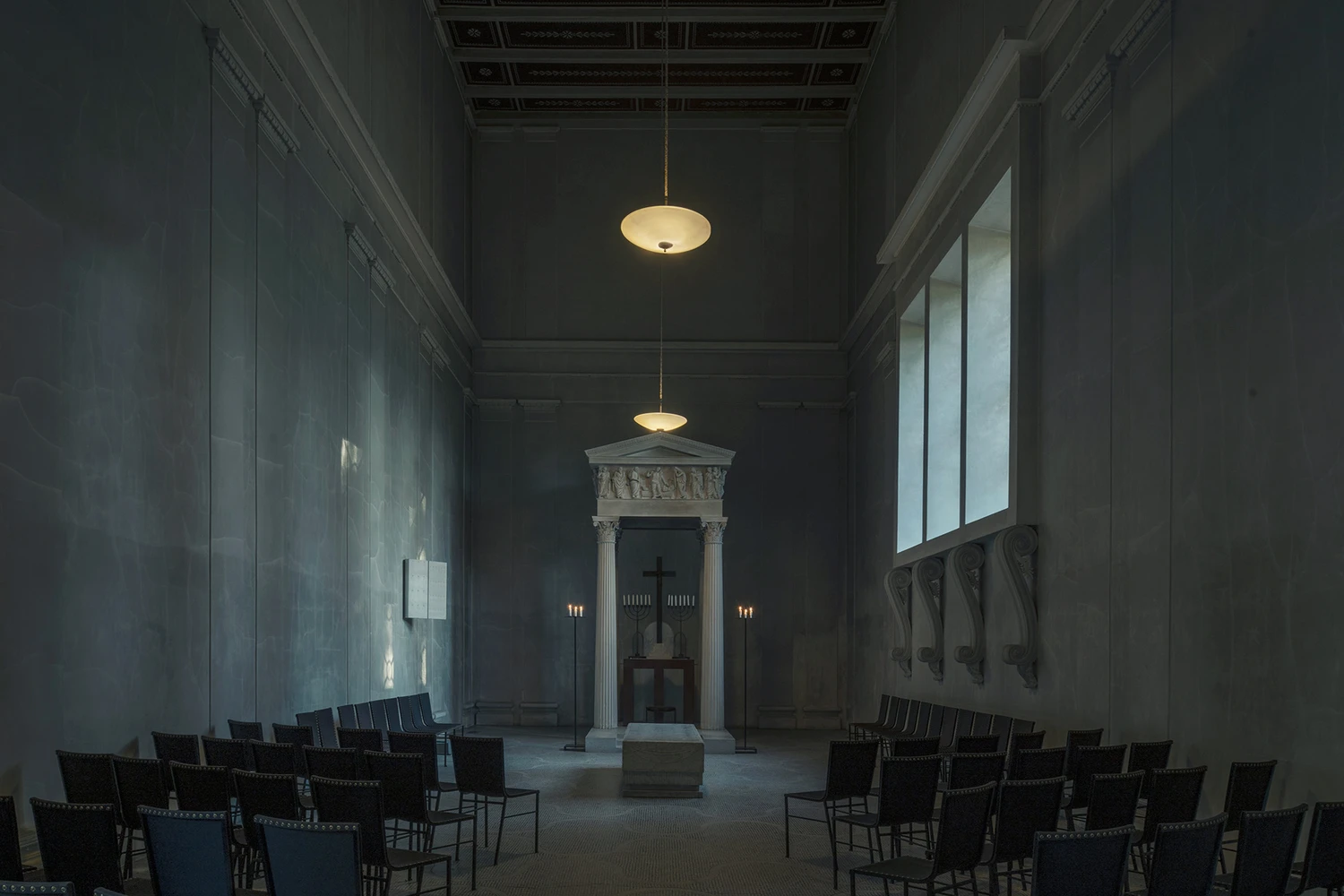
To visit Skogskyrkogården one hundred years after its conception is to step into a temporal knot—a place where the distinction between memorial and wilderness dissolves so completely that you begin to forget which is architecture and which is time itself. The Woodland Cemetery that rises from the Nordic forest floor outside Stockholm remains perhaps the most lucid argument for restraint ever built.
In 1915, when Erik Gunnar Asplund and Sigurd Lewerentz submitted their competition entry under the name "Tallum," they understood something essential: that a cemetery need not be a monument to ego, but could instead become a threshold where human memory learns to speak the language of the forest. It was a radical gesture—to let the wilderness speak, and to place human intervention in quiet dialogue with it.
Andy Liffner's photographic practice, accumulated over a full decade and culminating in an intense engagement during 2018, illuminates this threshold from within. His images do not document the cemetery as a historical artifact. Instead, they attune themselves to what might be called the spiritual ecology of the site—the way light breaks through pine branches in late afternoon, how stone darkens under winter rain, the particular gravity that gathers in places where people have chosen to lay their dead. Liffner's eye is trained not on the monumental but on the atmospheric, on what Japanese aesthetics names as "Ma"—the space between things, the silence that animates form.

The genius of Asplund and Lewerentz lay in their decision to preserve the existing forest rather than impose a designed landscape upon it. A long axial route bifurcates the space, creating two distinct emotional territories: one path dissolves into pastoral light, inviting meditative wandering; the other ascends toward something more austere, culminating in a stark granite cross and the Chapel of the Holy Cross. These are not gestures of monumentality, but of emotional calibration—architecture surgical in its restraint.
The Resurrection Chapel, completed by Lewerentz in 1925, stands as the fullest expression of this philosophy. Camouflaged within the pine forest quiet, it appears as a fragment of ancient memory. The portico, mounted on twelve slender columns, functions less as an architectural statement than as a psychological threshold. Light enters through a single tall window, while music descends unseen from a concealed organ loft, as though the building itself were breathing inward.
Liffner's photographs reveal the profound sophistication of this restraint. Where a lesser photographer might seek the picturesque, Liffner captures what the site actually offers: a patient, non-sentimental dialogue between human craft and natural time. Snow accumulating on stone surfaces, shadows stretching across winter pathways, the particular luminescence of a forest in dusk—there is something almost austere in the beauty of these images.
What emerges is the revelation that Skogskyrkogården was never a completed project but rather "a living organism: mutable, seasonal, and deeply spiritual." The cemetery changes with the hours and seasons; it is never the same place twice. This temporal mutability is central to its meaning. In a place where memory is grounded in soil and sky, the architecture must be equally subject to transformation. Most monuments insist upon their permanence; Asplund and Lewerentz created a form of memorial that acknowledges impermanence as its condition—a dissolution into the very soil that nourishes the forest.