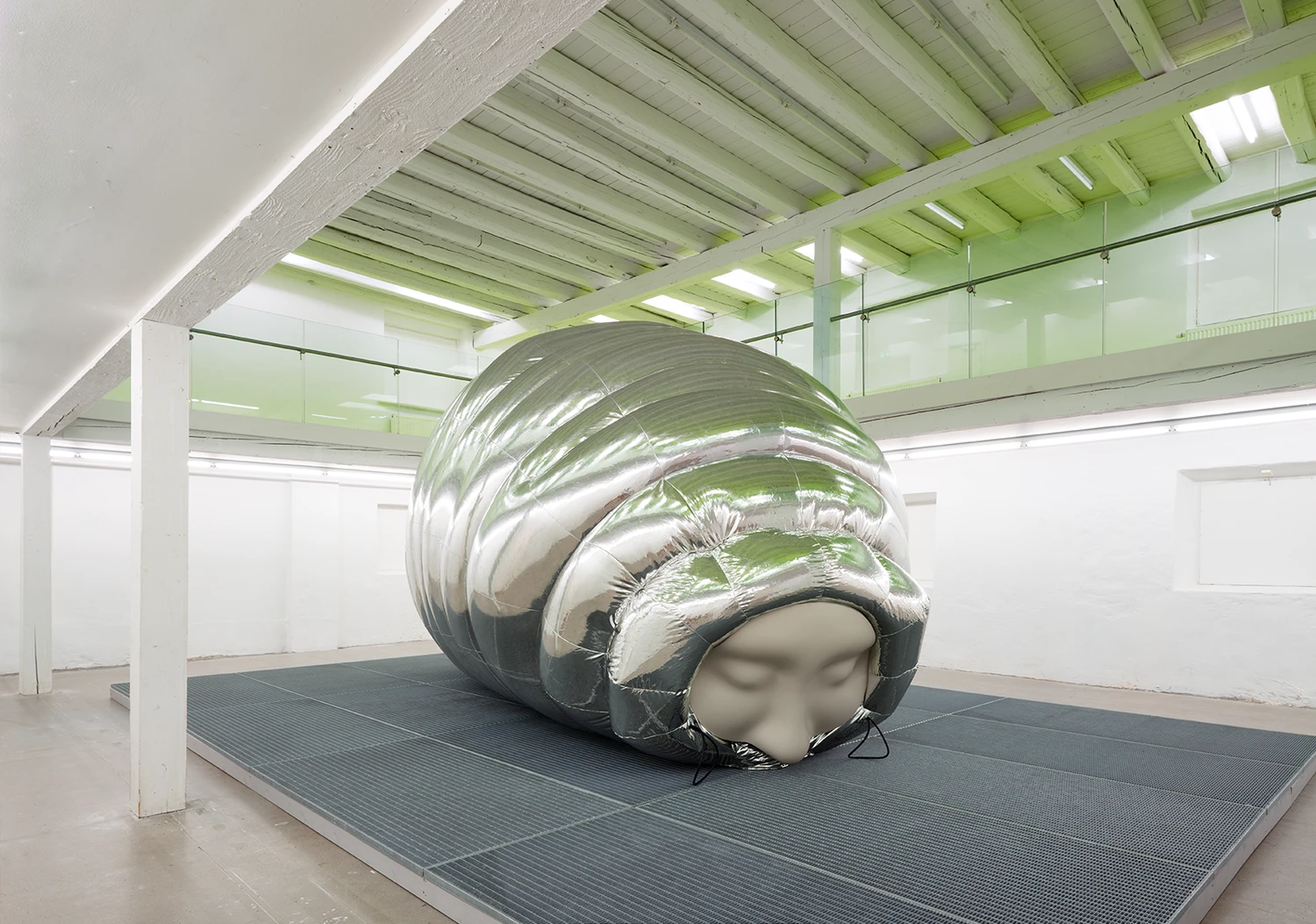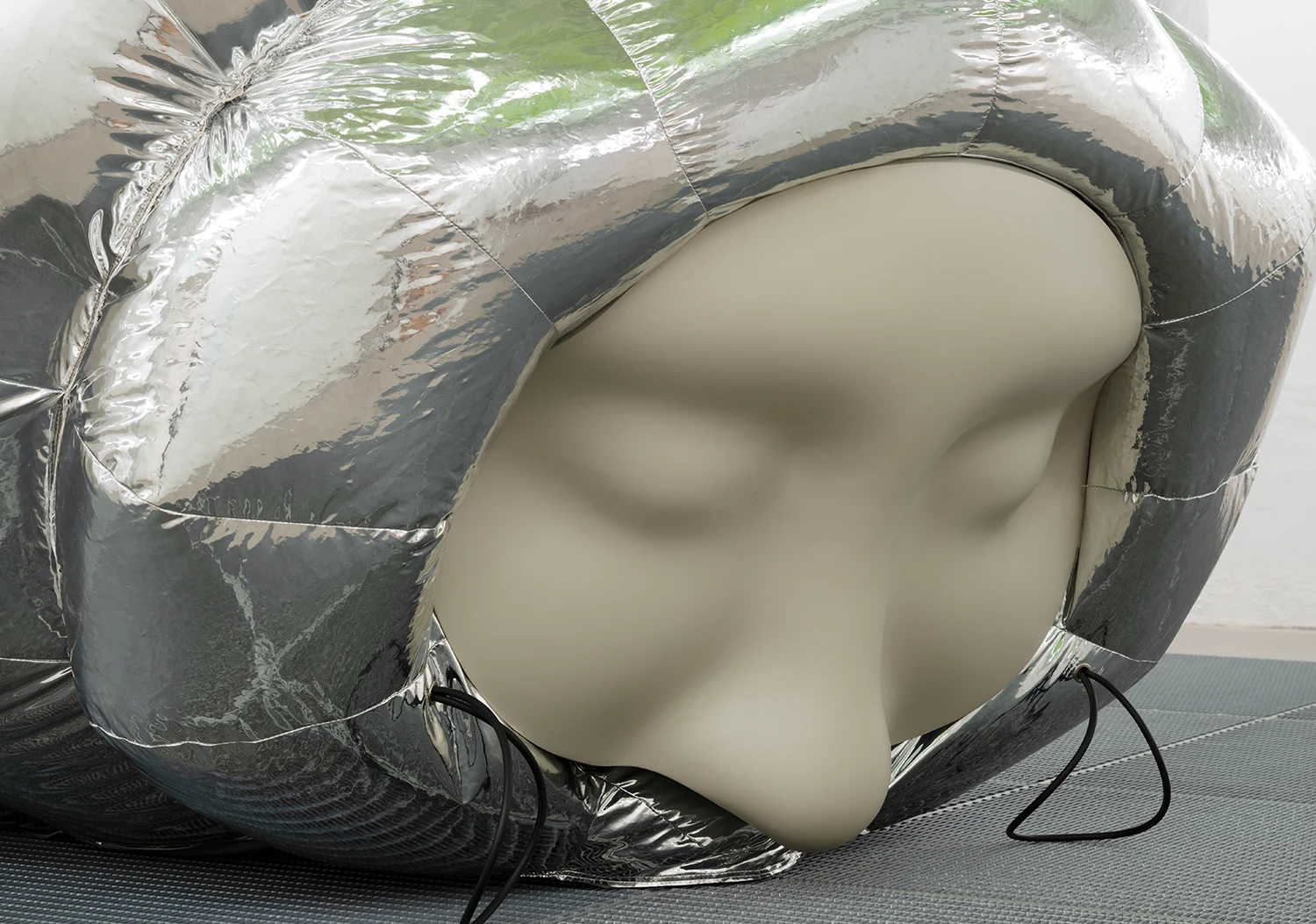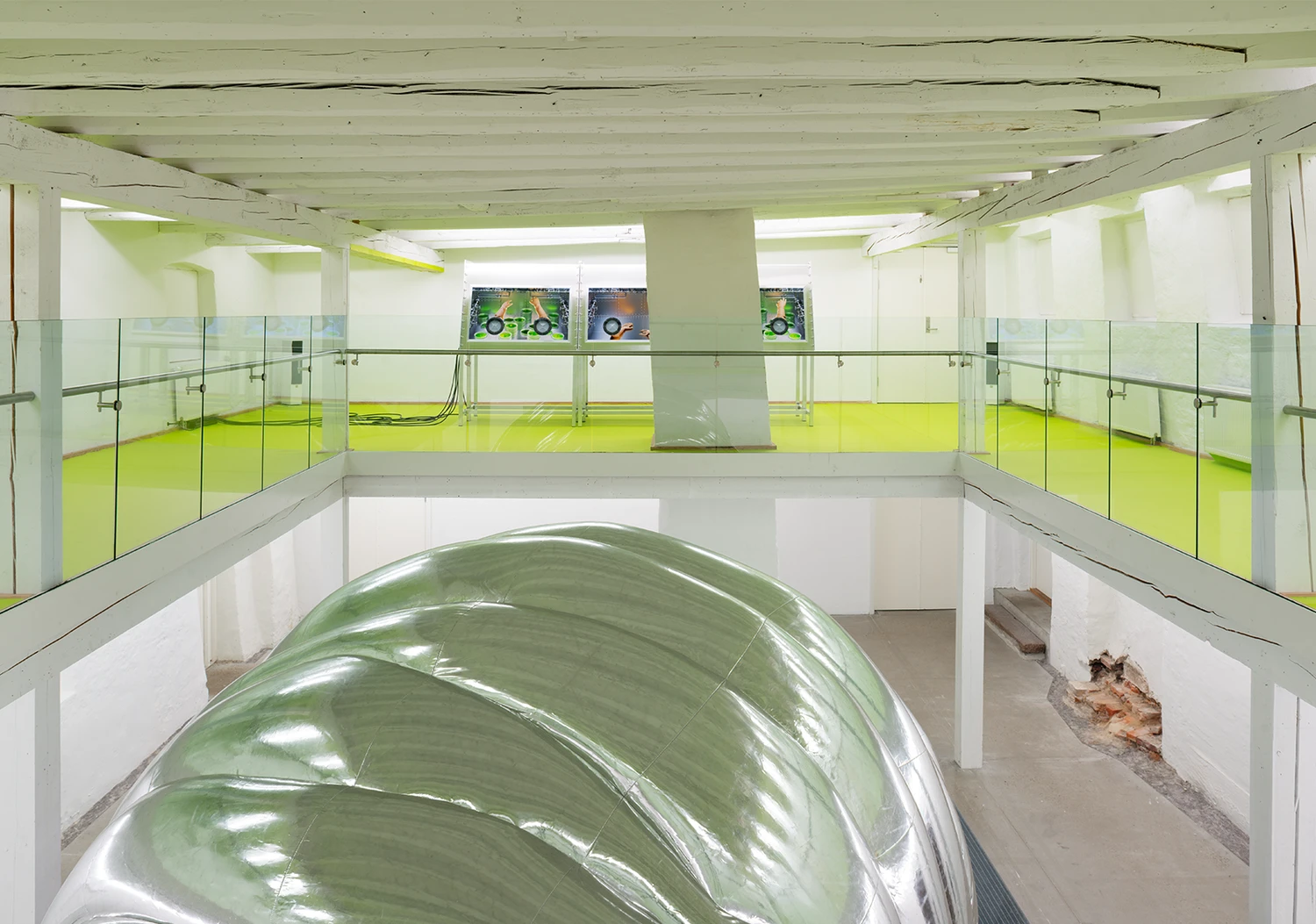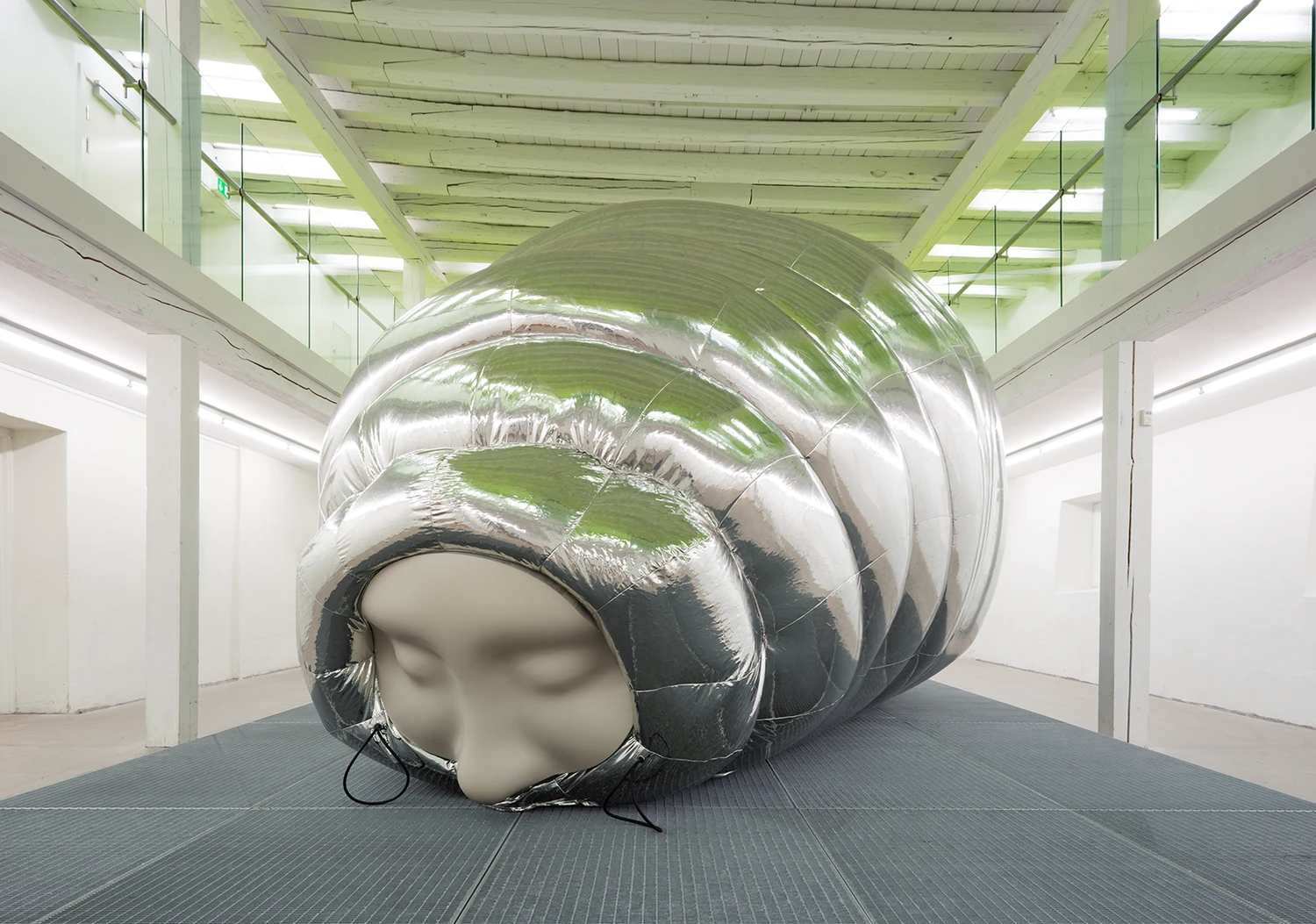
A monumental inflatable form occupies the double-height east wing of Viborg Kunsthal — a segmented, silvery mass that resembles something between a chrysalis and a crash-landed spacecraft. At its base, a human face emerges: eyes closed, serene, half-swallowed by the metallic shell that encases it. This is Stine Deja's human-bear hybrid, and it is breathing.
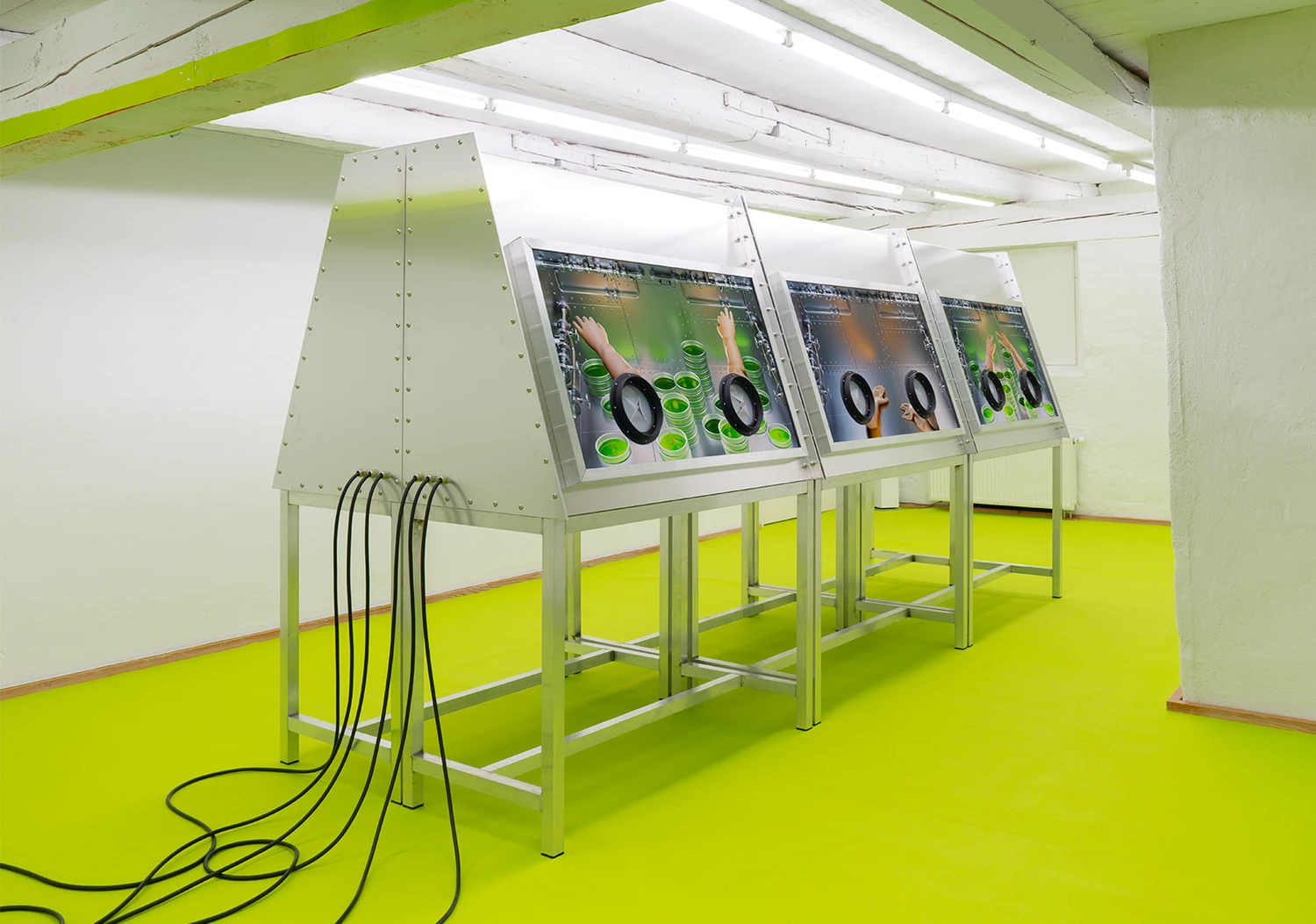
Micro Management, Deja's solo exhibition at Viborg Kunsthal, is a total installation that examines human existence in a world of extreme natural conditions and hypertechnology. The Danish artist has built an uncanny laboratory — a space suffused in acid-green light, threaded with black cables, and populated by objects that blur the line between scientific apparatus and sculptural proposition.
The focal organism is the tardigrade — the near-indestructible micro-animal that survives radiation, vacuum, and temperatures close to absolute zero. But Deja isn't interested in the tardigrade as metaphor. She's interested in it as blueprint. The exhibition projects tardigrade resilience onto the human body, asking what happens when science decides to engineer survival itself. The answer, staged across two floors, is seductive and deeply unsettling.
The monumental hybrid collapses the boundary between the architectural and the anatomical. Its reflective surface catches the green-tinged light and scatters it across gallery walls. The face at its base is uncanny: too smooth, too calm, a mask of posthuman placidity. Surrounding it, incubator-like structures house what appear to be bear eggs — luminous, nestled in apparatus that suggests both fertility clinic and specimen vault. Black cables snake across floor and walls like the circulatory system of some larger organism the gallery itself has become.
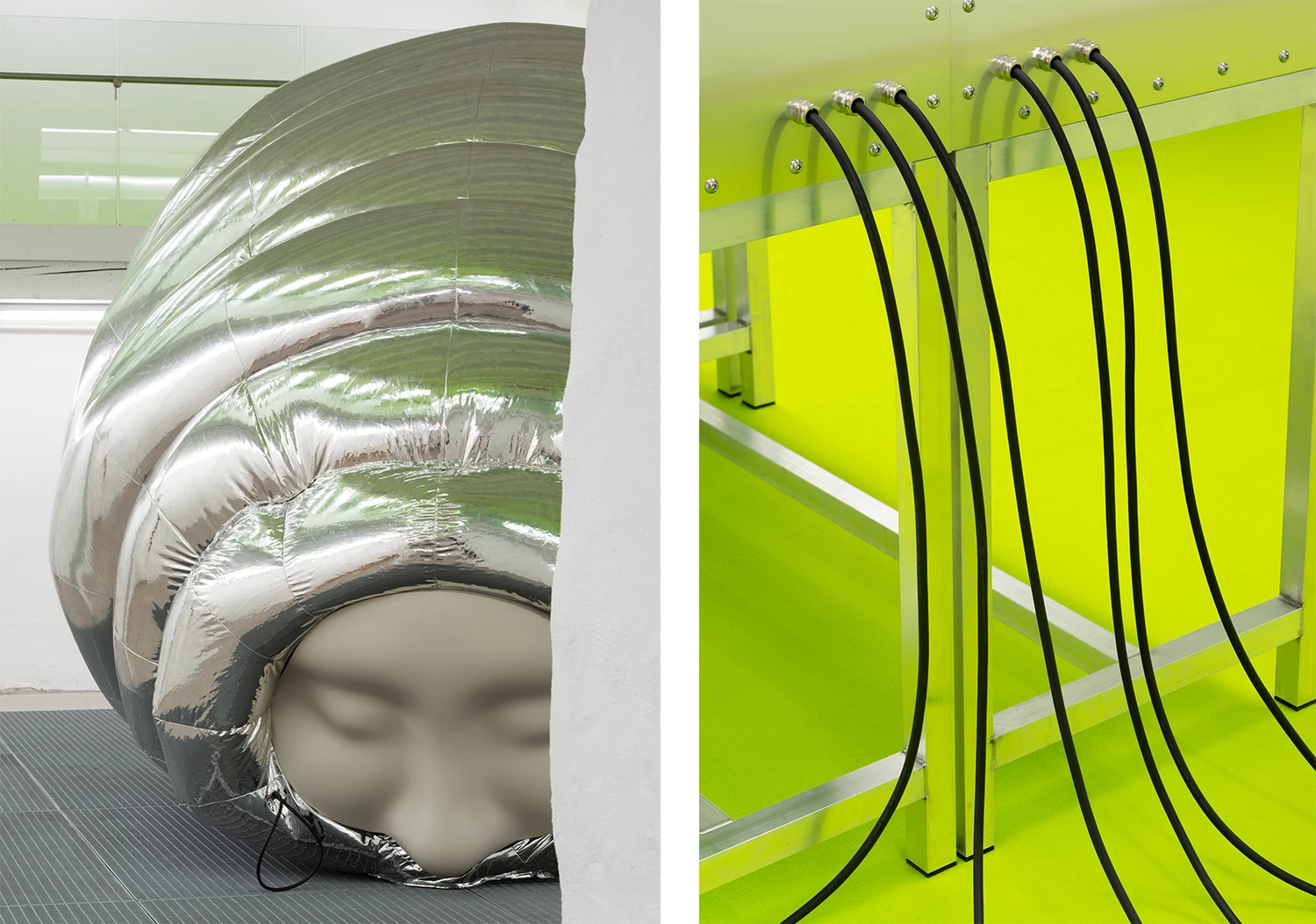
Deja's premise is grounded in actual science: "Scientists are already experimenting with bear genes in human stem cells," the exhibition notes. Researchers are exploring how biological mechanisms that allow bears to hibernate — slowing metabolism to near-death and reviving without cellular damage — might be adapted for human use. The exhibition makes this research tangible, visceral, spatial. The neon-green environment reads as both sterile laboratory and alien ecology, a space where the organic and synthetic have already merged.
The installation's power lies in its refusal to moralize. The beauty of the inflatable sculpture — its slow, meditative breathing, its silver sheen — is genuine. There is tenderness in the closed eyes of the hybrid, a suggestion of surrender to a process that might be salvation or obliteration. But the laboratory setting introduces a counter-frequency: the aesthetics of control, of life reduced to parameters to be optimized.
Micro Management names precisely what immortality would require: not transcendence, but administration. Not freedom from death, but endless optimization of the conditions of living. The bear sleeps. The cables hum. The eggs glow. And somewhere in the gap between the mythic and the clinical, Deja has built a space that makes you feel both possibilities at once — the awe and the dread, the wonder and the managed quiet of a world that has forgotten how to die.