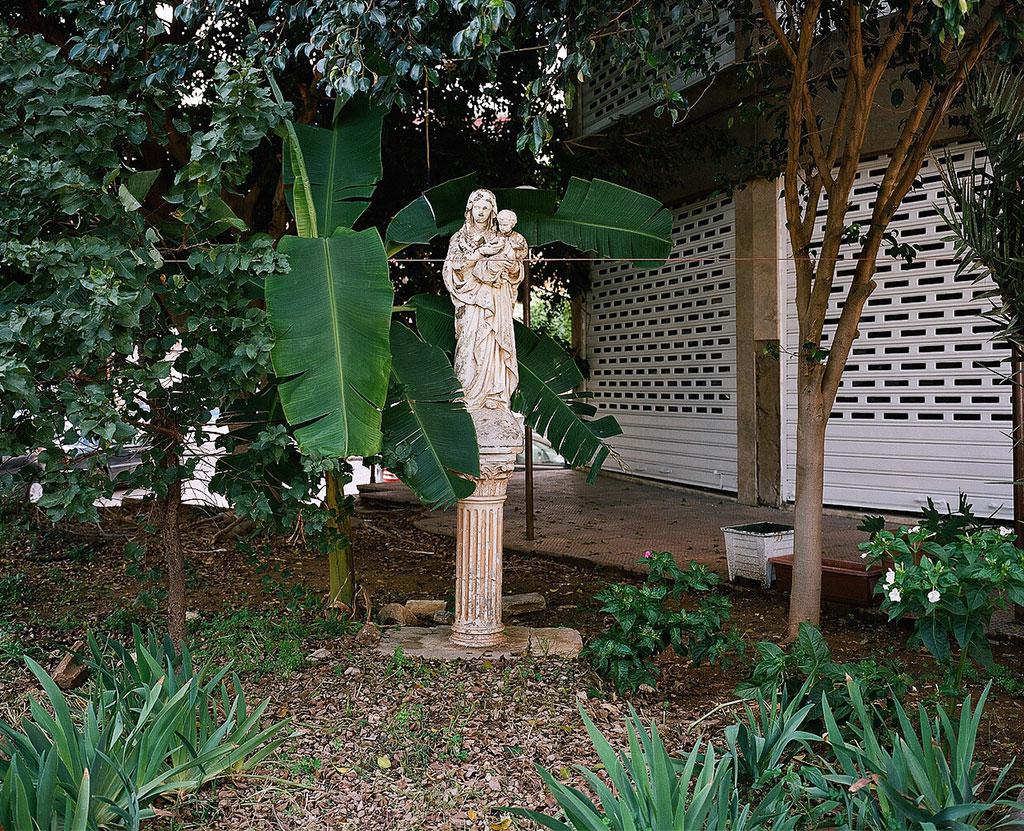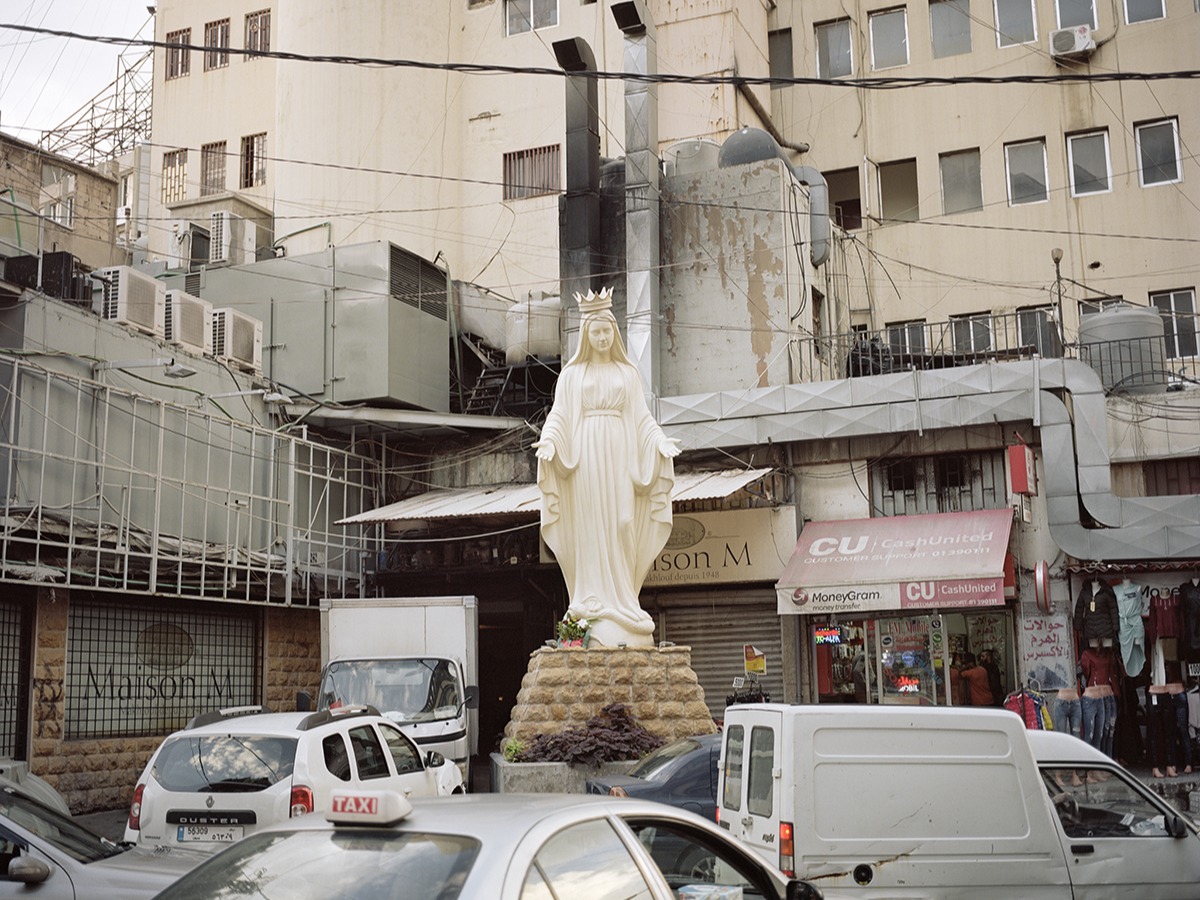
In ASNAM, Georges Salameh constructs a cartography of belief that is both quietly absurd and tragically precise. Over nearly two decades, the Beirut-born photographer has traced the slow yet inexorable invasion of Lebanon’s urban and semi-urban landscapes by Christian statuary—Virgin Marys, weeping saints, angelic warlords—erected not by state decree or ecclesiastical authority, but by individuals and communities acting from the grassroots up.
The project is neither a documentary in the traditional sense nor an overtly political statement; it is, rather, a sustained phenomenology of return, an archaeology of spiritual sedimentation in the aftermath of civil collapse.
From the outset, ASNAM is anchored in Salameh’s dislocated relationship to Lebanon. “I was born in Beirut, but I left Lebanon when I was 16,” he recalls. “I started returning every three, four, maybe five years... At first, I was trying to record Lebanon in the present, but I realised I was only seeing echoes of my past life.” This tension between recollection and estrangement charges the work with its spectral ambiguity. ASNAM doesn’t simply document statues—it maps a cultural psyche fractured by war, exile, sectarian tension, and longing.
The images themselves are haunting in their banality. A crucified Christ stands sentinel in front of a Total gas station. A Virgin Mary is perched near a discount hunting supply billboard advertising AK-47s. Saints cluster like roadside hitchhikers along the coastal highway. These figures are neither sublime nor kitsch—they are emblems of an uneasy metaphysical territorialism, at once absurd and entirely sincere. “They inhabited unusual spaces in the city that are in-between public and private,” Salameh explains. “This aspect is compelling because public space is almost inexistent in Lebanon... everything is private or owned by the municipality.”

Lebanon’s postwar condition is one of fragmented sovereignties, and ASNAM captures this atomised spatial logic through its statues. Here, religiosity does not retreat to the cloister or cathedral; it is inserted into the brutal friction of everyday life. The sacred is no longer transcendent—it is infrastructural. "It’s not just about religion," Salameh insists. "It’s about fear, about marking territory. Public space is supposed to be where dialogue happens. But in Lebanon, the absence of true public space means identity must be imposed instead of shared.”
The Arabic word asnam plays on this dualism—meaning both “statue” and “idol.” The implication is clear: these sacred forms, stripped of their ecclesial context, hover uncomfortably close to fetish. “Putting a statue in a church or monastery is not the same as putting it in a lane or gas station,” Salameh continues. “There’s a strange sacredness in this hidden human gesture... a small democratic act.” These micro-monuments, ungoverned by aesthetic regulation or urban planning, are acts of re-appropriation—a vernacular liturgy of resistance and nostalgia.
And yet, ASNAM resists sentimentality. There is melancholy, yes, but never elegy. Salameh’s lens is too rigorous, too conscious of the spatial and historical violence that underwrites the visual field. He speaks of “sedimentations of reality,” likening his practice to that of a geologist—a patient unearthing of compressed temporalities and psychic strata. The result is not a singular narrative but a polyphonic mythology of place. “At times, my work leans to the obscene and to laceration, and others to the noble and to the sovereign,” he says. “I search for the right distance of things.”

That “distance” is perhaps the project’s most enduring tension. Salameh identifies as a “self-exile,” someone whose homeland exists largely in childhood memory and myth. His relationship to Lebanon is intimate yet mediated—both participant and outsider, his gaze mourns and mocks in equal measure. He refers to Lebanon not merely as a landscape, but as a traumascape—a term that resonates with both psychoanalysis and post-conflict theory. His peripatetic camera walks these spaces like a secular pilgrim, observing but never fully belonging.
Ultimately, ASNAM is not a story about statues. It is a story about visibility, power, displacement, and the idiosyncratic ways communities inscribe meaning onto contested ground. It is about spiritual ruins that are not buried, but flamboyantly installed. It is also about the absurdist theatre of postwar Lebanese modernity, where Virgin Marys can watch over traffic jams and saints become DIY urban planners.
The project, which Salameh began in 2003 and informally concluded in 2019, now exists as a living archive—part book, part installation, part performance-lecture. “I do not have a defined timeline or story,” he says. “It evolves with the participants.” Like Lebanon itself, ASNAM refuses neat closure. It is not a work of nostalgia, but of uneasy continuity.
Referencing Imru’ al-Qais, the pre-Islamic poet, Salameh titles the series “Let Us Stop and Weep.” The invocation is archetypal and immediate—grief not as conclusion but as prelude. In a country where public memory is constantly contested and re-inscribed, Salameh’s work provides neither monument nor manifesto. What it offers, instead, is a gaze: deliberate, lingering, gently unmoored—a visual theology of fracture.