Nicola Ghirardelli and Andrea Luzi meet at the threshold where matter submits to transformation — where the act of making is also an act of burning, and what remains is not ash but apparition.
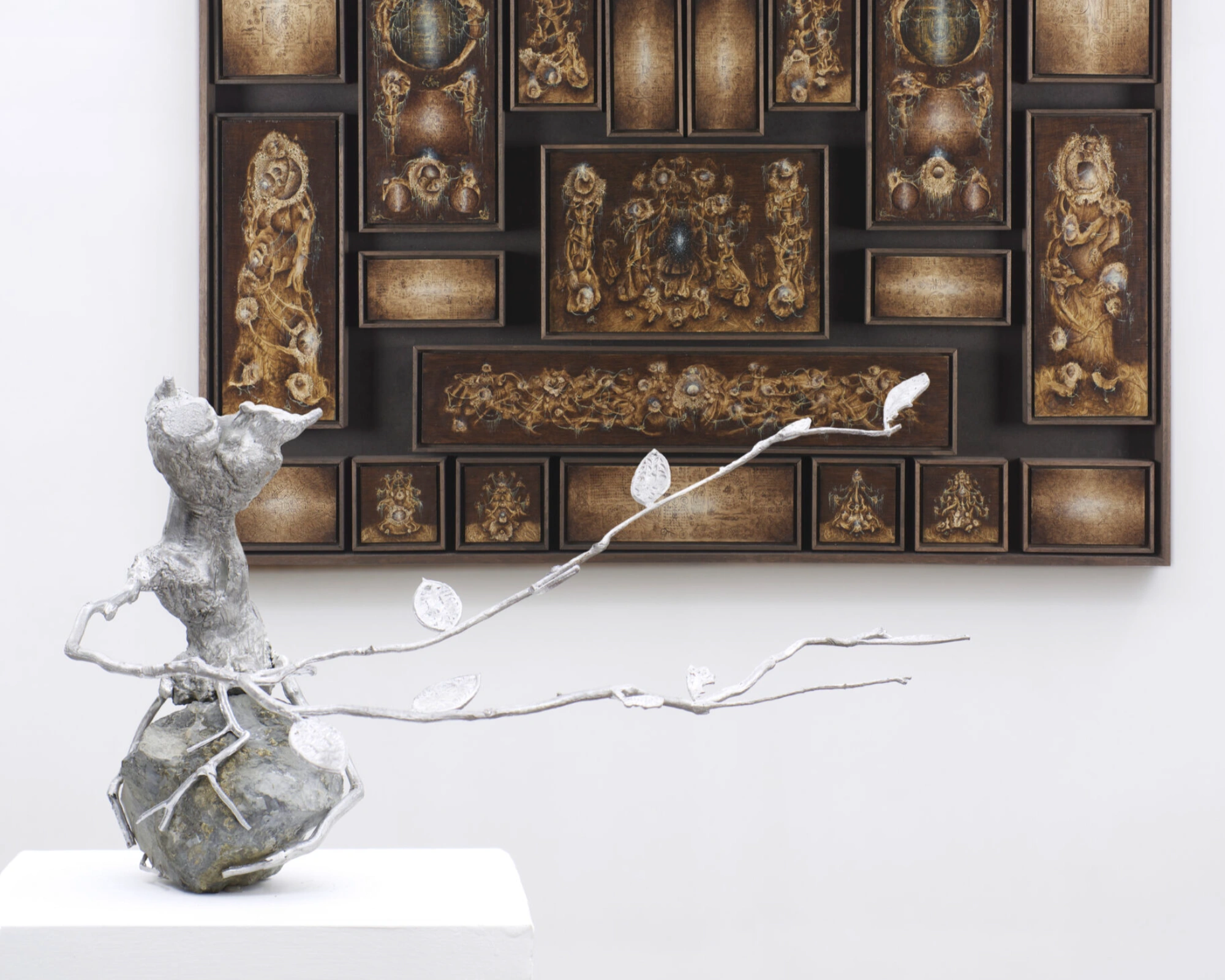
The first room at Anni Wu Gallery in Milan sets the coordinates. Two Gothic-inflected plant forms — quartz and pyrite rising from basalt — reach upward as if drawn toward something luminous. These are Ghirardelli's sculptures, organisms that refuse the boundary between mineral and architecture, between relic and living system. Beside them, Luzi's canvases pulse with a chromatic density that feels less painted than channeled — the surface saturated, layered, trembling with figures that emerge from darkness like frescoes recovering their memory.
This is The Fire and Its Ghosts, a double solo exhibition curated by Zoe De Luca Legge, and its logic is not comparison but convergence. Fire connects the two practices — not metaphorically but materially. In Ghirardelli's work, it is the biochemical force that participates in the coagulation of form, consuming material until it becomes residue, perhaps relic. In Luzi's painting, fire is instinctual energy — the mystical glow that animates gesture, that casts the shadows from which archaic presences emerge.
Ghirardelli's sculptural language operates as a research device moving across installation and site-specific intervention. His process generates meaning through a system of impressions — archaeological fragments, natural suggestions harvested from the everyday — staging unresolved frictions between the natural and the anthropic. The works are hybrid organisms in which forms of otherness, generational trauma, and apocalyptic omens coexist, searching for a formal balance that never quite arrives.

Barrueco (2026), a pair of plaster bas-reliefs named after the irregular pearls from which the Baroque takes its name, echoes the structure of a reliquary. Bone-like elements alternate with mother-of-pearl shells to construct a frame that holds, at its center, delicate structures in silvered brass inspired by valves and poisonous plants. The reference to art history is deliberate — not as homage but as material to be metabolized, grafted onto morphologies that form a bestiary of fragile, iridescent shapes drawn from narratives entirely overlooked by an anthropocentric perspective.
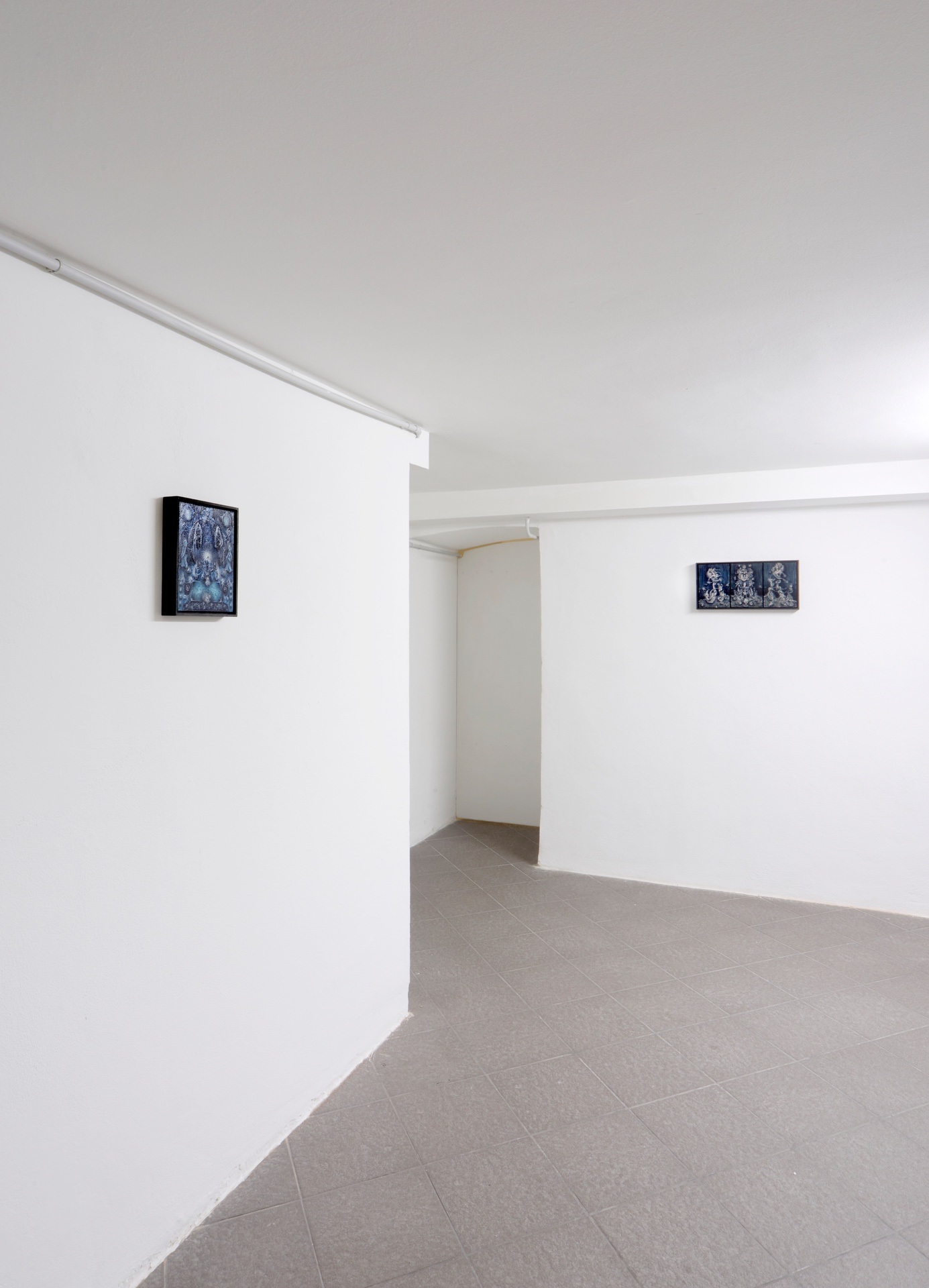
Luzi's painterly process begins with a meditative yet instinctive gesture — the discipline of the monotype fused with the velocity of mural painting, the rigor of intaglio printmaking merged with the immediacy of graffiti culture. His imagery draws on suggestions that appear irreconcilable: popular in its directness yet liturgical in its construction, capable of holding together low and high culture, tuning the viewer to frequencies that feel received rather than composed. In La signora del gioco (2026), the chromatic rhythm of psychedelic music merges with the iconography of sacred art — ceremonial, phantasmagoric, populated by figures that abandon classical perspective in favor of a vertiginous, almost divinatory narrative.
The polyptych La grandezza del nulla pt. 3 (2026) fragments into an infinite visual vocabulary — elements expanding and folding back into shells, an attempt to decipher the unknown through an almost encyclopedic painterly gesture. As the individual panels decrease in size in the following room, losing their vertical dimension and taking on a nearly object-like quality, the artist's visual repertoire converges into a language that employs codices with divinatory value. Figurative elements, symbols, ideograms — each sign carries the potential of a language yet to be spoken.

On the lower floor, Ghirardelli's Viriditas (2026) reaches its fullest momentum — a ceiling intervention born from research into media archaeology, inspired by the celestial vaults of Byzantine churches produced in an era when the biological contiguity between humans and animals was perceived as self-evident. A double Fibonacci sequence composed of starfish, shells, and vertebrae guides the viewer toward Agape (2026): a large shell in dark bronze oxidized with sulfur, its mirrored interior filled with water and psilocybe.
The invitation is explicit — to entrust one's senses to nonhuman agencies, to experience the exhibition as cosmogony rather than display. Ghirardelli deconstructs the myth of the solitary creator, opening instead to a more-than-human creative dimension where fire and biochemical elements actively participate in the coagulation of the artwork. Luzi, meanwhile, transforms gesture into vision through rituals of energetic channeling that treat painting not as representation but as séance.

What persists is not the fire itself but its afterimage — the ghost that inhabits the space between destruction and emergence, between the relic and the living thing. Not spectacle, not elegy, but the tremor of matter remembering what it was before it became something else.