NADIR gathers Zishi Han and Laurence Sturla at Gianni Manhattan in Vienna around the moment a map stops telling the truth, tilting the axis of looking until terrain and its history fold back on the viewer.
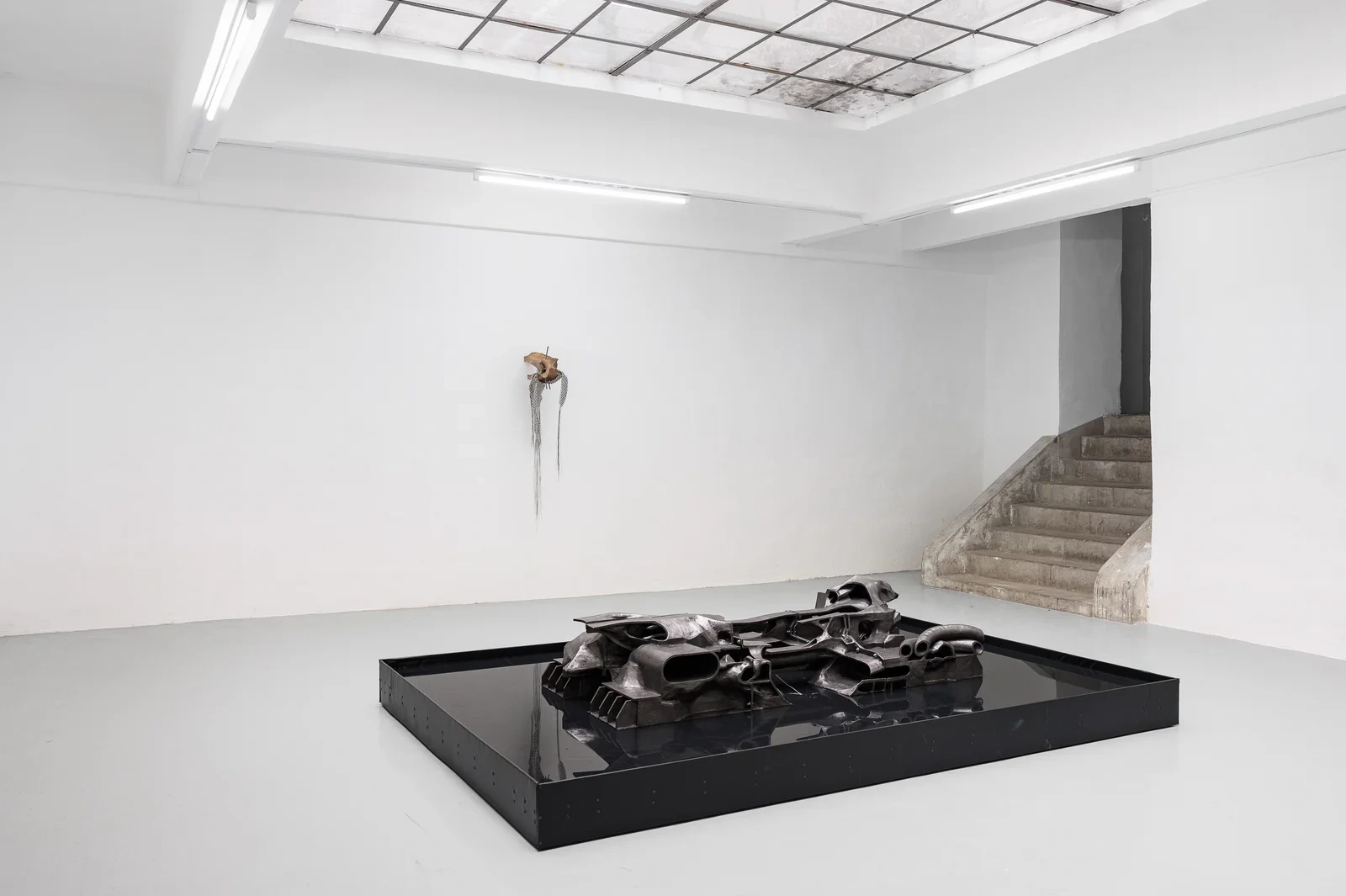
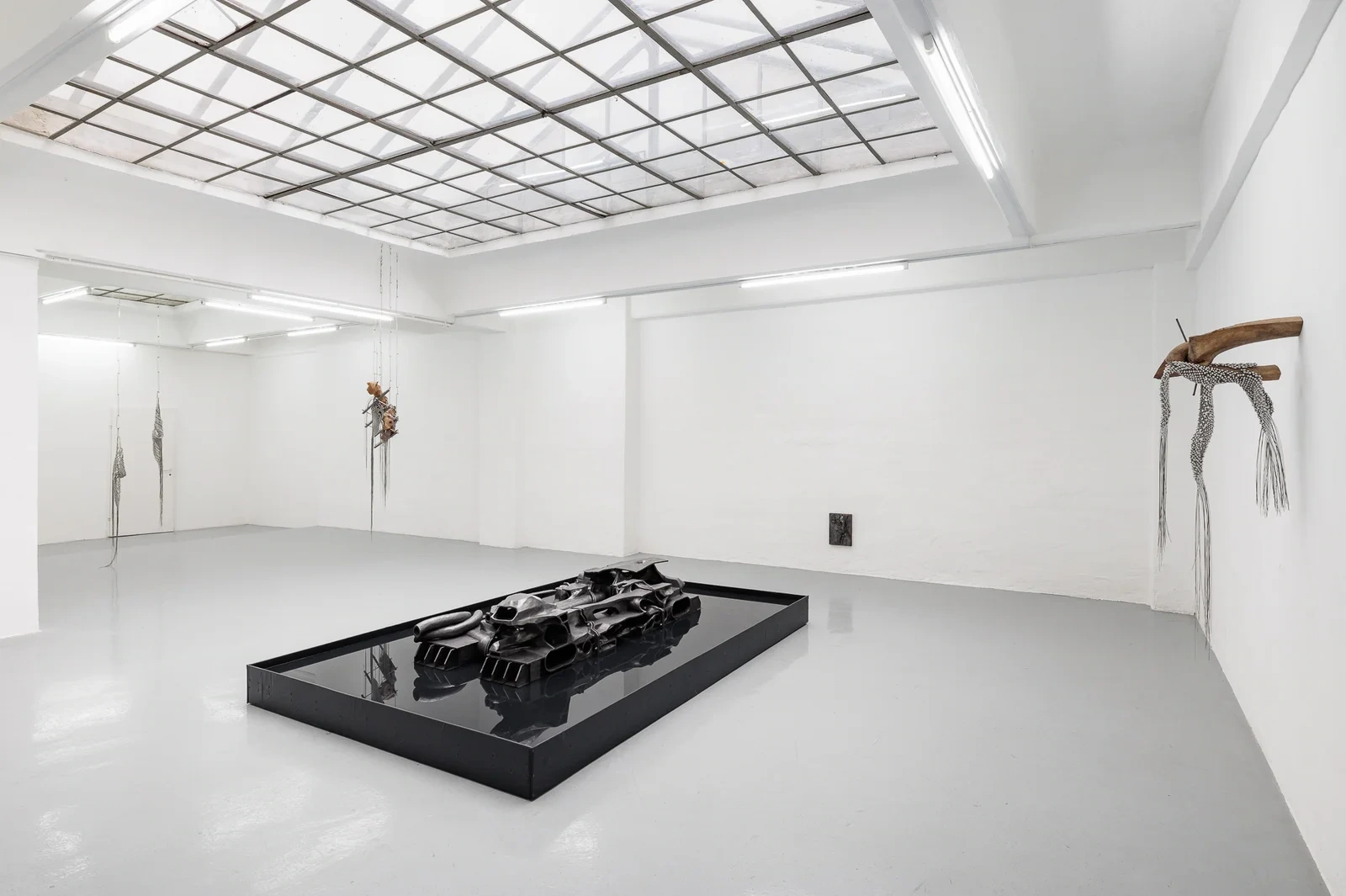
The lowest point is a vantage. Nadir names the position directly beneath the observer, the floor of the celestial sphere, and the works here behave as if suspended between that floor and the sky above it. Laurence Sturla's Fieldnotes (Plant Theatre) lies in a shallow pool of black water, a graphite-dark mass that reads at once as engine block, collapsed architecture, and aerial terrain. The surrounding room falls into the water's surface. The space overhead is folded into how the piece is seen.
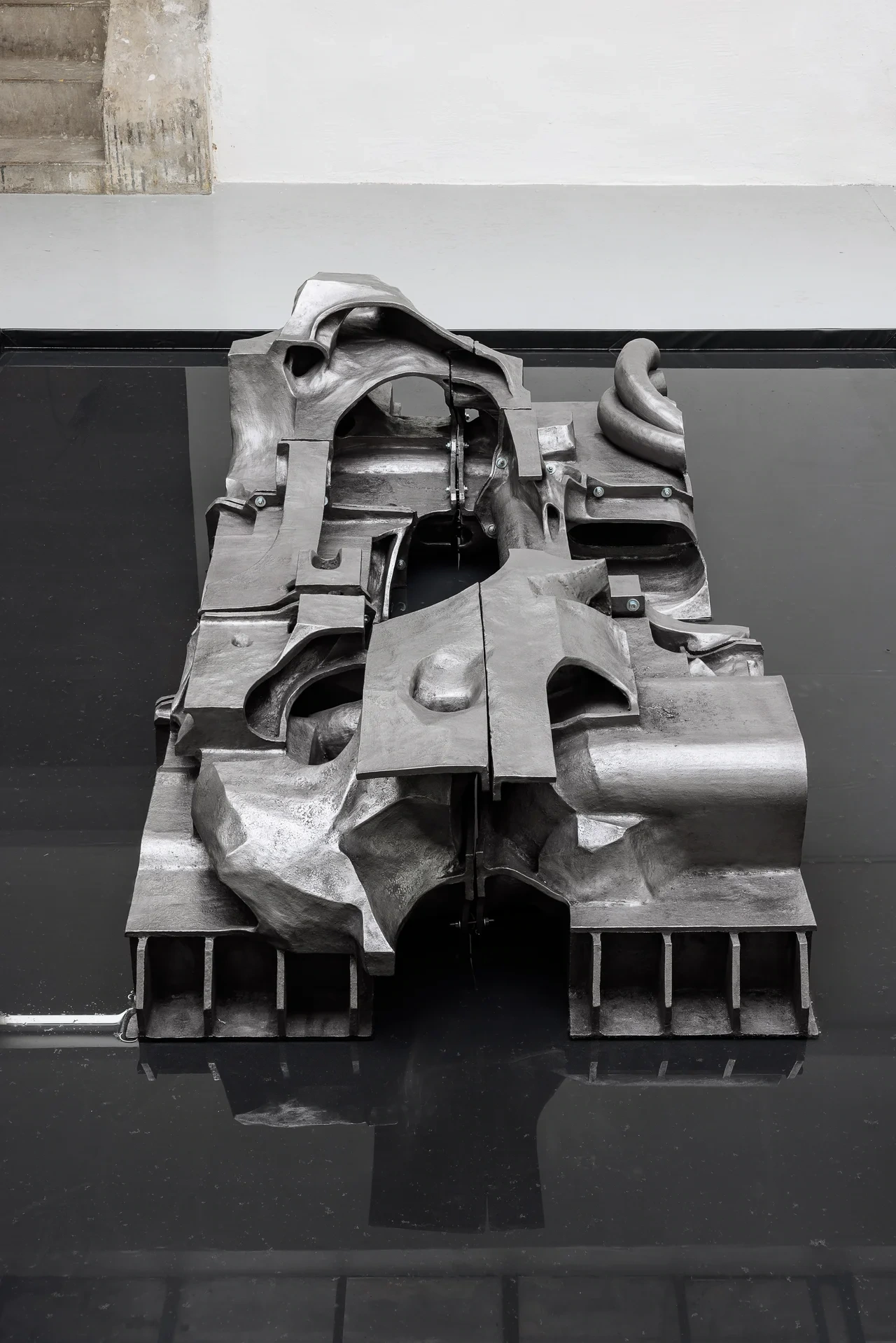
Sturla grew up in Swindon, once a node of England's industrial revolution, now a landscape of empty and repurposed factories. He treats terrain as something “marked, annotated, obsessively cross-referenced against the real.” The starting point was a question of axis: how to shift the anthropocentric angle through which catastrophe is usually viewed. The answer arrives through The Peregrine, J.A. Baker's account of a man dissolving into the sightline of a hunting bird. You look down onto the sculpture, surveying it, circling it, and for a moment you are the falcon and not the field.
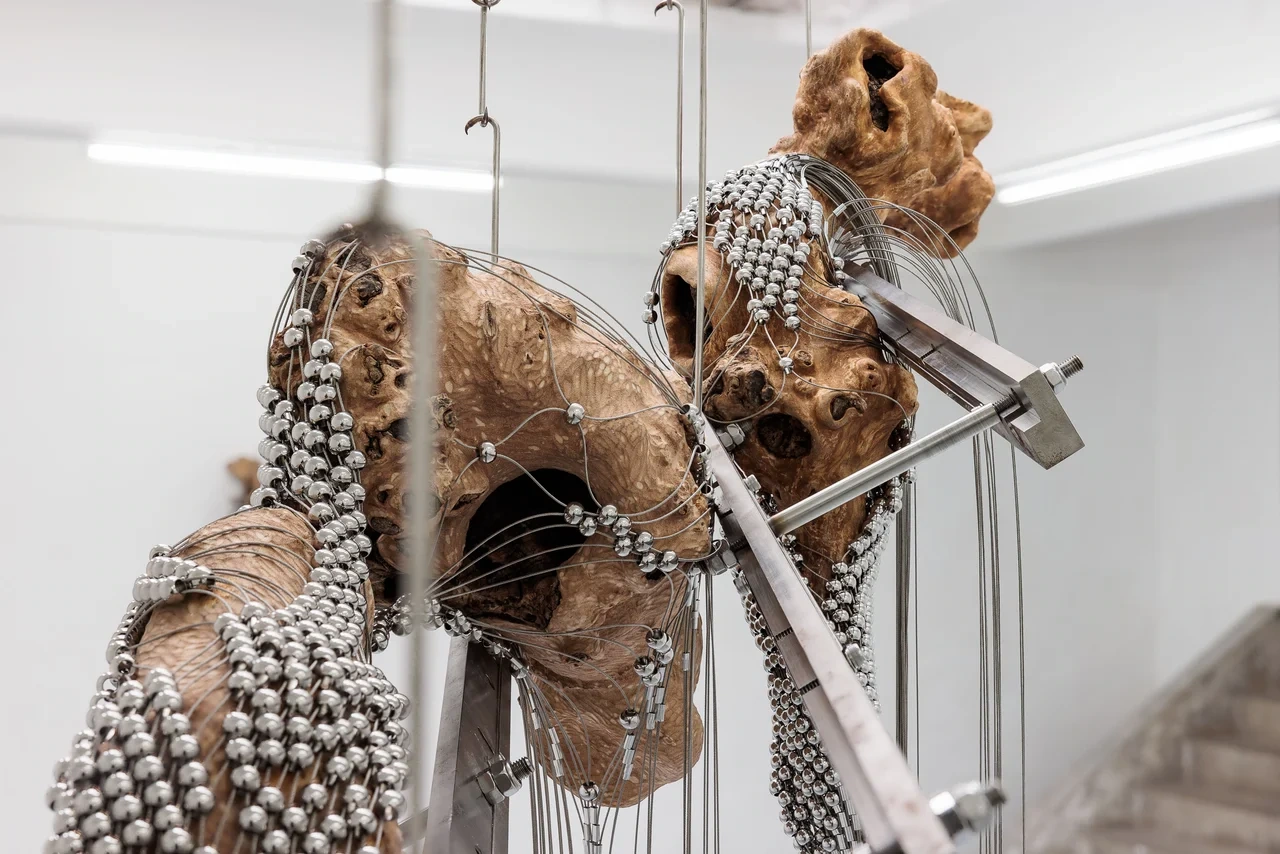
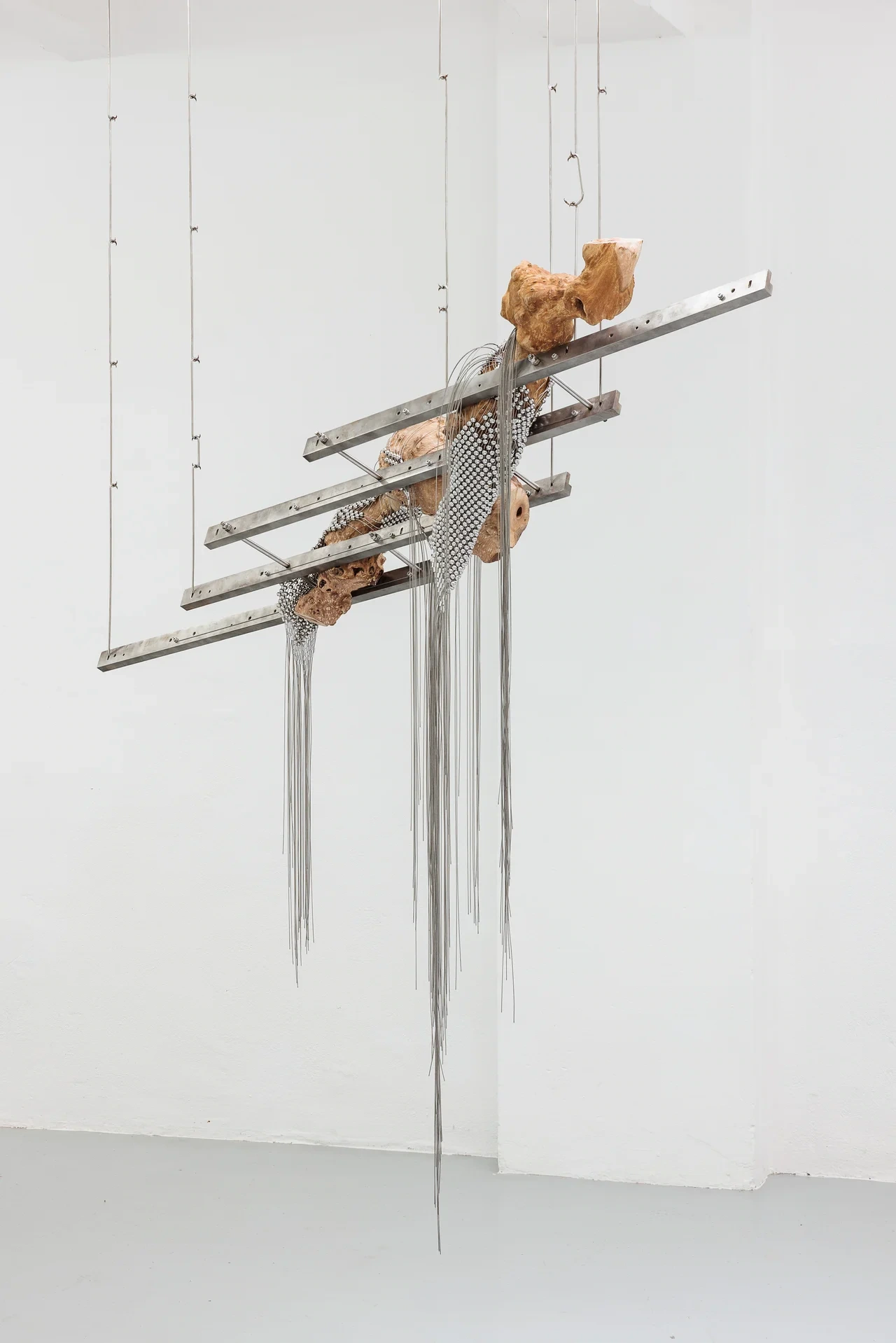
Zishi Han approaches the same wound from another direction. The bodily nucleus of his series xoxo is found London Plane wood, knotted and pale, clamped to steel measuring bars and sheathed in a handwoven net of stainless steel wire, its intersections pinned by small beads. The net follows the grain the way a surgeon maps bone before a cut. Long wires spill from the mesh and pour toward the floor, so each work hangs as a diagram of its own forces: vectors, pressure, and movement extruded into three dimensions.
The London Plane is often called the ultimate city tree, planted across continental Europe because it thrives where other species choke on pollution. It is also a product of early globalisation, a botanical hybrid carried by trade. It reached Shanghai in 1902 with the French authorities and became central to the French Concession; by the 1950s it accounted for eighty-seven per cent of the city's street trees. To handle this wood is to handle a colonial inheritance, a living monument disguised as landscaping.
This is where the two practices rhyme. Sturla folds sky into ground; Han binds a tree's history into a net that reorganises the air around it. Neither offers the map as a neutral document. Both treat it as a record of what has been extracted, displaced, and lost. The curvature of Han's wood and the tension of his wire decide how the pieces fold in on themselves; Sturla's pool decides that you will never see the work without also seeing yourself returned to it.

A line about Echo hangs over the show. “Where there is no Echo there is no description of space or love,” the text offers. “There is only silence.” Echo is myth's figure of longing and physics' figure of distance and design, and both readings hold. To measure a space is to send something out and wait for its return, deformed. These works are that deformed return: terrain that answers back, wood that keeps the shape of its own displacement.
Han and Sturla propose that mapping is never innocent. The map, they suggest, “has always been the first act of possession,” and to remake it is to ask whether the world can be held without being owned. To understand how thoroughly the world has been altered, the axis of looking has to move first.
A map is a claim pressed onto ground. Here the claim is turned over, suspended, set adrift in black water, and asked, quietly, to give the ground back.