Davide Allieri arrives at Kunstraum Dornbirn with coordinates — 47°24’35’’N / 9°44’20’’E — that locate a place precisely while withdrawing it from any legible time, staging the historic Vorarlberg industrial hall as a non-place of suspended civilisation, where fibreglass bodies, severed cables, and an omnipresent acoustic drone conspire into something neither dystopia nor elegy but stranger than either.
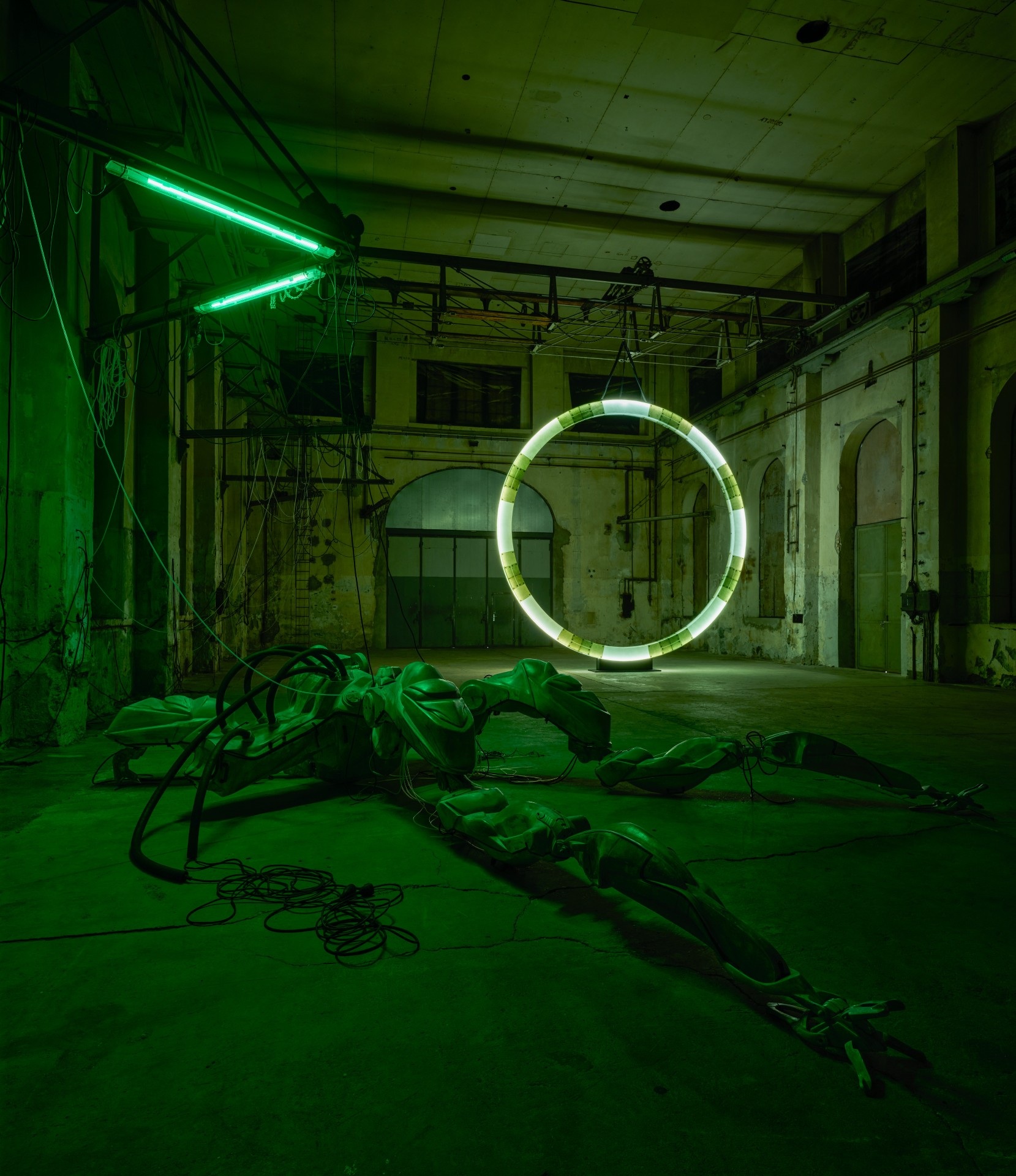
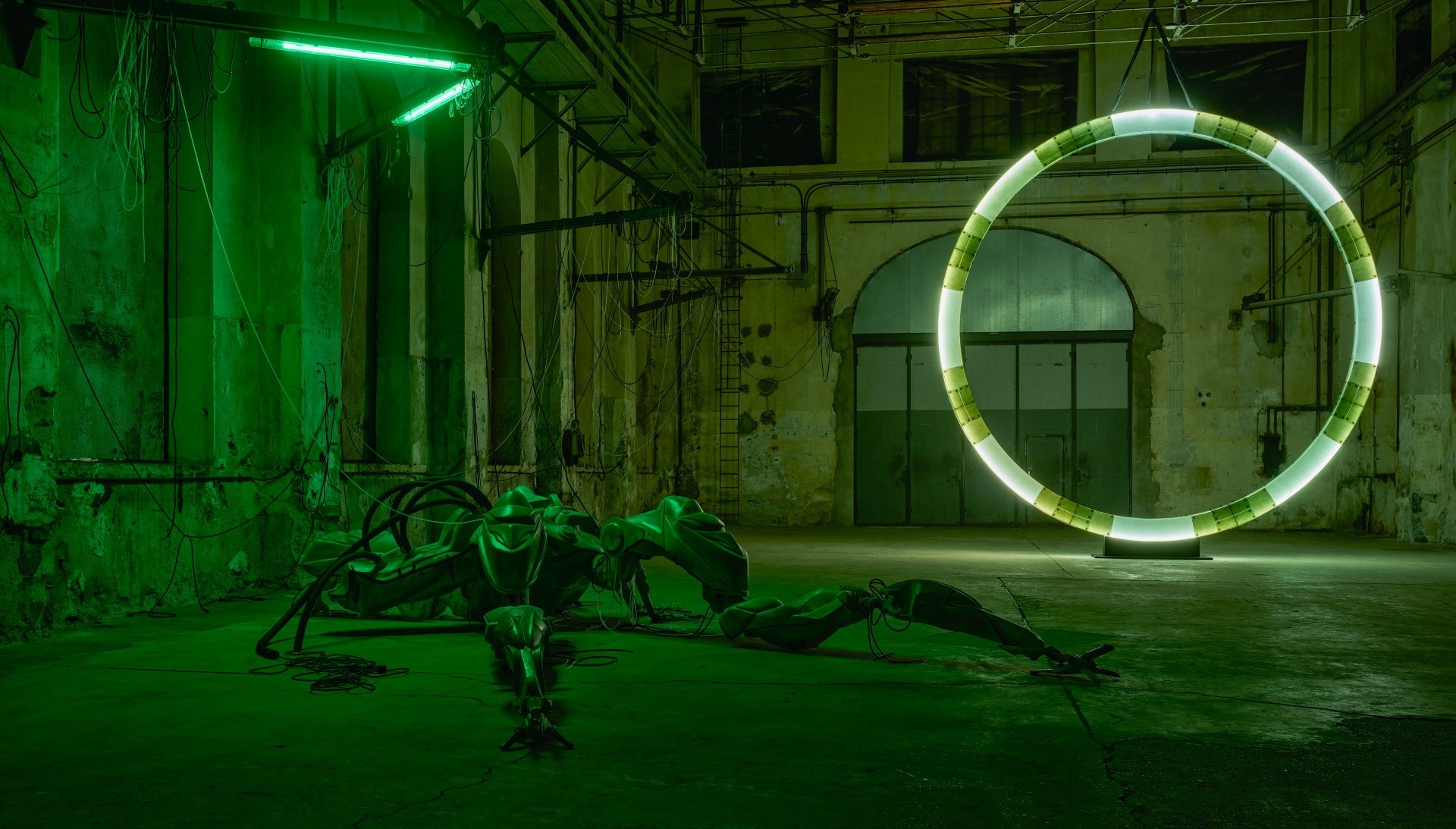
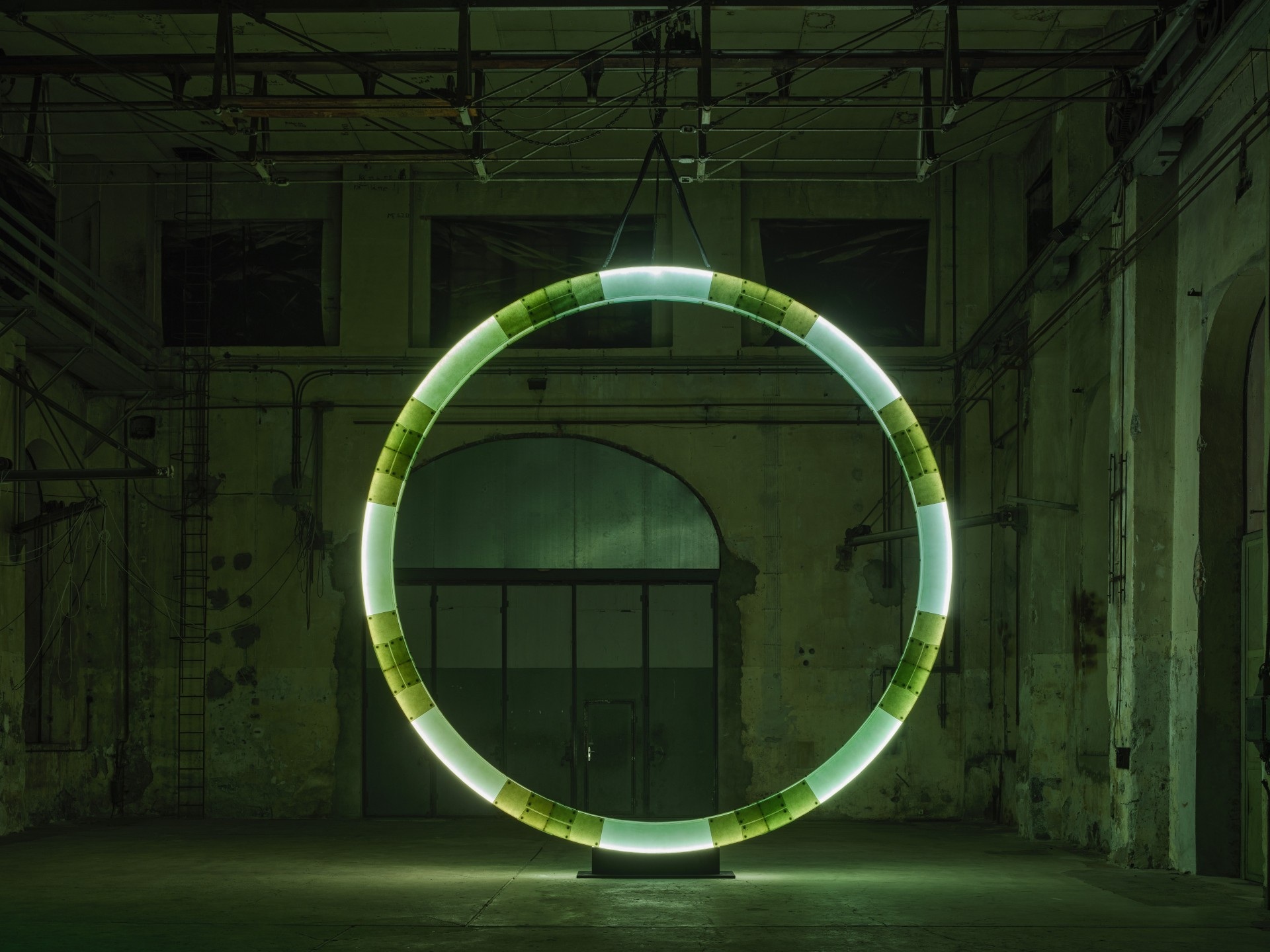
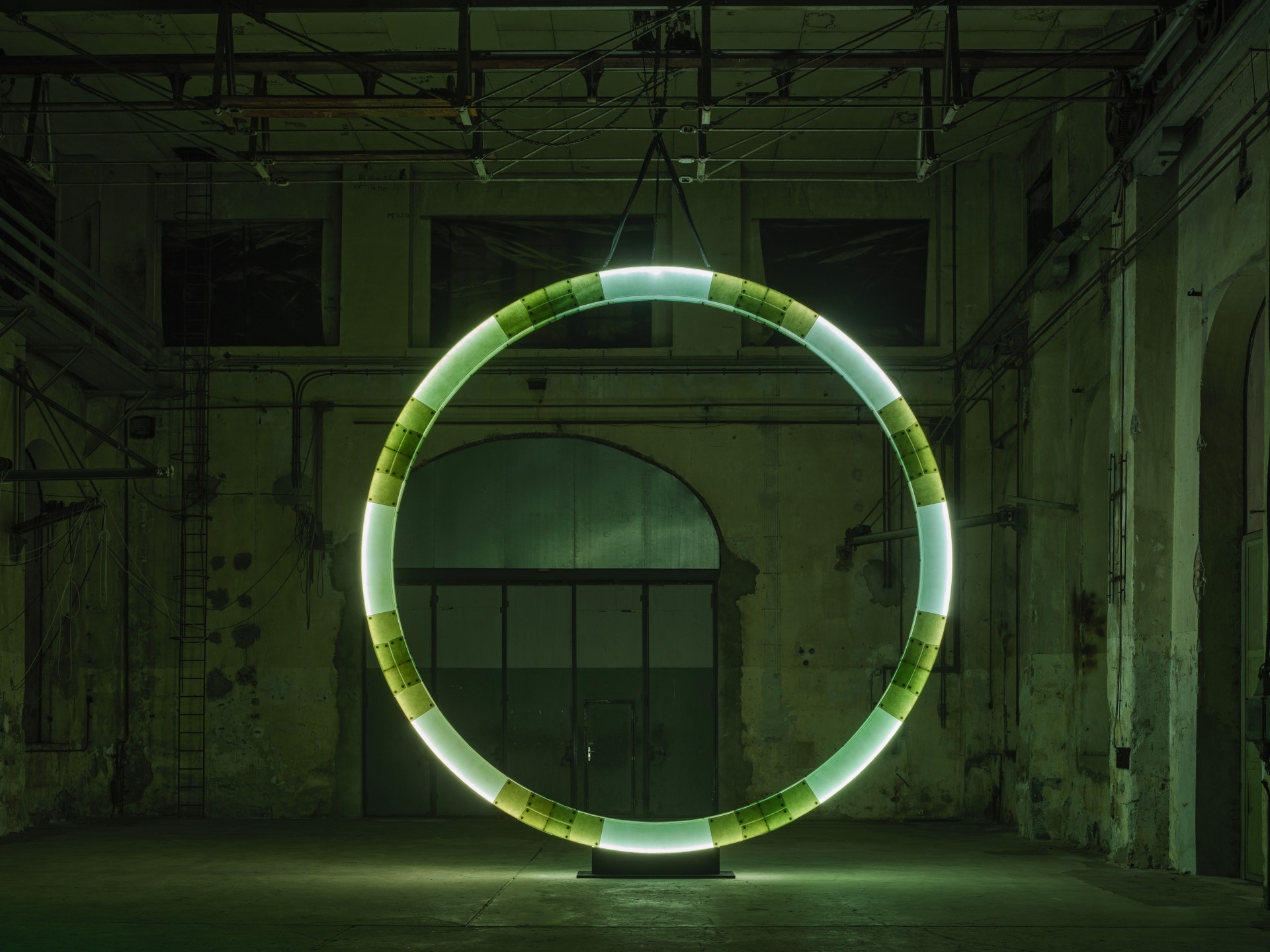
You enter from a municipal garden in spring. Then you are somewhere else entirely. The hall has been sealed against daylight — an artificial atmosphere of pale haze and controlled luminescence replaces the ordinary. At the centre, a large circular sculpture rises: Ring, 2026, a portal of ambiguous function — passage, relic, sign. Its surface is fibreglass, tooled to uncanny precision, and it glows. Whether it transmits or merely echoes is not clear. Across the floor, cables extend in every direction — strung between sculpture and architecture, running beneath feet, stretched taut across beams — forming a diagram of technical infrastructure whose logic never resolves into legibility.
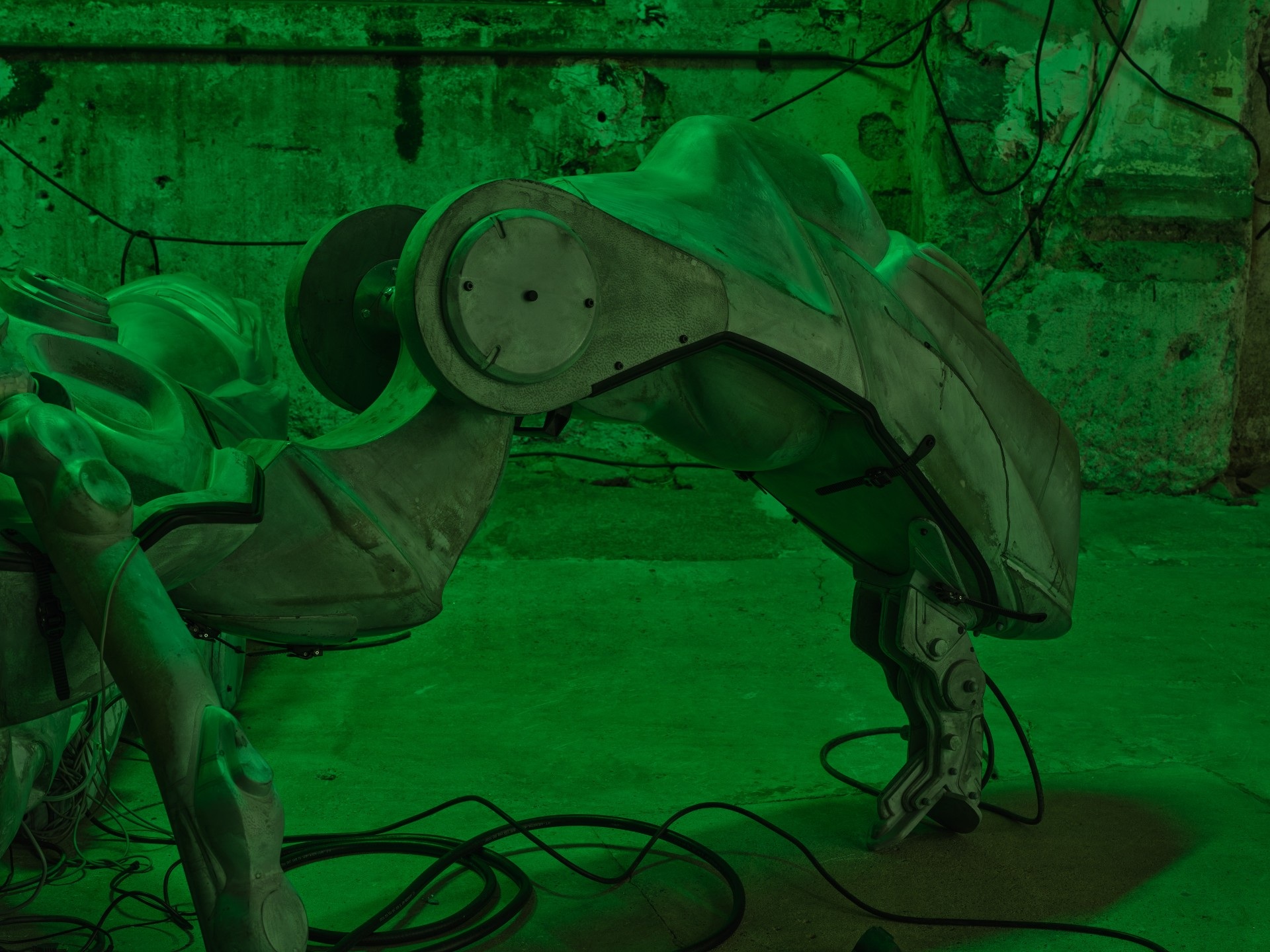
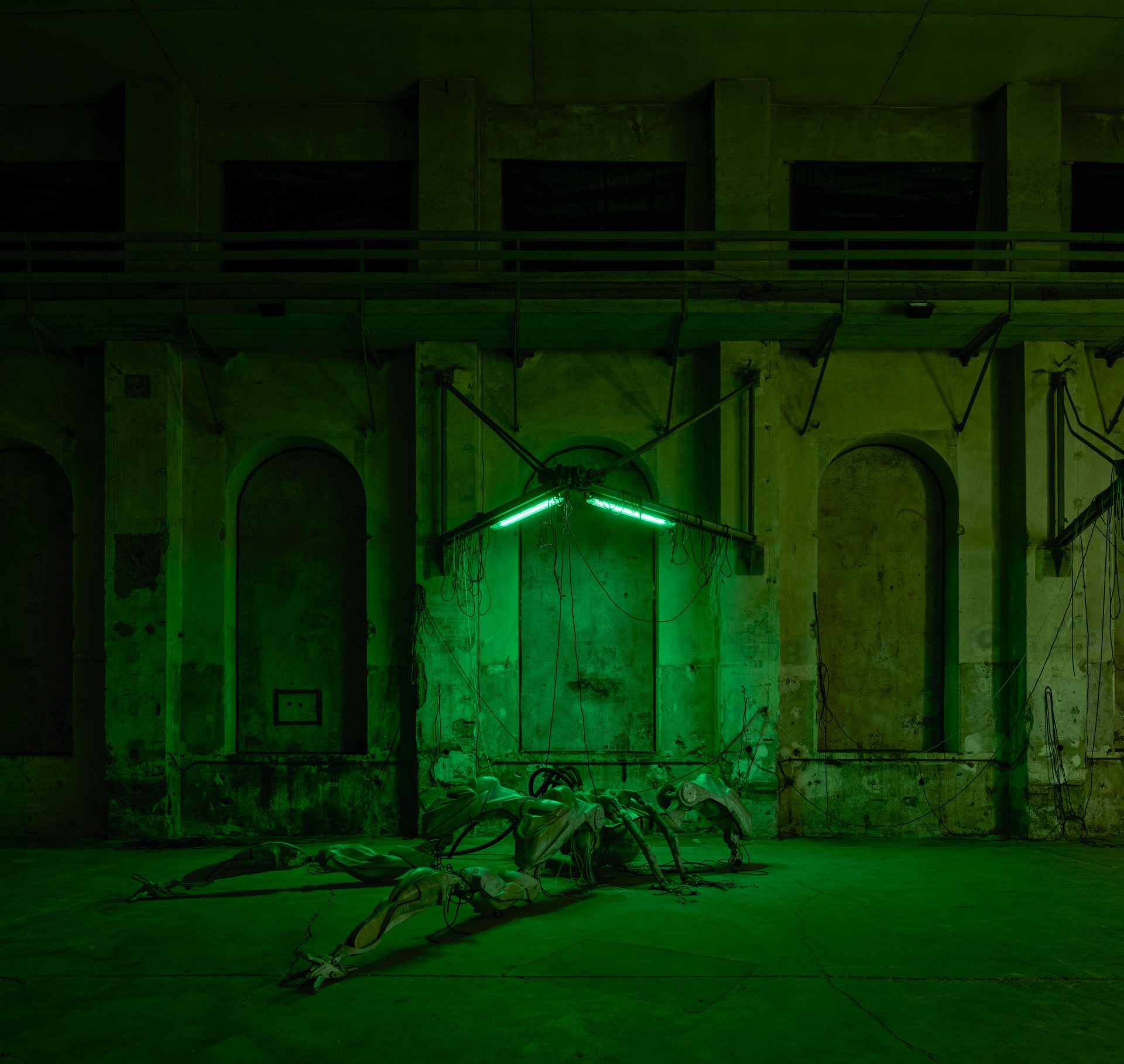
Nearby: Mecha (protective suit), 2026 — a four-metre figure that reads simultaneously as drone, exoskeleton, and shed skin. The references are deliberate and multiple: contemporary motorcycle body parts, animated combat drones, fragments of car chassis abstracted into something post-human. But the figure is hollow. This is the conceptual insistence at the heart of Allieri’s practice — his sculptures are not masses but containers, not presences but enclosures. A solid body is merely an object; an empty one holds space, memory, and the faint pressure of potential. The fibreglass walls are thin enough to seem dematerialised, present and translucent at once.
Sound designer Francesco Peccolo fills the space with a specially composed drone — low-frequency oscillations interrupted by metallic resonances, fragmented impulses, the suggestion of signals arriving from great distance or no distance at all. The acoustic field does not illustrate the sculptures; it extends them. Space becomes a resonating body. Time stretches, loses its grip on sequence. What Peccolo and Allieri produce together is not atmosphere in the decorative sense but a suspension — a condition in which orientation dissolves not because the work is confusing but because it refuses to confirm what moment it is.
Allieri has spoken of Marc Augé’s non-places — those transit zones that are precisely located yet resist belonging, identity, and relation — and the concept operates here not as metaphor but as structural method. Airports, motorway interchanges, waiting rooms: Augé’s non-places are the architecture of modernity’s excess, the spaces that proliferate as destinations multiply. Allieri shifts the concept into speculative territory, producing what the source texts describe as a non-time: time neither cyclical nor punctual but linearly extended — an elongation of the present without discernible origin, without goal.
This is the exhibition’s sharpest critical proposition. Not apocalypse — Allieri is explicit about his indifference to the romantic ruin, the familiar end-of-world iconography. Not utopia either. What remains after those grand narratives exhaust themselves is not wreckage but something more unnerving: a present in suspension. The bodies are absent. Movement has halted. Yet something persists, vibrates, carries latent charge. The cables terminate in loose ends. Nothing is activated. Everything suggests the imminence of activation.
The architecture of Kunstraum Dornbirn is itself a participant — the hall’s history is the Vorarlberg metal industry, and that industrial past saturates the space as material trace rather than heritage display. Allieri does not aestheticise this history; he allows it to remain a resonant framework, something that conditions the air without being narrated. The fibreglass sculptures — technically precise, aesthetically uncanny — sit inside a structure that was once about fabrication, production, function. Now function has been suspended. The forms persist without their original purpose. Whether this is mourning or merely observation is the tension the work refuses to resolve.
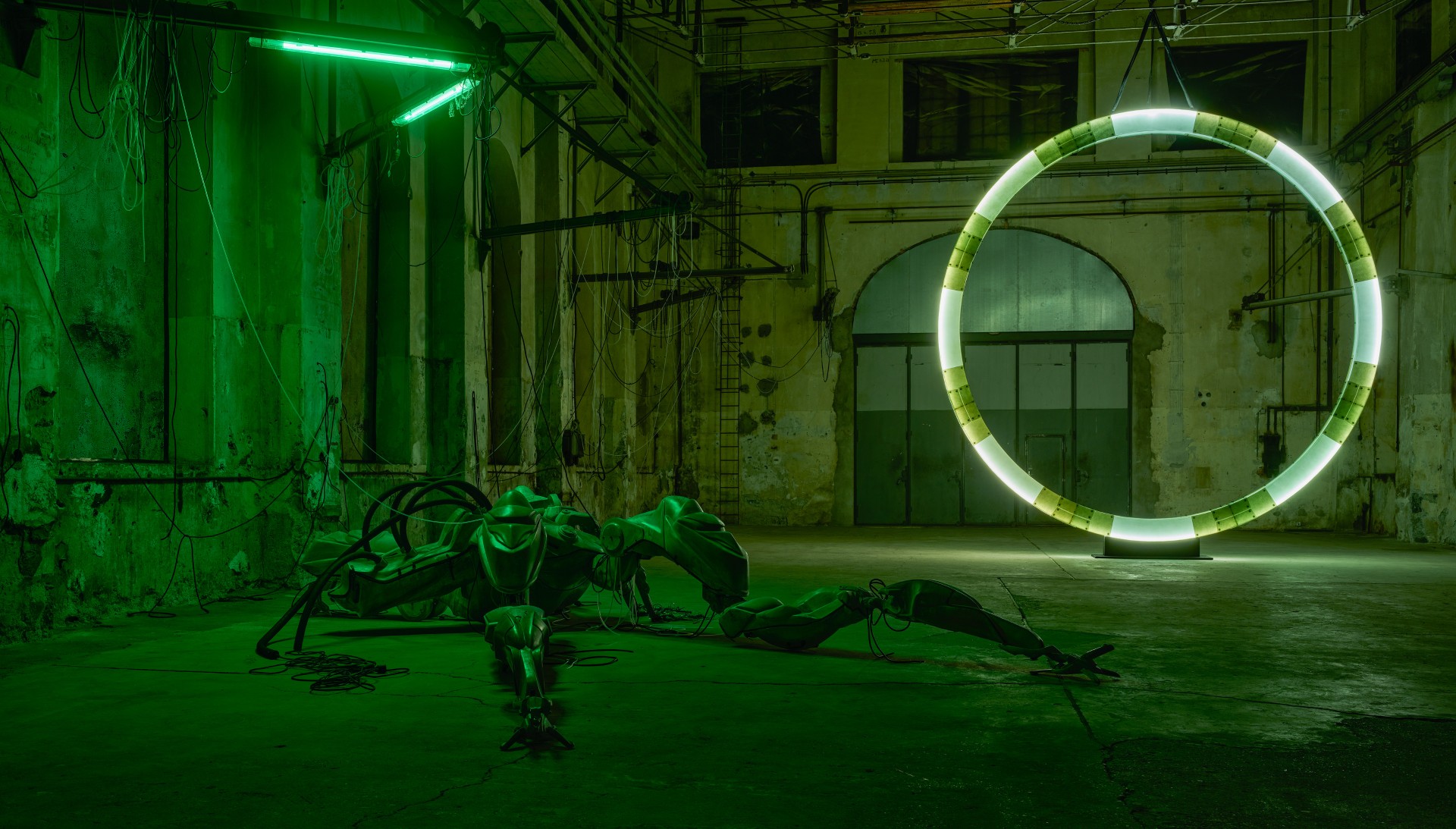
What the dysfunctional network of cables and hollow bodies proposes is something like a theology of the interval — not the sacred as transcendence but as threshold, as the gap between states, as the space in which meaning has not yet collapsed but has not yet cohered. Allieri positions the viewer inside that gap. Not at the end of a civilisation, not at the beginning of a new one, but at the exact coordinate where the two cannot be distinguished.
A set of coordinates is, by definition, a fixed point. What Allieri has built at those coordinates is something that refuses fixity — not because it is vague, but because suspension is its exact subject. The future has lost its function as a projection surface. What remains is this: a present so extended it begins to resemble eternity, an emptiness so precisely shaped it carries more weight than any solid thing.