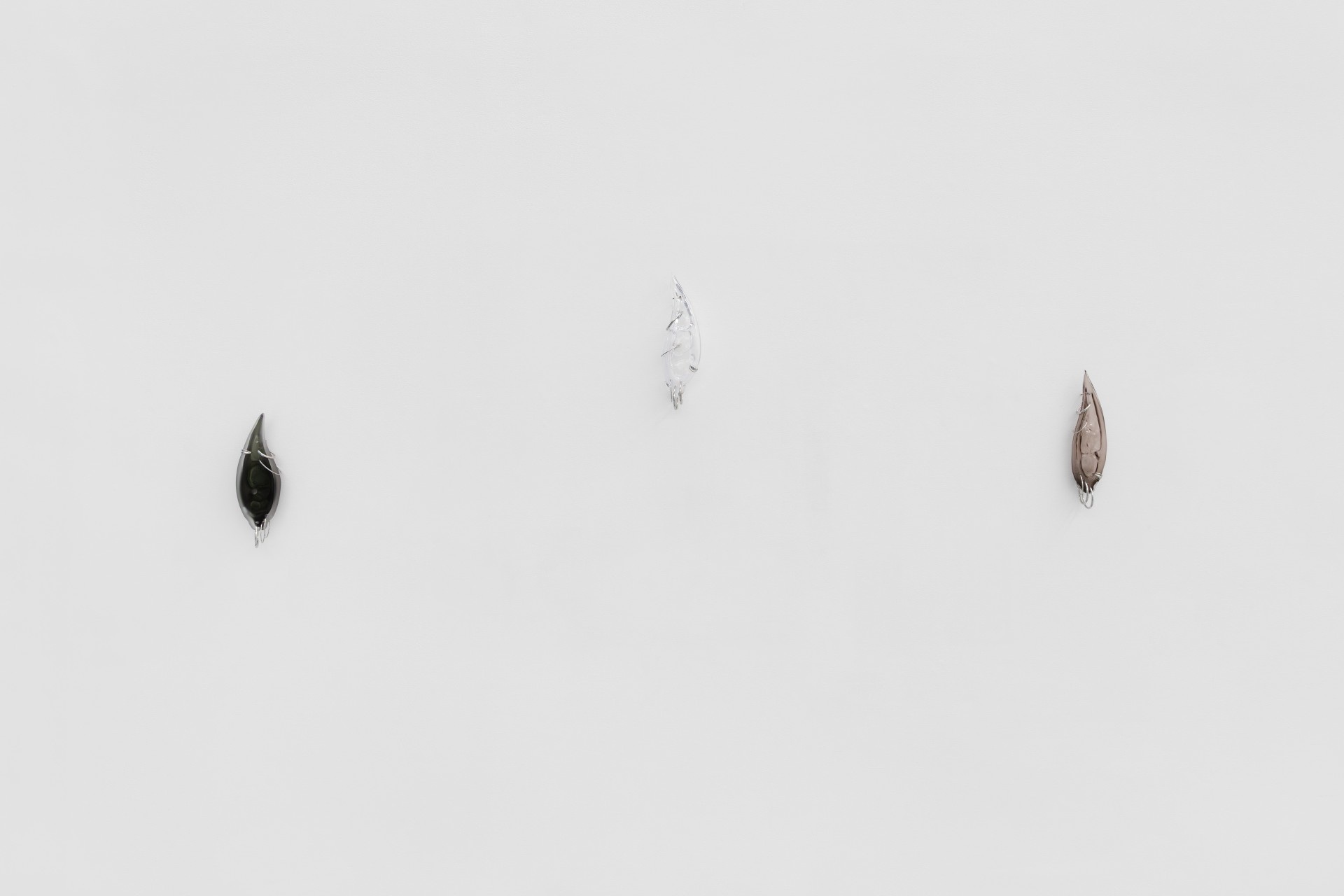
Floryan Varennes stages a landscape both natural and surgical at Xxijra Hii in London — an artificial medical garden where the transparent skin of PVC and glass renders the body visible, vulnerable, and irreducibly held.
To enter Even Spectres Can Tire is to step into a system — not a room but an anatomy. The works present themselves as casings, shells, enhanced structures that suggest a body without fully restoring it. Veins branch like fragile maps across complex steel formations. Organic matter — flowers, branches — presses against clinical enclosures. The scent of living things drifts through a domain of the synthetic. Nothing here resolves into a single register. What reads as protection simultaneously reads as containment.
Varennes works across PVC, glass, steel, and organic materials with a precision that is both mechanical and tender. The sculptures function less as objects than as apparatuses — orthoses, prosthetic shells, fragments of armour that neither heal nor harm but suspend. Scale shifts between the intimate and the architectural. Surfaces remain porous, translucent, deliberately unsealed — as though the works themselves are breathing, or waiting to.

The Pixies — a series of orthotic forms — embody the condition at the exhibition's core. They hover between what has been and what is yet to arrive, presenting possible alternatives to the body rather than replacements for it. There is something of the medieval about them — Varennes has long positioned his practice between medievalism and science fiction — and something of the post-human, though the work refuses either category cleanly.
The cocoon form in Ark extends this ambiguity. What appears as shelter also suggests isolation — a membrane that holds the body in suspension, where longevity is not redemption but endurance. The cocoon does not promise transformation in the triumphant sense. It preserves life by sealing it off, by holding it in a state of unresolved becoming. Protection and confinement share the same skin.
There are echoes here of Ursula K. Le Guin's speculative ecosystems — worlds where fragility, transformation, and survival coexist beyond binary oppositions. Varennes constructs a similar threshold. Bodies are altered but not erased. Enhancement is not upgrade but metamorphosis — not a movement toward perfection but a lateral drift into something unrecognisable and still alive.
The Spikes — ear-like fragments that reference both fantasy lore and wartime trophy rituals — push this further. In fantasy, elves possess sharpened hearing; in history, a severed ear becomes evidence of domination. Varennes collapses these registers. An organ once attuned to sound and perception is estranged from its function, reclassified as artifact, relic, object of power. The real and the fictional merge until the distinction ceases to matter.

Video game landscapes haunt the installation — Varennes draws openly from the digital worlds he inhabits. The branches of Millefleurs rest on the floor like remnants of a rendered forest, hovering between nature and fantasy, present and future. Their scent pulls the viewer back toward the organic after an encounter with the sterile and the fabricated.
The exhibition resonates with Jacques Derrida's hauntology — a condition in which the present is permeated by ghosts of unfinished pasts and unrealised futures. These layered temporalities persist materially here: suspended in glass, sealed in PVC, held within protective shells. The spectres of the title are not metaphorical. They are structural — built into the work's transparent surfaces and porous membranes.
Not an exhibition about care, then, but about the architecture of care — its geometry, its enclosures, its capacity to sustain and confine in the same gesture. What remains when the spectre tires is not collapse but a quieter form of persistence. A body held. A membrane still intact. Life continuing — not as triumph, but as endurance without resolution.