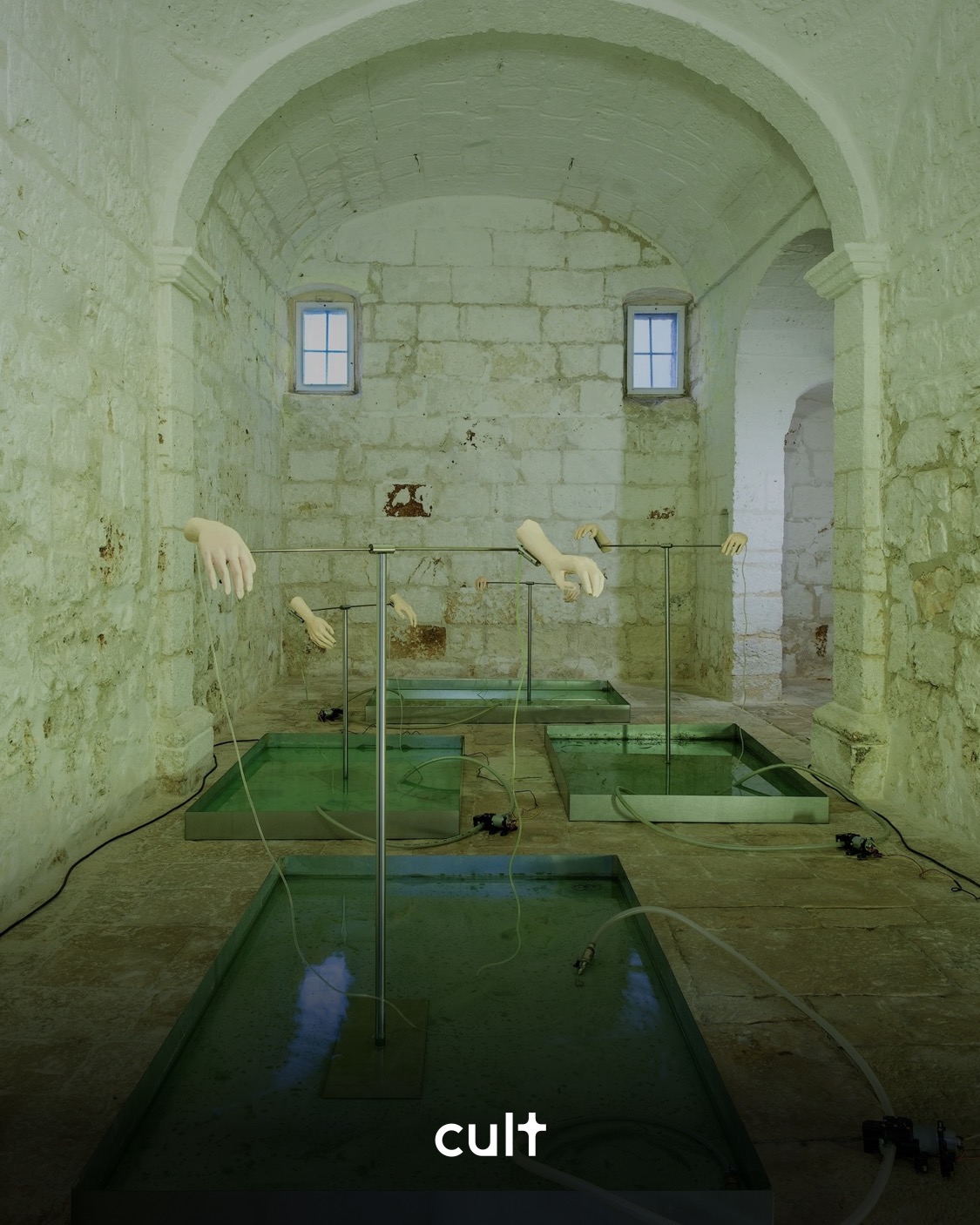
Water does not close systems; it opens them. This is the fundamental premise that animates Arianna Ladogana's installation within the Ex Chiesetta at Fondazione Pino Pascali in Polignano a Mare—a place where stone walls and vaulted ceilings have witnessed centuries of human ritual, and where now four sculptural bodies half-dissolve in tanks of perpetual liquefaction.
The work, selected for exhibition by curator Roberto Cuoghi as part of the tradition of the Pino Pascali Prize, arrives not as a single authoritative gesture but as one voice in a rotating chorus of five artists. This curatorial modesty itself becomes part of the work's meaning: no singular ego dominates the threshold; instead, the space remains open to multiple presences, echoing Ladogana's own philosophy that identity exists not in fixity but in relational flow.
The sculptural elements at the heart of the installation are bodies caught in a state between dissolution and metamorphosis. Neither entirely human nor entirely machine, they exist in the liminal space that posthuman theory now insists we all inhabit. These forms float, submerge, transform within tanks that collect the remains of matter in perpetual liquefaction. To encounter these bodies is to begin thinking differently about what a body is. We tend to imagine bodies as bounded entities, discrete units sealed against the world. Ladogana's installation asks us to reconsider: what if "our bodies are not closed systems, but tidal, porous, and fragmentary"?

This question opens into a larger philosophical terrain. Ladogana engages explicitly with hydrofeminism—a theoretical framework that positions water not as a resource to be managed but as a primary matrix of relationship. Water is what connects us; water is what flows through us. The primordial ocean from which life expanded onto dry land remains present within us, cellular, continuous, never fully abandoned. To think with water is to think in terms of flows, dispersions, fragments—precisely the language of Ladogana's dissolving bodies.
The technological dimension refuses easy comfort. The installation does not present technology as external to bodies, as something imposed from outside. Instead, the machine insinuates itself into organic matter; the two entangle inseparably. This is not apocalyptic imagery; it is rather an attempt to represent truthfully the condition we already inhabit. We are already cyborgs, already hybrid, already neither completely organic nor totally artificial.
The work enters into dialogue with the concept of symbiogenesis—the principle that cooperation between organisms drives transformation. The dissolving bodies are not isolated entities in self-destruction but "transition points in a broader flow of transformation." This reframing transforms what might appear as degradation into metamorphosis, into the ongoing rewriting of life itself.
Within the pale stone chapel, where light enters through narrow arched windows, the work achieves a particular temporal suspension. "There is no catastrophe, but transformation; there is no end, but incessant rewriting of what we call life." To acknowledge our dependencies, to embrace our fragmentation, to understand ourselves as interwoven rather than autonomous—this is not diminishment but expansion. The bodies dissolving in their tanks gesture toward a form of becoming that exceeds the logic of bounded individuality, suggesting that freedom lies not in integrity but in dissolution, not in closure but in the openness of perpetual transformation.