

The warehouse is 478 square metres of raw concrete in Woolloongabba, Brisbane. It used to be a motorcycle wreckers — Japanese brand names are still sharpied onto the overhead beams, and a pulley system hangs from the upper floor like the skeleton of an industry that moved on without cleaning up. Into this scenery of collision, crushing, and salvage, curator Holly Eddington has placed five artists and called the result Total Loss.
The title borrows from insurance terminology: the point at which damage repair is declared unviable, when the cost of restoration exceeds the value of the thing being restored. It is a clinical phrase for an absolute condition — the moment the assessor walks away. Eddington's exhibition uses this threshold as a lens for reading the present, where Benjamin's angel of history sees not a chain of events but a single continuous catastrophe, wreckage upon wreckage hurled at its feet by the storm called progress.
The five artists — Seren Wagstaff, Bleu281_, Adam Cole, Brodie Monro, and Vienna Curran-Stanovsek — work across painting, sculpture, and installation, and the warehouse absorbs them all without hierarchy. The industrial architecture refuses to be neutral. Every work exists in dialogue with the raw concrete, the exposed steel, the residual violence of a space built for dismantling. What might read as discrete objects in a white cube here becomes part of a continuous field — art and ruin operating on the same frequency.
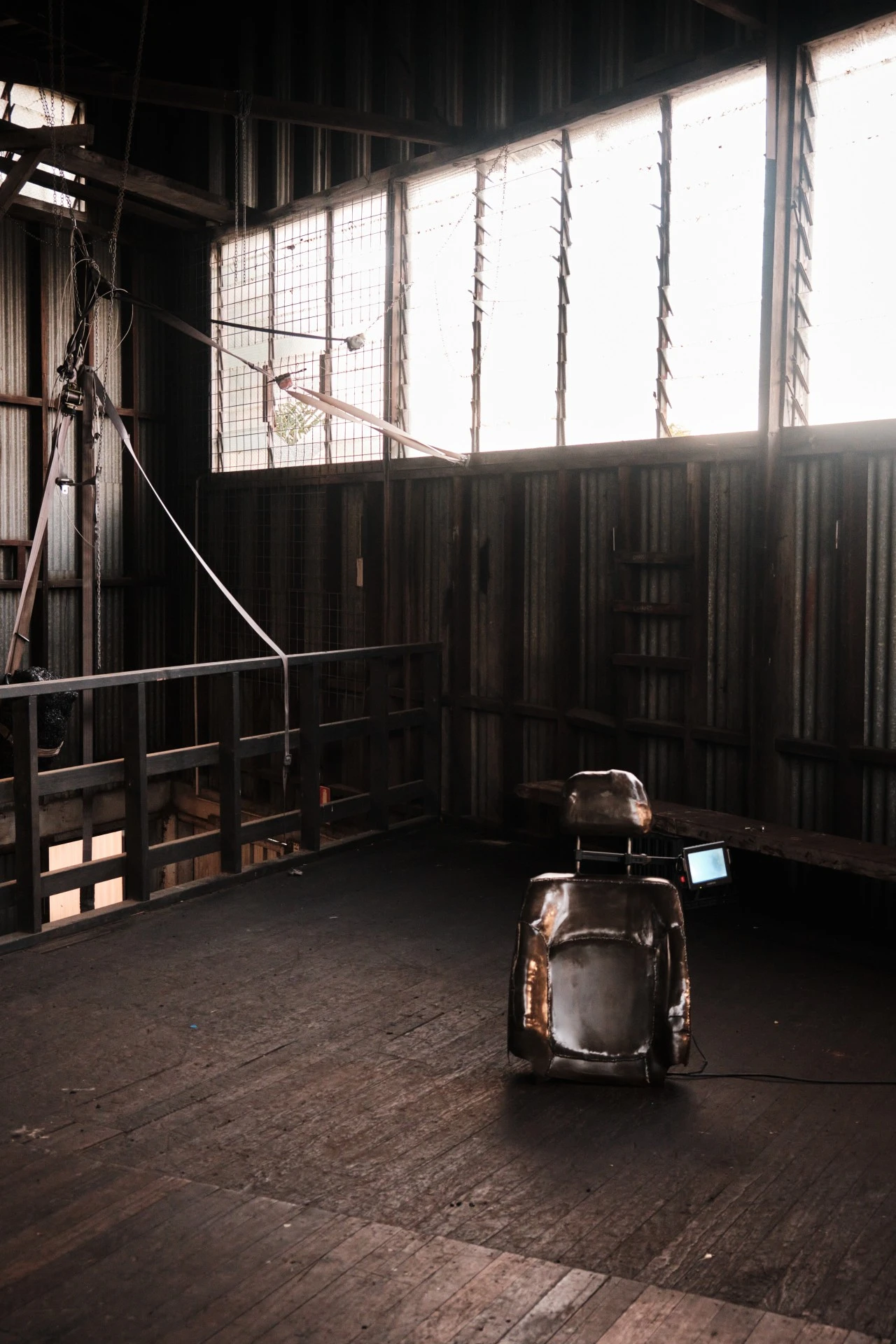
Eddington's curatorial essay invokes the Laocoön — that frozen apex of agony where cause and consequence collapse into a single image, where the catastrophe has already begun but the sculpture holds it in permanent suspension. The parallel is deliberate: these works occupy a similar temporal register, a thickened present in which damage is neither past nor future but ongoing. The warehouse itself performs this condition. Its past as a wreckers is not history — it is residue, still legible in the marks on the beams, the oil stains on the floor, the industrial geometry that frames every piece.
There is a doubleness threaded through the exhibition that Eddington names explicitly. To crush is to apply a downward force, to produce a folding in on oneself. But a crush is also an infatuation — an irrational, unrequited attachment. The etymological jump between these meanings is speculative, but the emotional logic holds: it is the proximity and intensity of catastrophe that draws us toward it. Lauren Berlant's cruel optimism — the condition of remaining attached to fantasies that actively harm us because we cannot imagine life without them — hovers over the show like weather.
What capitalism cannot fix, it replaces. What it cannot replace, it forgets. Total Loss refuses both operations. The warehouse remembers. The pulley still hangs. The brand names persist on the beams. And the work installed within this space insists on staying with the damage — not to repair it, not to aestheticize it, but to inhabit the wreckage as a present condition, to camp out inside the breakdown and refuse the consolation that suffering will be delivered somewhere else. The pile of debris grows skyward. The angel cannot close its wings.


