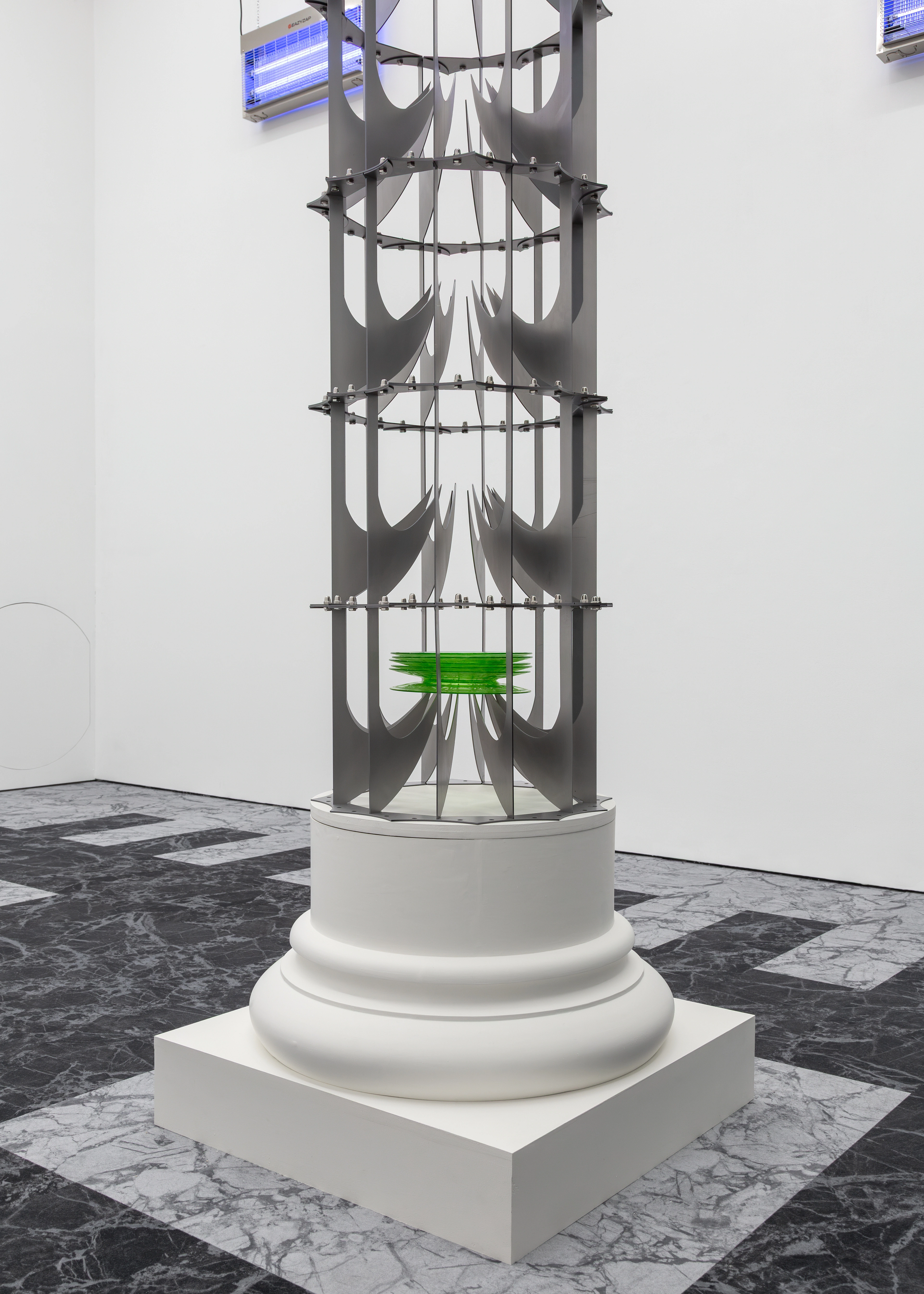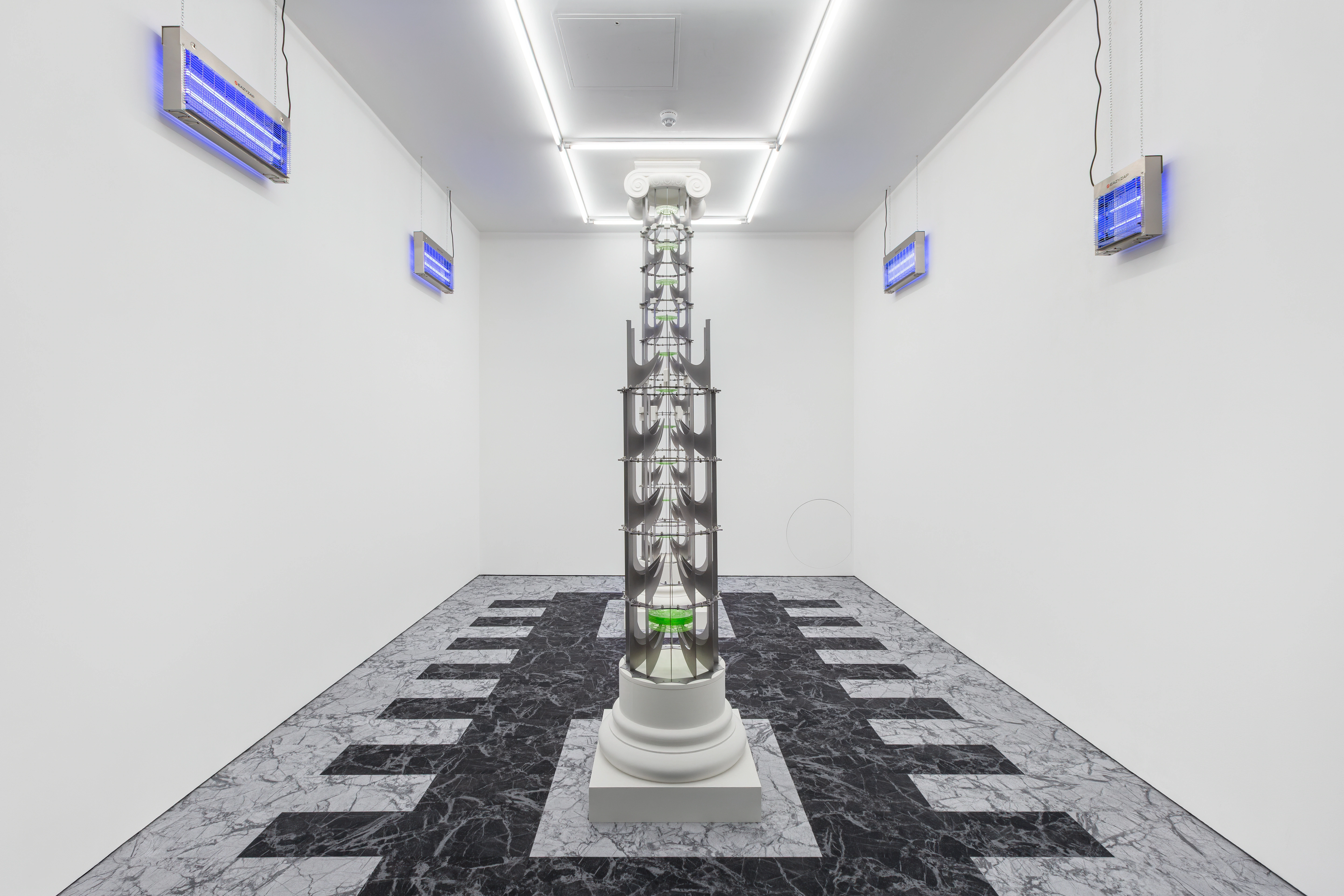
Authority has always dressed in borrowed stone and borrowed light. In Amélie Mckee’s Solarium, her debut solo exhibition at Plicnik Space Initiative in Deptford, both are counterfeit, and the counterfeit glows.
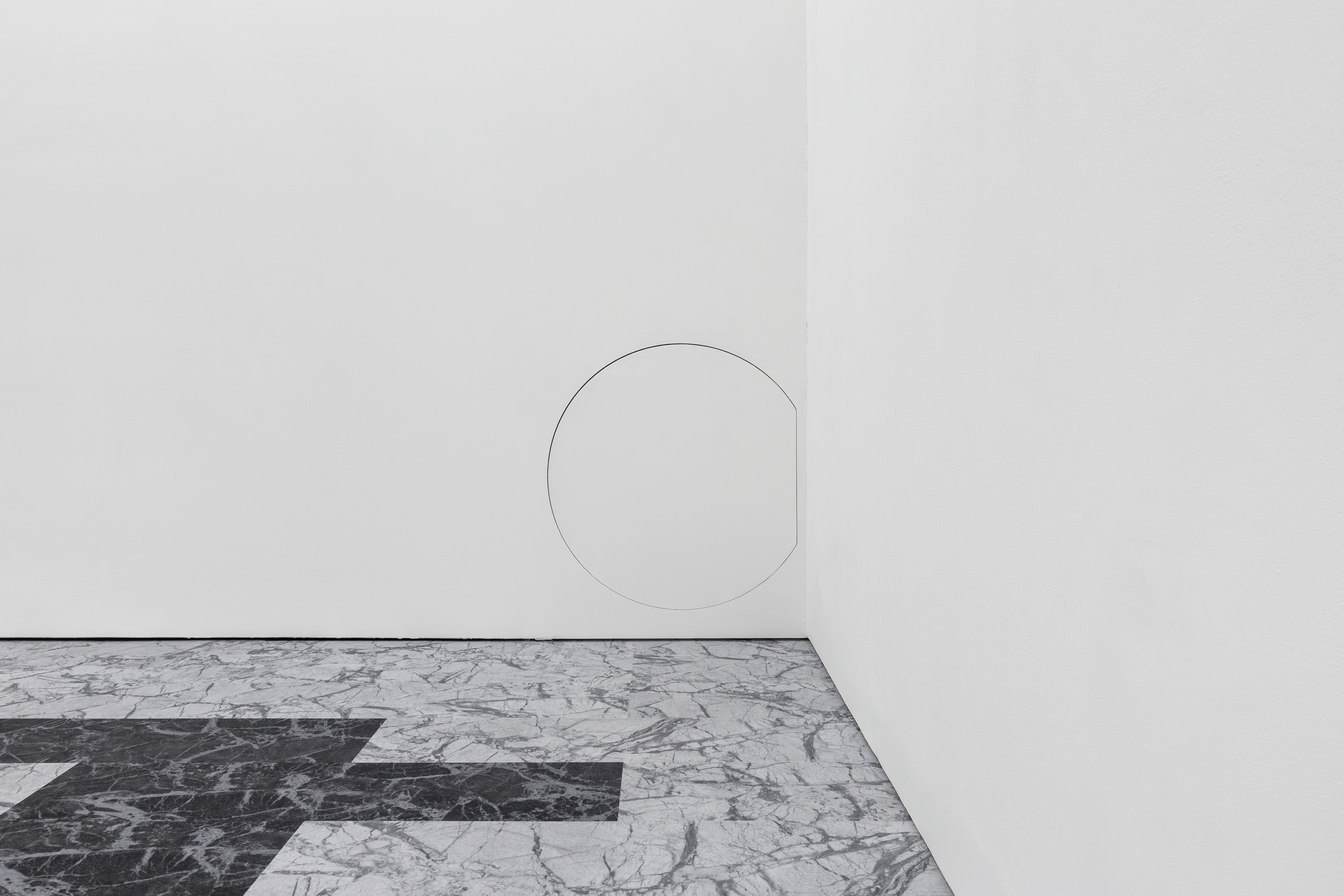
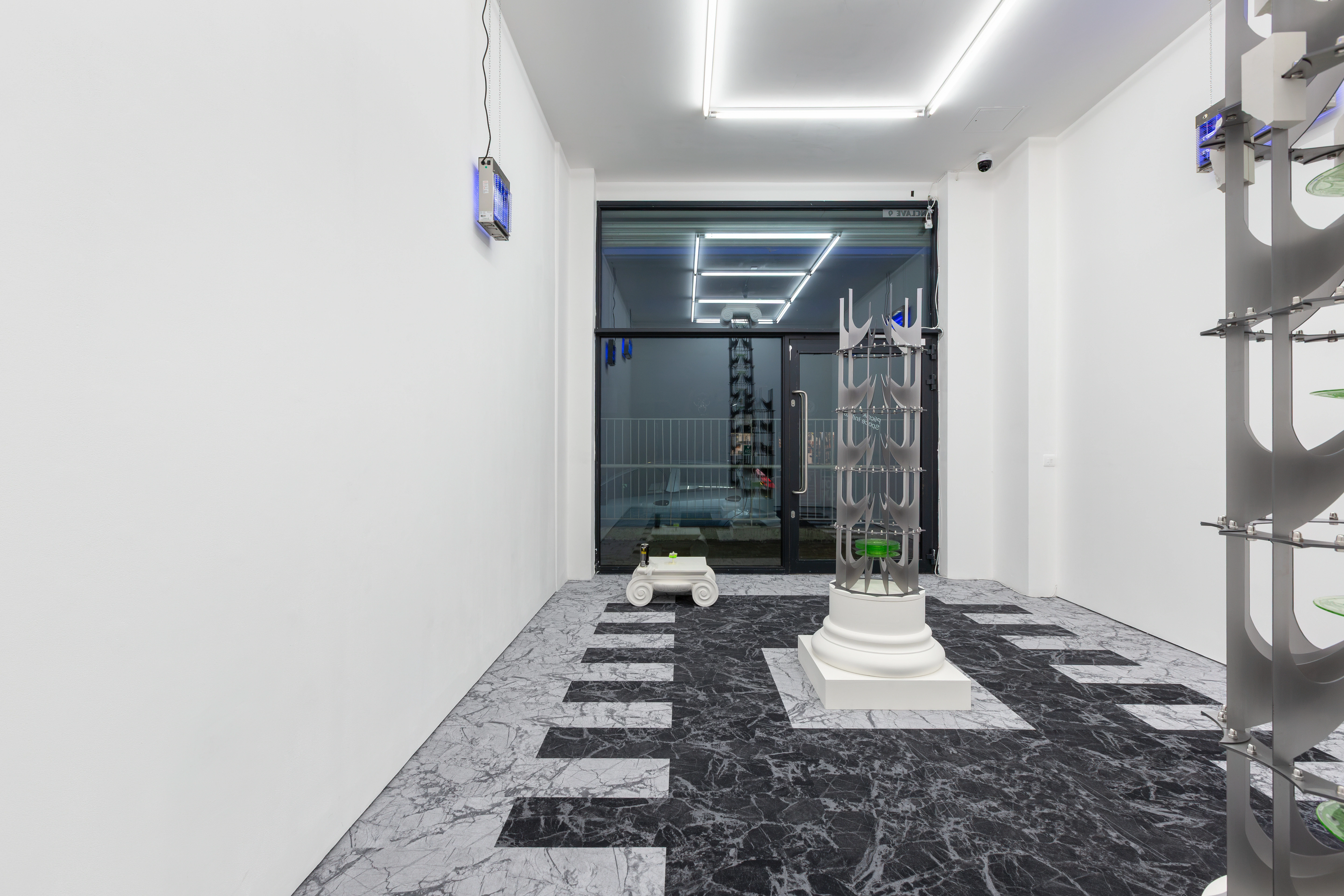
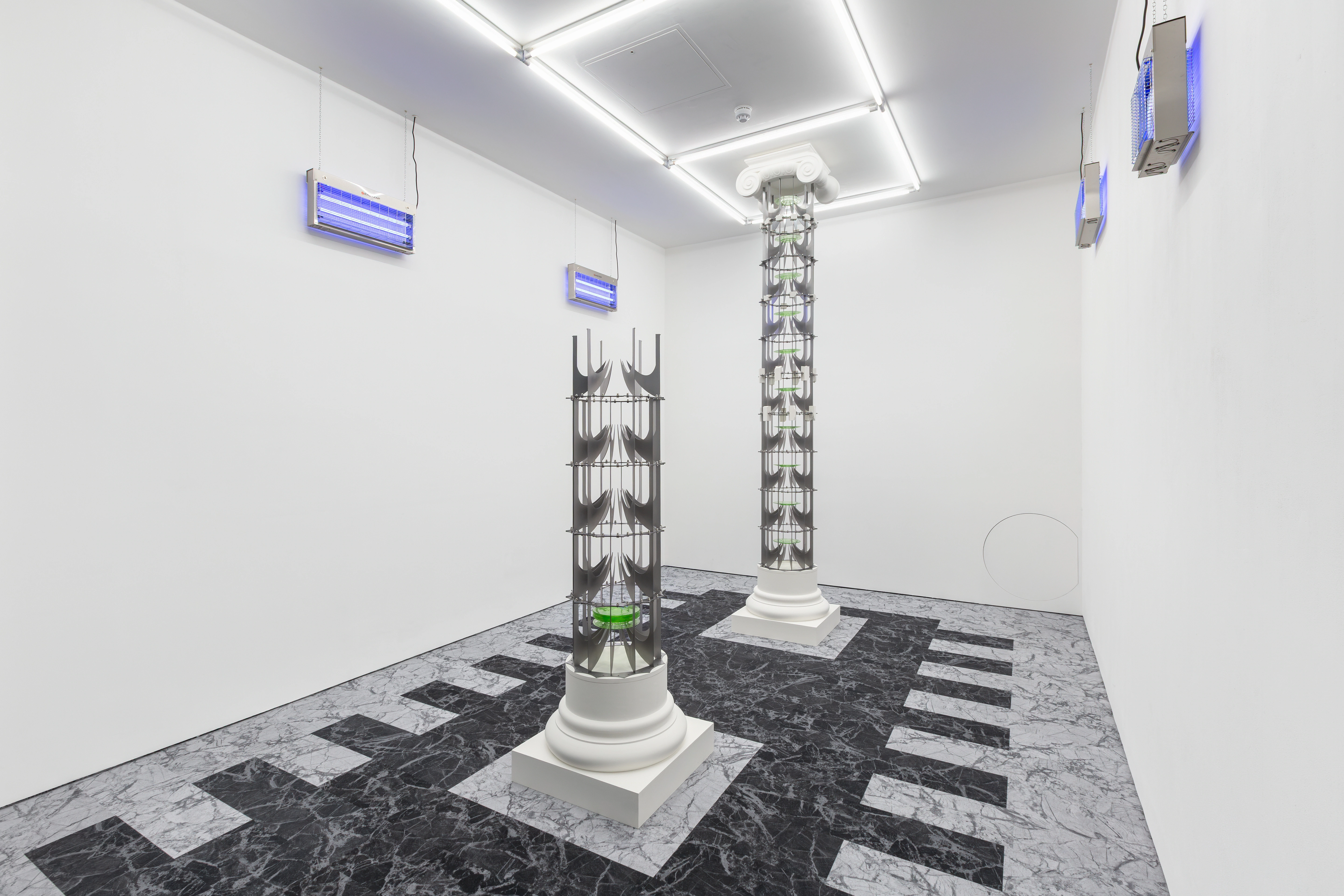
The floor gives first. Marble, the stone of banks and ministries, is laid here as faux marble carpet planks, soft enough to walk on, and the planks will not hold their pattern: their sections misalign until the most expensive surface in the classical repertoire reads as hazard warning stripes. Wealth has been turned into a warning and put underfoot. Through it all runs a soundtrack of winter storm ambience, weather without cold, domesticated as thoroughly as the stone.
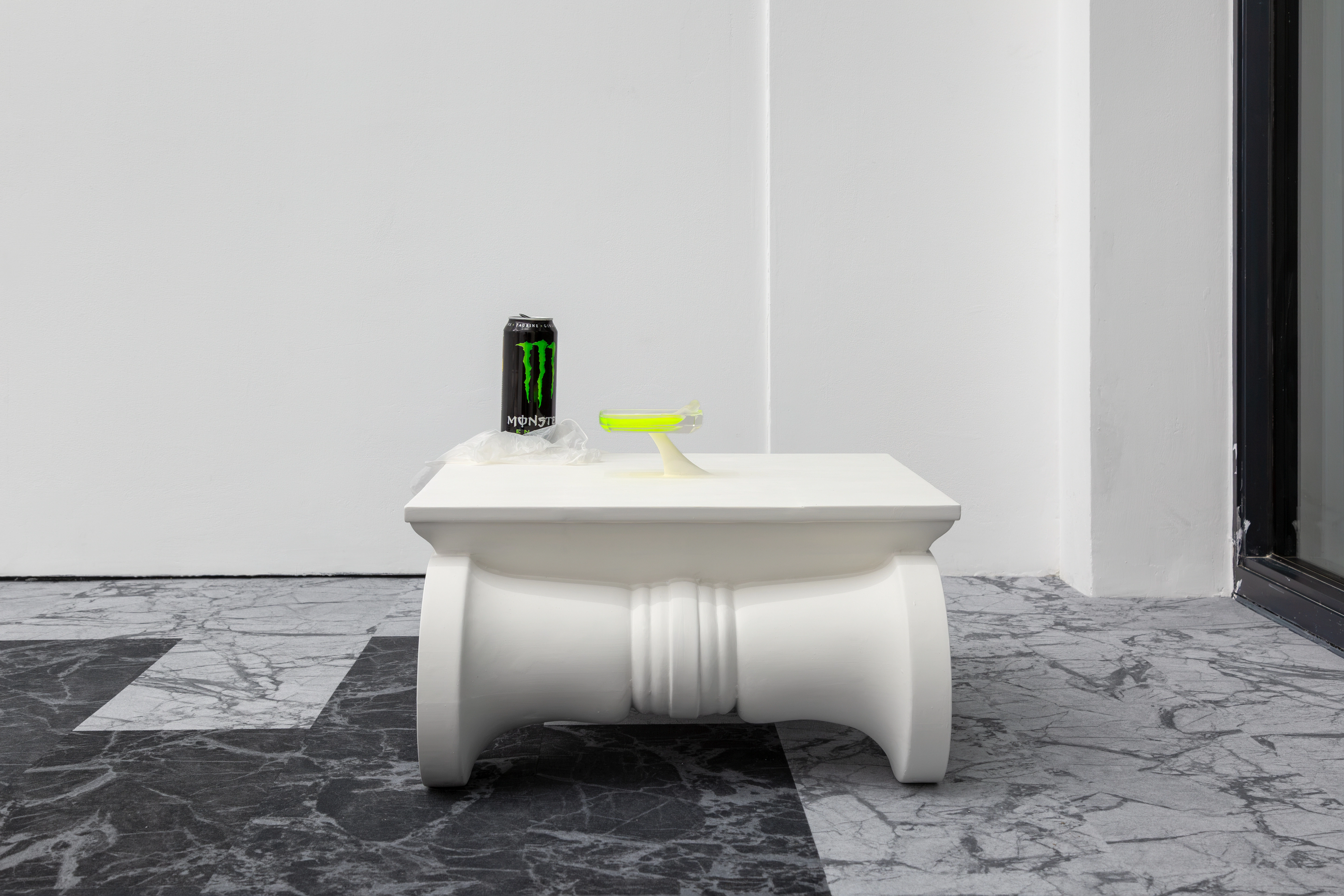
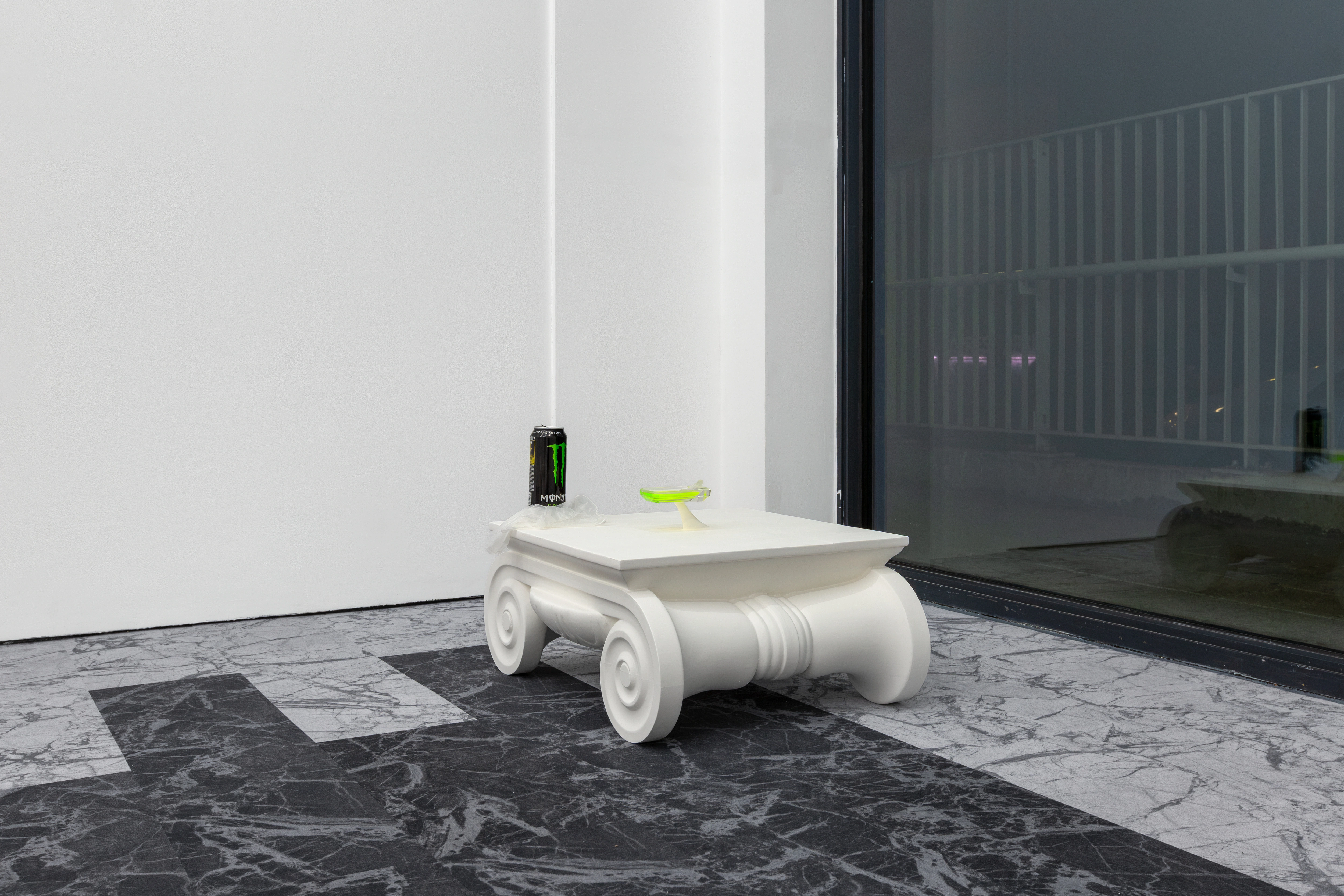
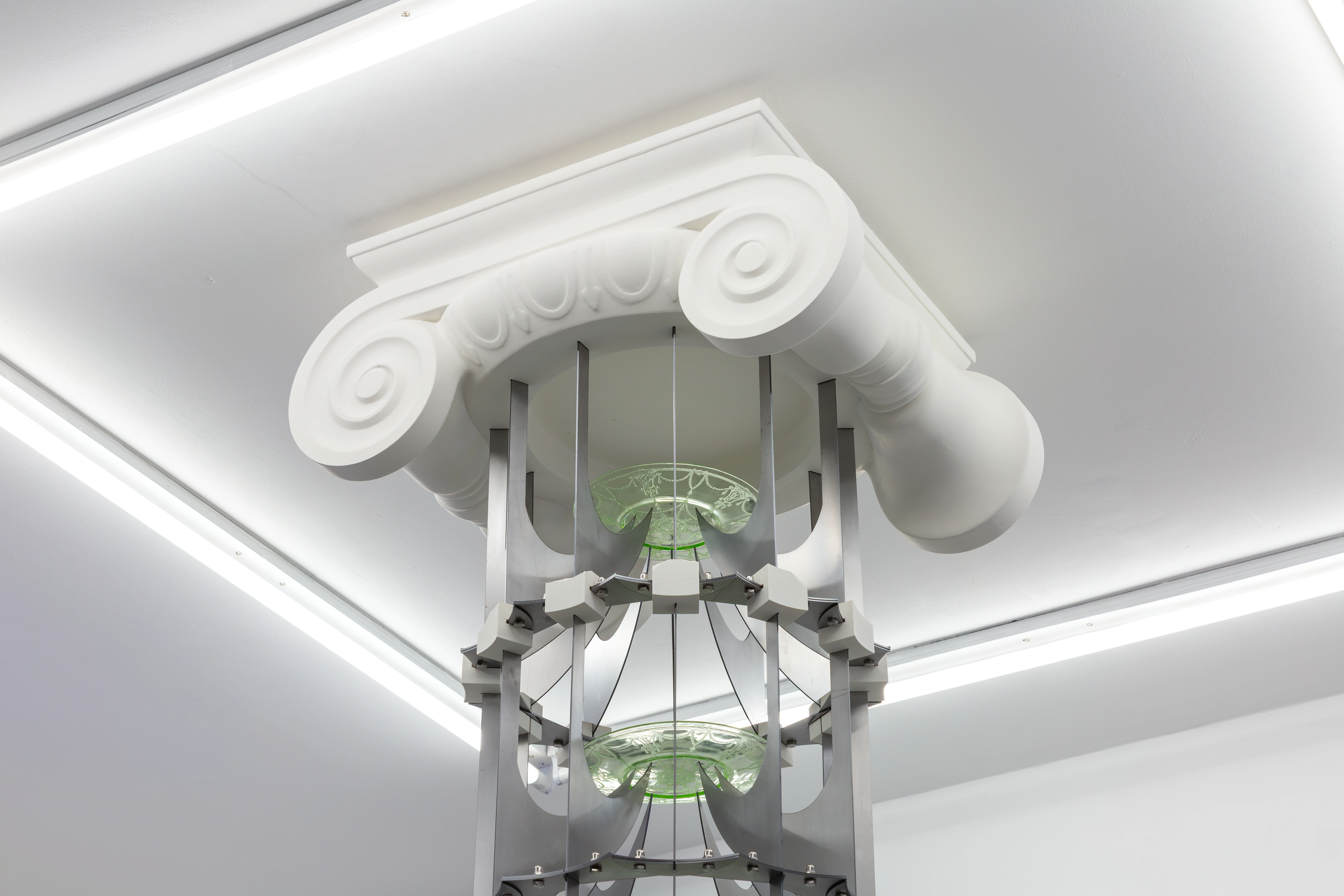
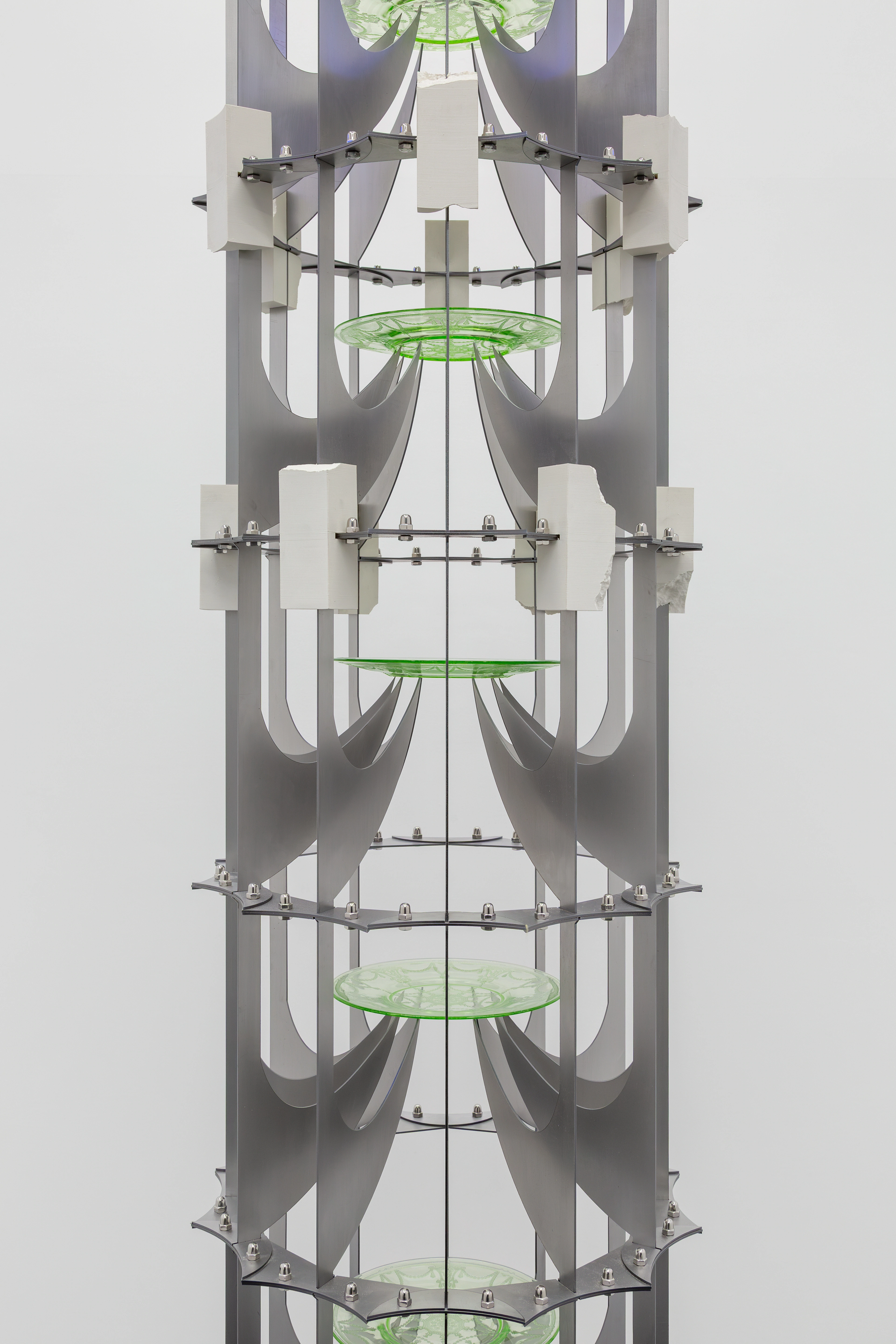
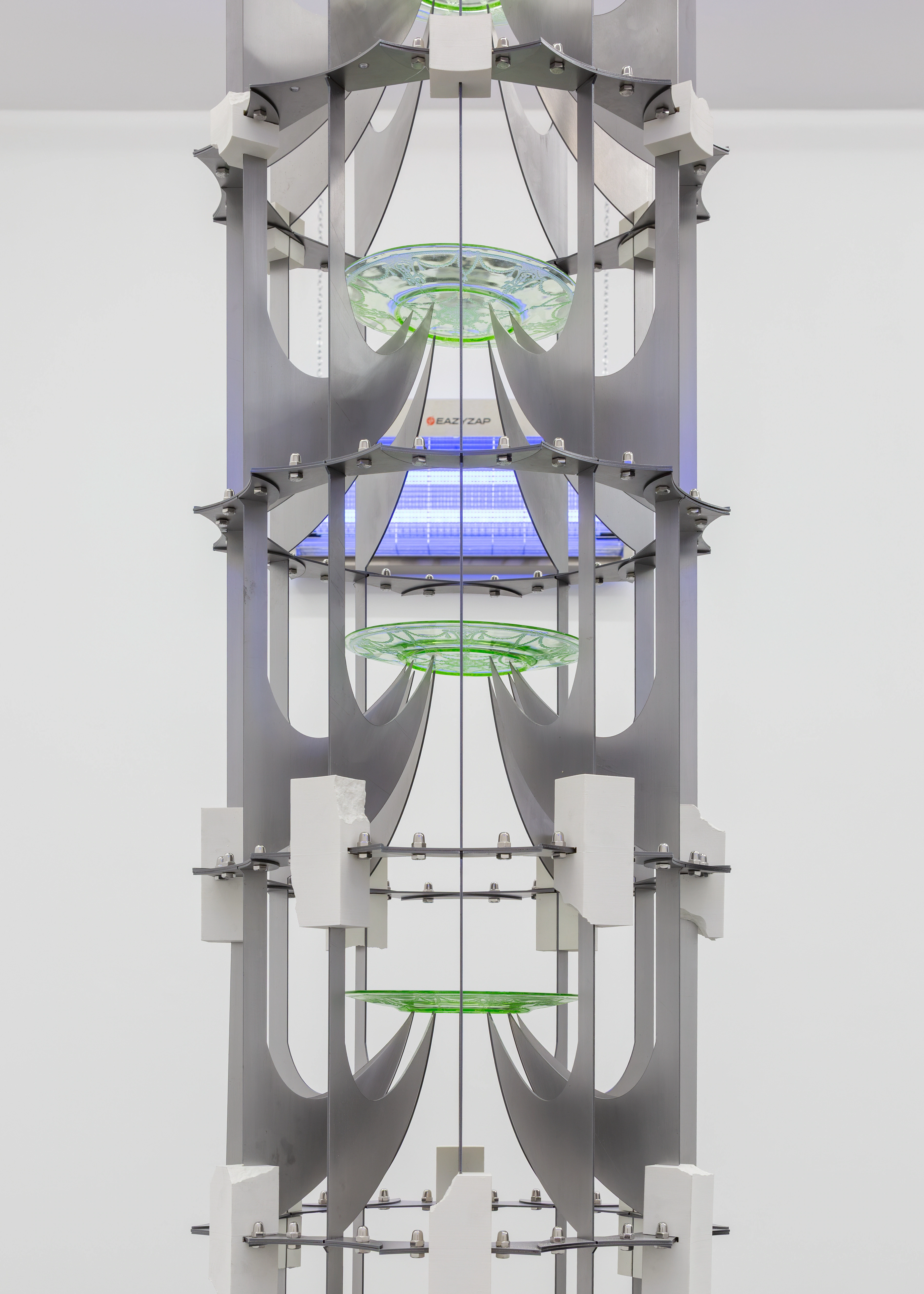
Two columns hold the centre. Cameo Ballerina, a pair in mild steel, plaster and 3D-printed Ionic column tops and bases, each 357 centimetres tall, speaks the neoclassical dialect of the state. The Ionic order emerged in Ionia in the sixth century BC and returned more than two millennia later as the uniform of public authority; Robert Smirke modelled the British Museum’s Ionic columns on those of the temple of Athena Polias at Priene. Mckee’s capitals are printed rather than carved, and the one dislocated onto the floor beside the pair gives the game away, its antiquity cancelled by a material far lighter than it looks. In the curators’ phrase, “This recurring, deliberate artificiality suggests the extent to which said frameworks are themselves synthetic.” The order was always a costume. Here the seams show.
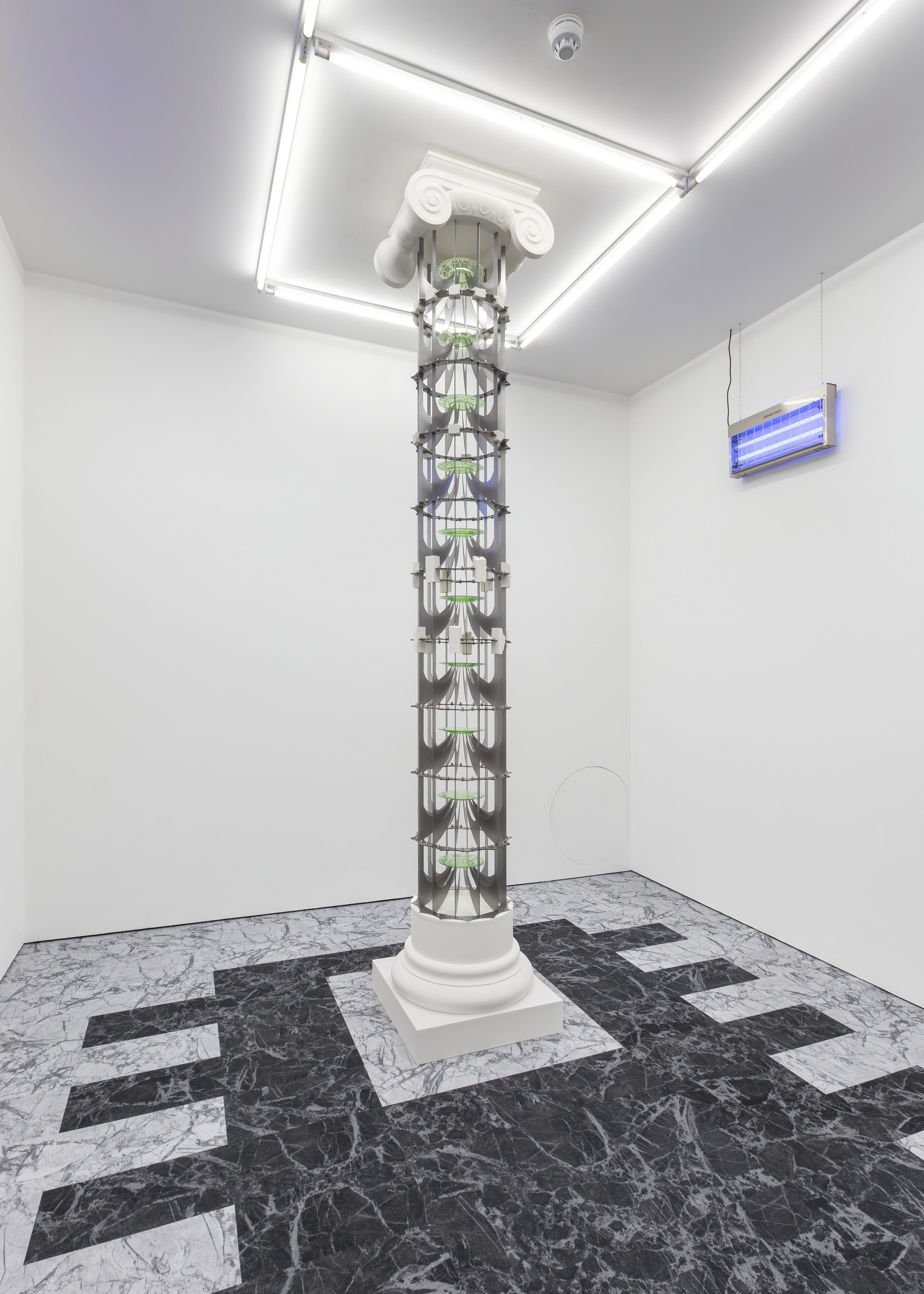
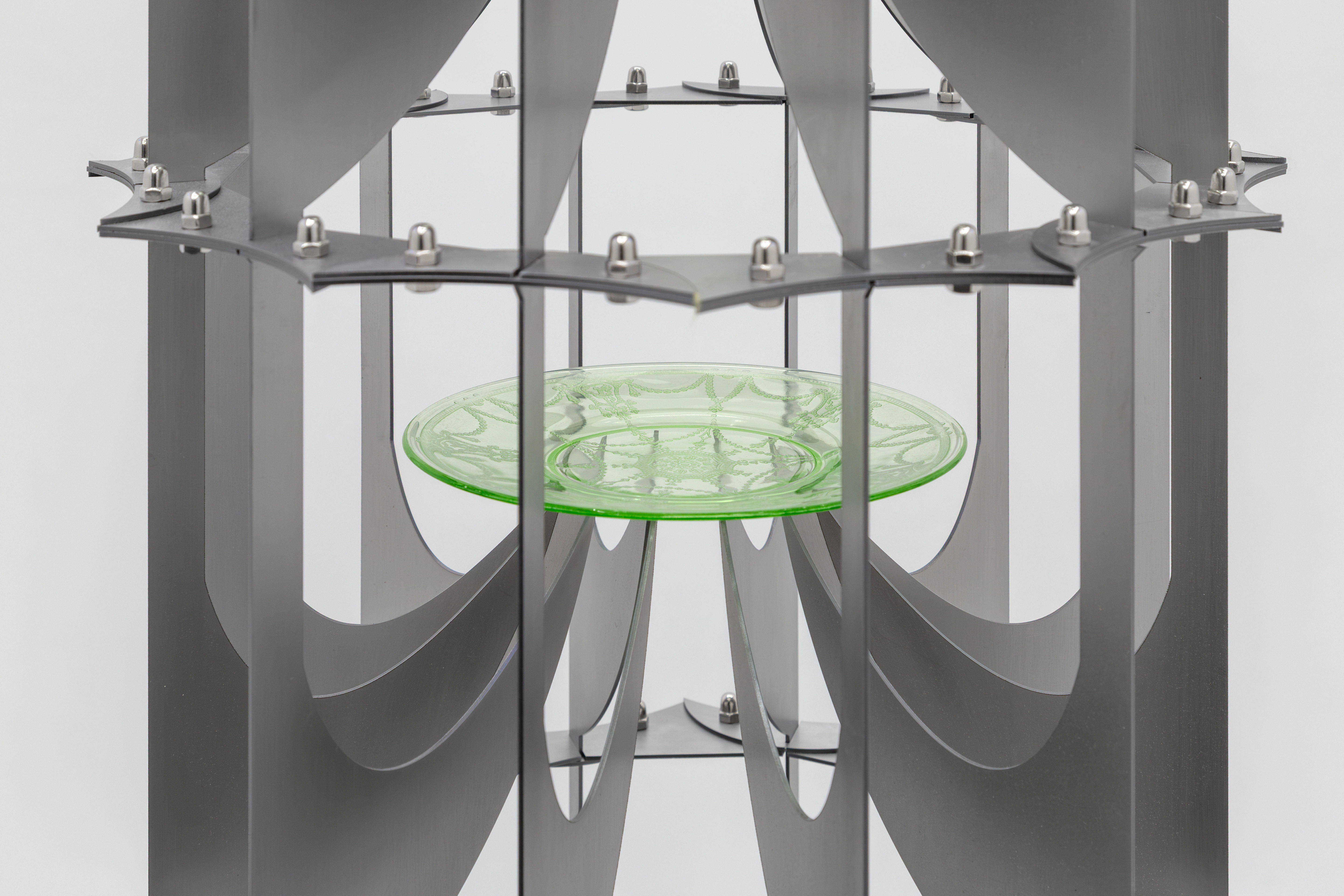
The steel has a second ancestor: Nikola Tesla’s Wardenclyffe Tower, raised on Long Island with J. P. Morgan’s money at the start of the twentieth century to send messages across the Atlantic and, in its larger ambition, power without wires. Morgan stopped paying, and the tower was demolished for scrap during the First World War, a cathedral to a current that never flowed. Grafted onto the Ionic order, the tower’s form makes the columns look like machines for gathering or sending energy. Two pieties, classical virtue and technological salvation, share a spine. Where a power source ought to be, there are salad plates: vintage uranium glass, stacked into the steel brackets at the centre of each pillar.
Uranium glass is a material rewritten by every decade that handled it. A byproduct of radium extraction, it turned up in tableware and ornament through the 1920s and 1930s, cheap decor that fluoresces green under ultraviolet light. Then the bomb needed the uranium. In the United States, supplies went to the Manhattan Project from 1942 and stayed restricted well into the Cold War; production fell away. After Hiroshima and Nagasaki, as Digby Warde-Aldam writes in his essay for the show, “nobody much wanted it in their living room”. Ornament, then ordnance, then something stranger: Mckee sets these orphaned dishes into her columns like cells in a battery, decor drafted once more into the service of power.
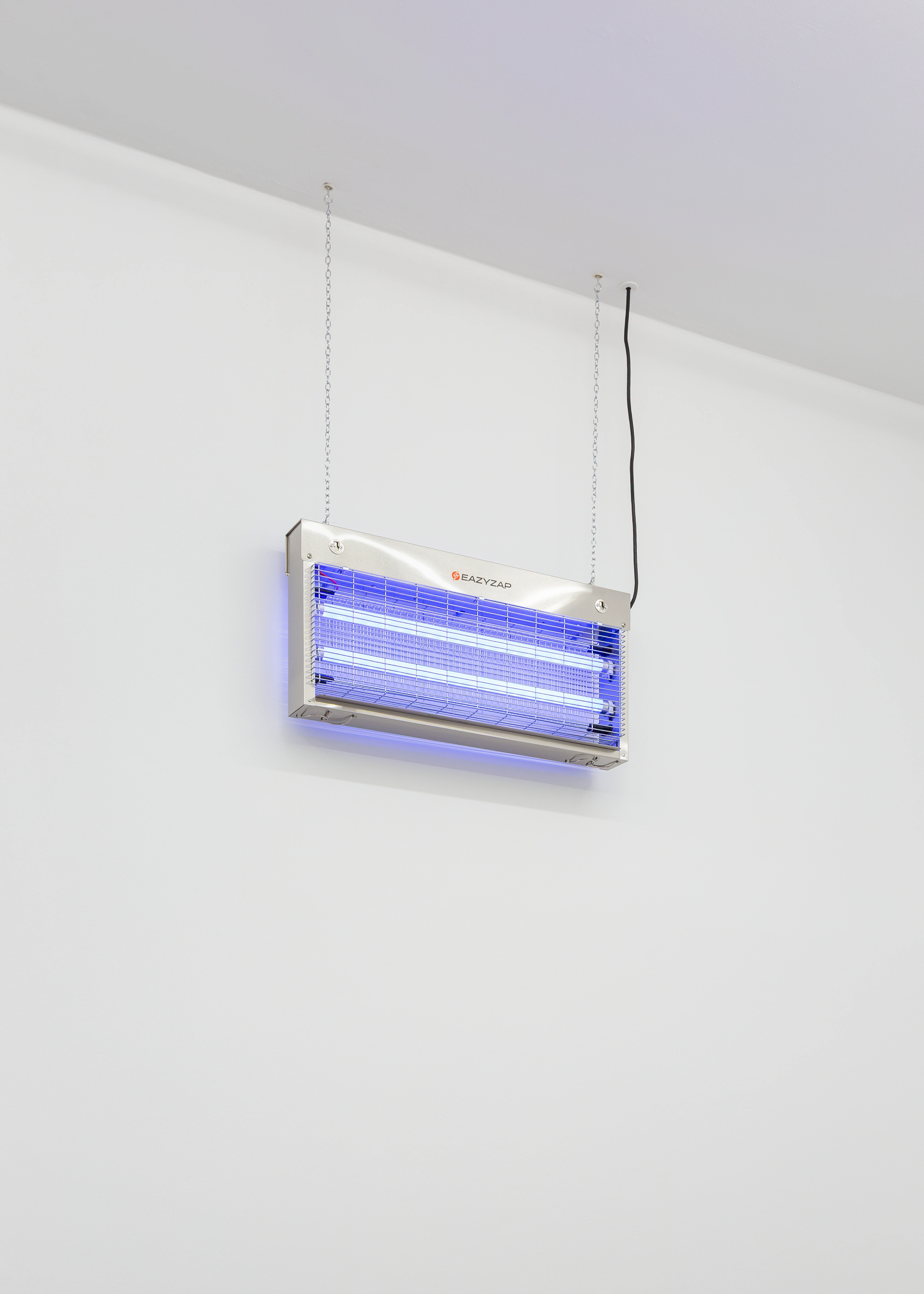
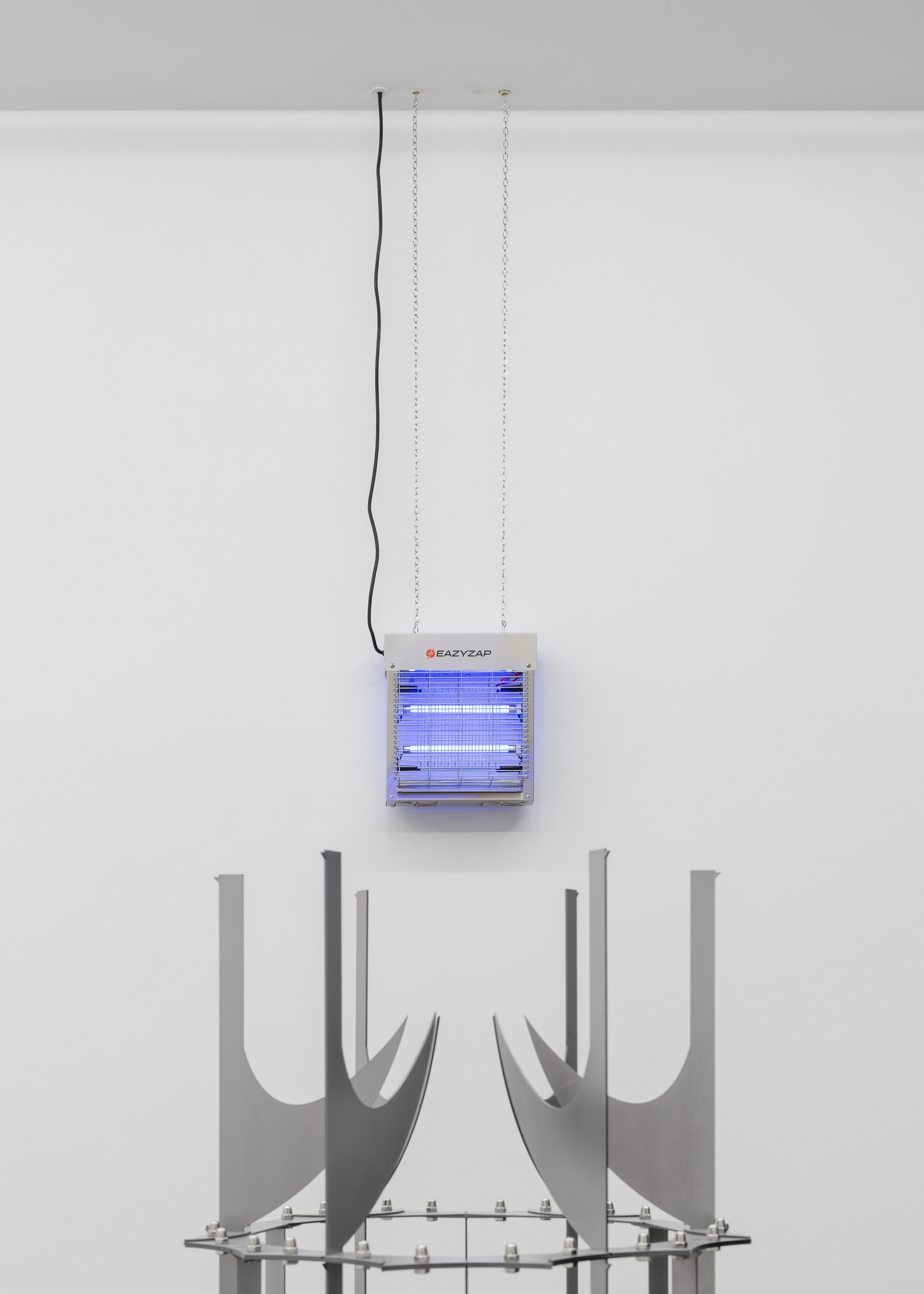
The light does the rest. The industrial insect lights installed in the space emit ultraviolet at 365 nanometres, the wavelength insect eyes answer most strongly and, by coincidence, the one used to test uranium glass for purity. An appliance built to lure and kill becomes the instrument that makes the plates confess. The title sharpens the joke. A solarium was first a room for taking the sun; the word has since come to mean the sunbed as well, a machine that sells ultraviolet to skin, and 365 nanometres falls inside the UVA band such lamps rely on. Mckee’s sun belongs to the same family, but its congregation is insects, and its blessing is fatal.
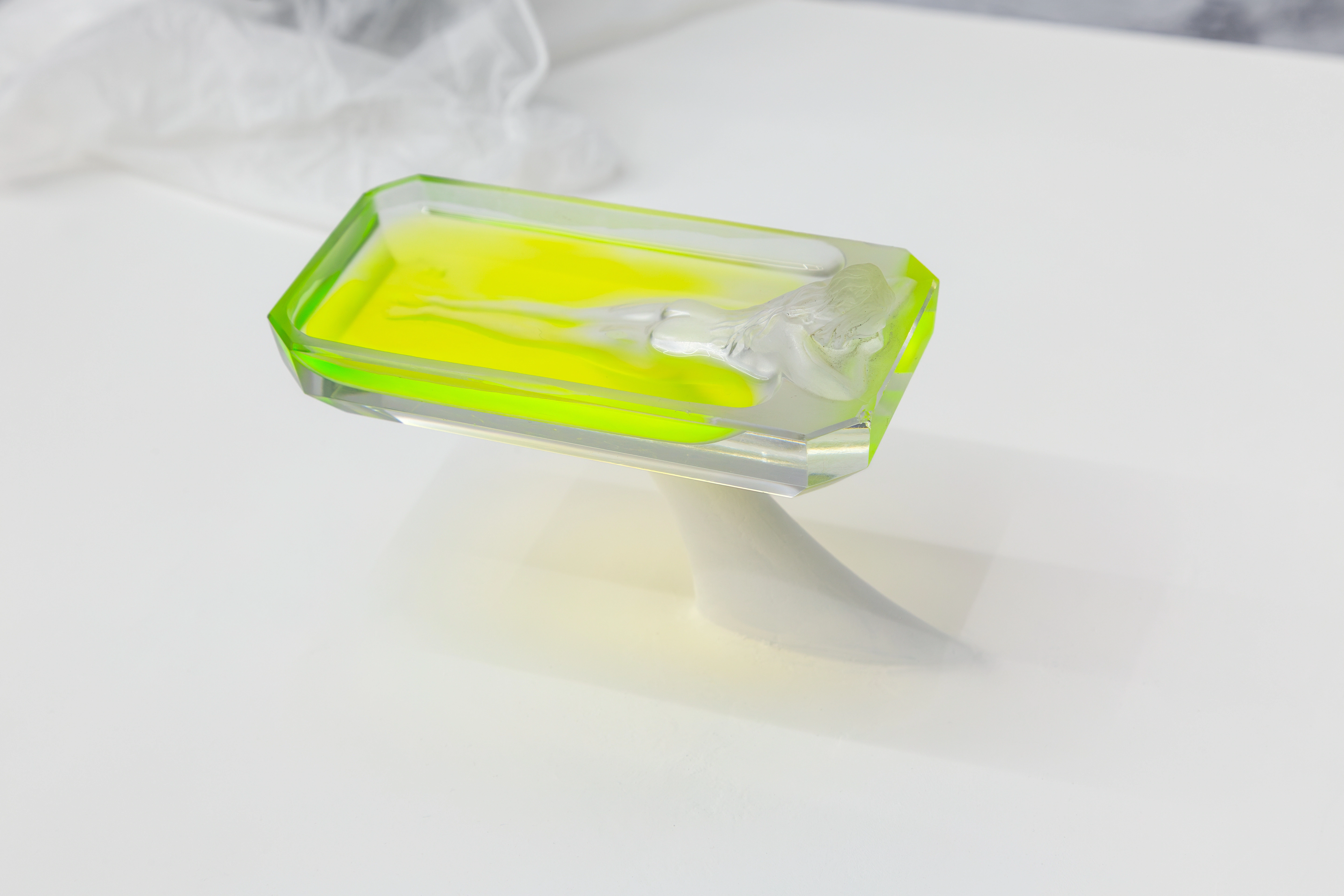
Meditation folds the same logic into a smaller devotion. Above the 3D-printed column top on the floor floats a 1928 glass pin tray known as Girl in a Pool, filled with Monster energy drink. Riboflavin, plentiful in the drink, fluoresces under the same ultraviolet, so the soda glows in kinship with the plates. A dressing-table vessel for hairpins becomes a votive bowl for a drink sold in the idiom of the slasher film, poised over the fallen fragment of an order. Warde-Aldam reads Monster as capitalist subversion that offends good taste on purpose, and his essay ends on the question the room keeps asking back: “who is really the Monster here?”
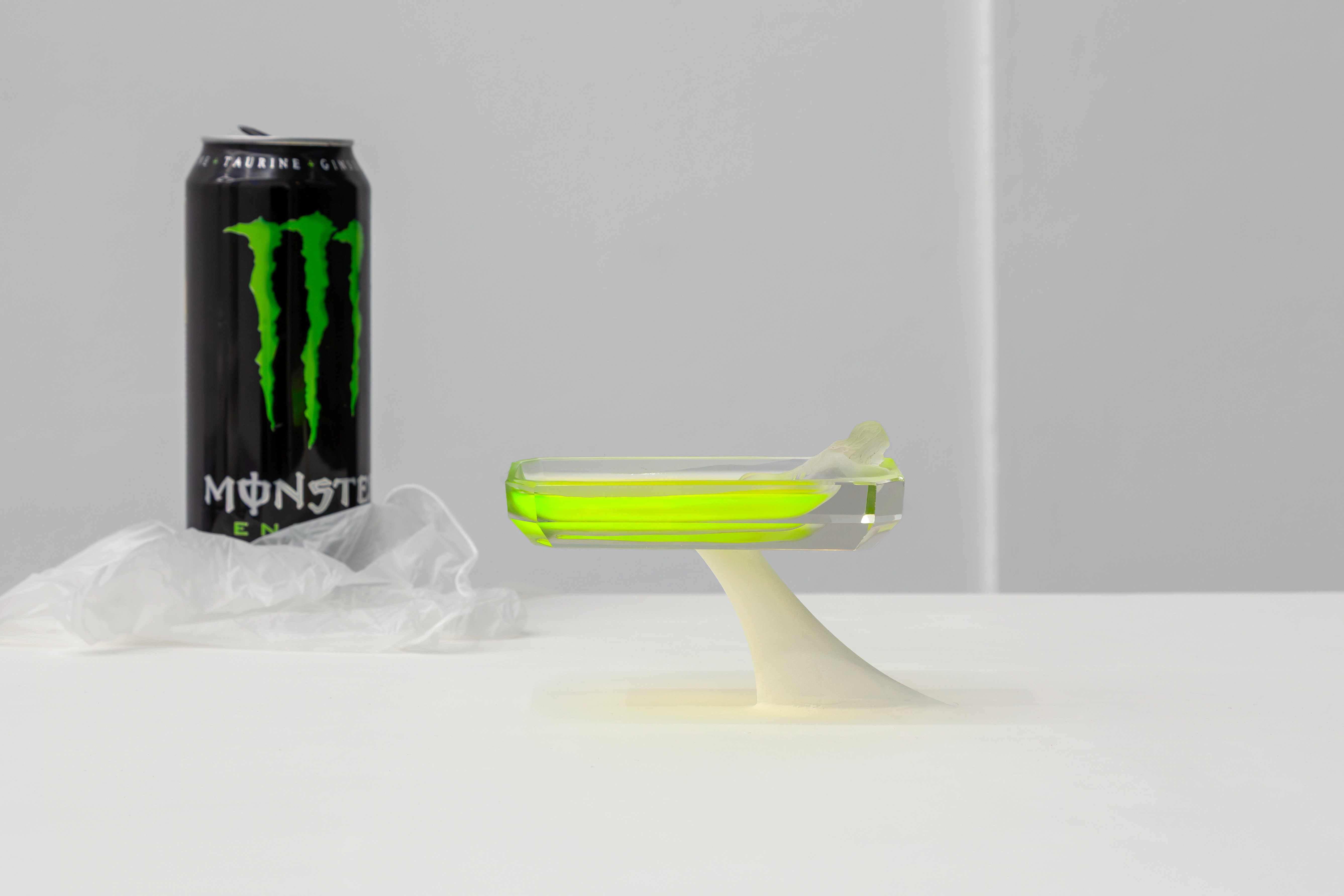
Glowing green is a learned fear. The radiation trefoil, drawn up at the University of California’s Radiation Laboratory in Berkeley in 1946, was first printed in magenta on blue; cartoons did the rest, until phosphorescent green meant contamination on sight. Glass like this was mostly made before that lesson was taught, as ornament, and it is read after it, as threat. Nothing in the material has changed. The hostility belongs to the frame: the appliance designed to kill, the tableware that looks like poison, the luminous drink, and behind them the authoritarian habit of co-opting aesthetics, borrowing the poise of the column and the glamour of the future so that power can pass for nature.
Against all this, the soundtrack offers comfort, storm ambience as soft as the stone has been made, and the comfort is part of the trap. The setting never settles. It holds, as Kollektiv Collective write, “the liminality of a display window, the sterility of a laboratory, and the surrealism of a simulation”: a shop that sells nothing, an experiment without a result, a world rendered rather than built. A fourth work, 40524839 continued, in plywood and paint, offers only a number for a title. Each element changes meaning with its frame. Legitimacy rests on contradictions it cannot afford to show, and Solarium drags them into the ultraviolet.
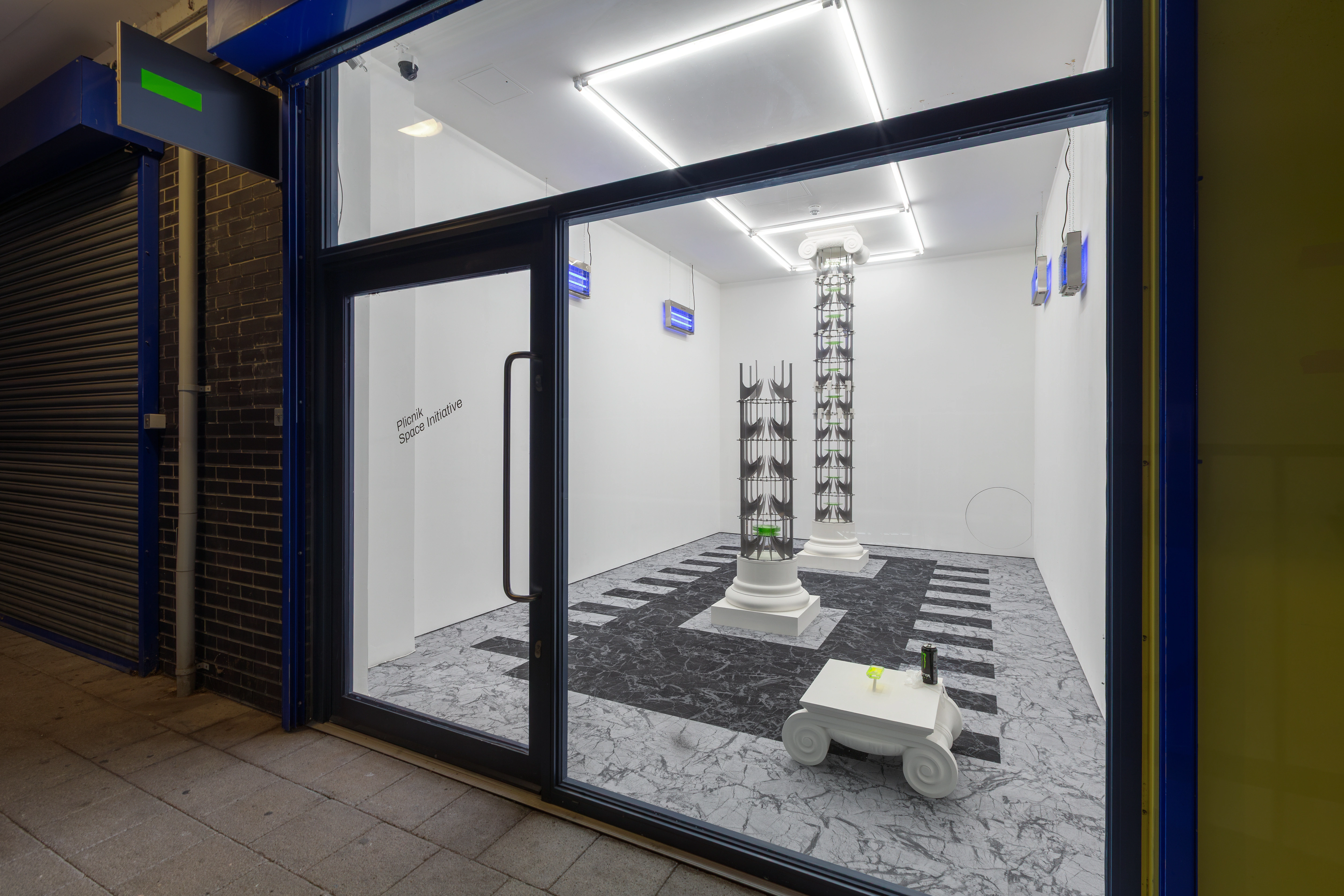
A solarium sells a sun on demand: warmth without weather, radiance without sky. Mckee’s keeps the promise and withholds the mercy. The marble is carpet, the capital is printed, the plates are salvage from an atomic century, and under a light designed for killing, all of it glows. Not a temple, but a lure built in a temple’s image. The insects have always known what the light is for. Everyone else is still deciding.