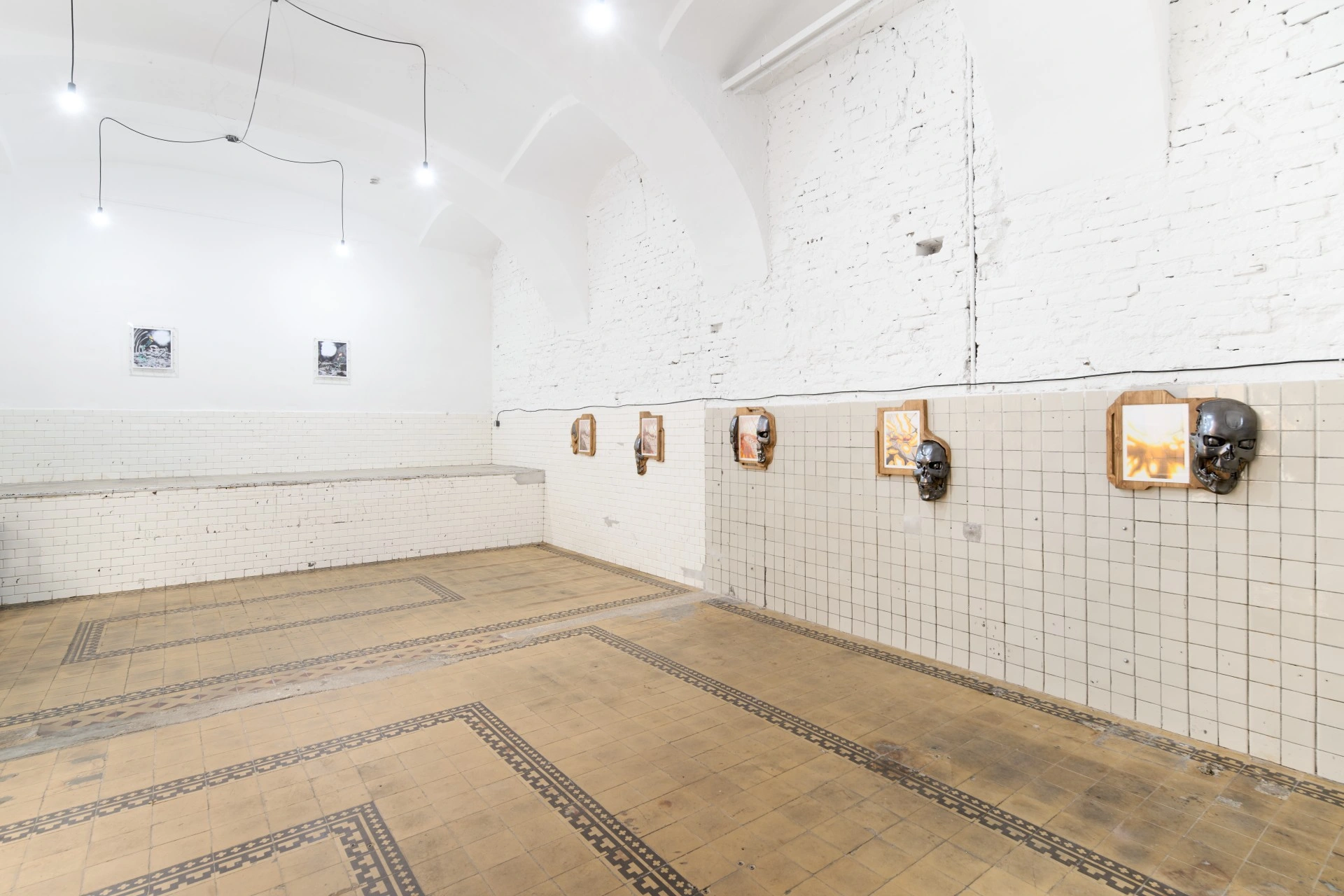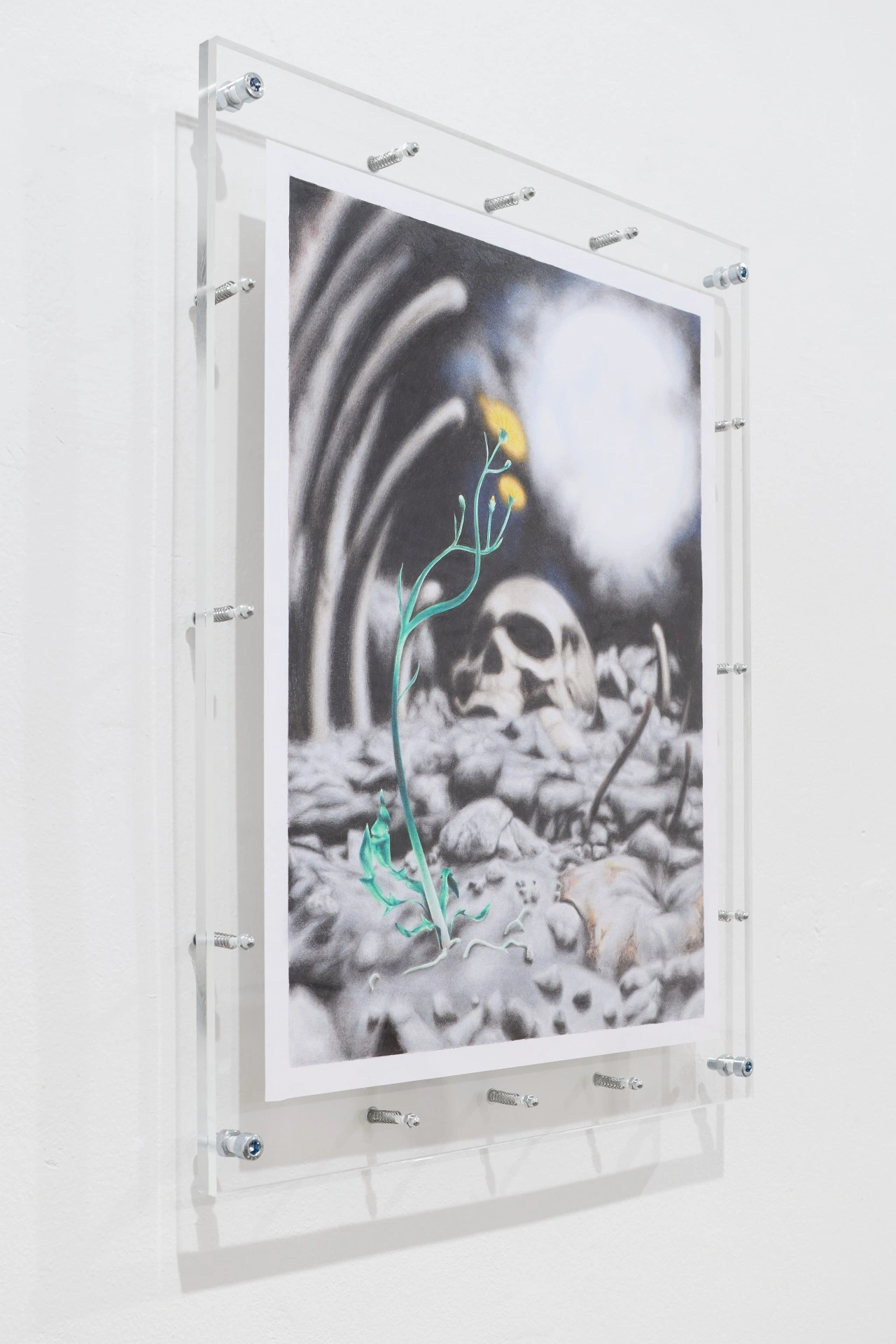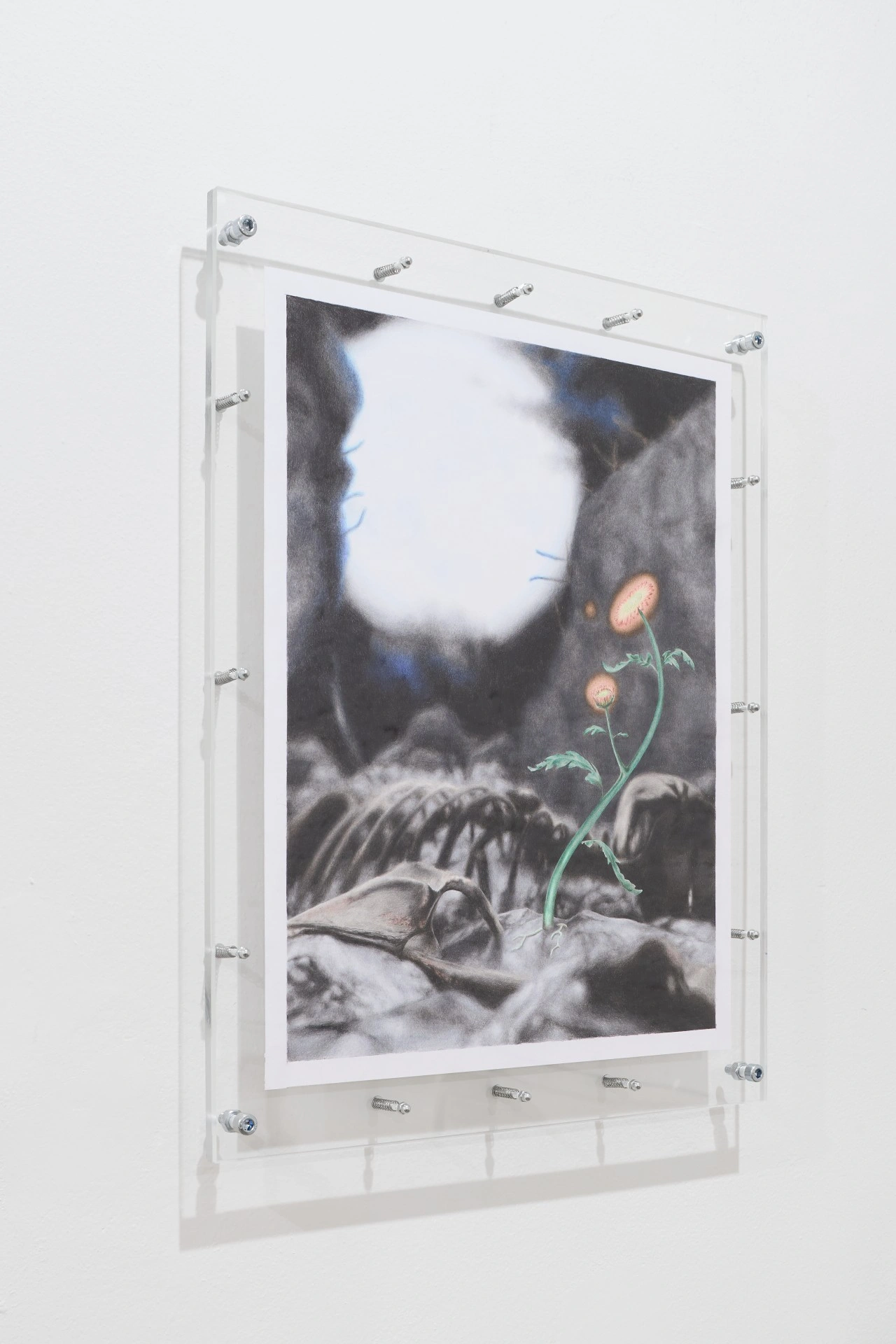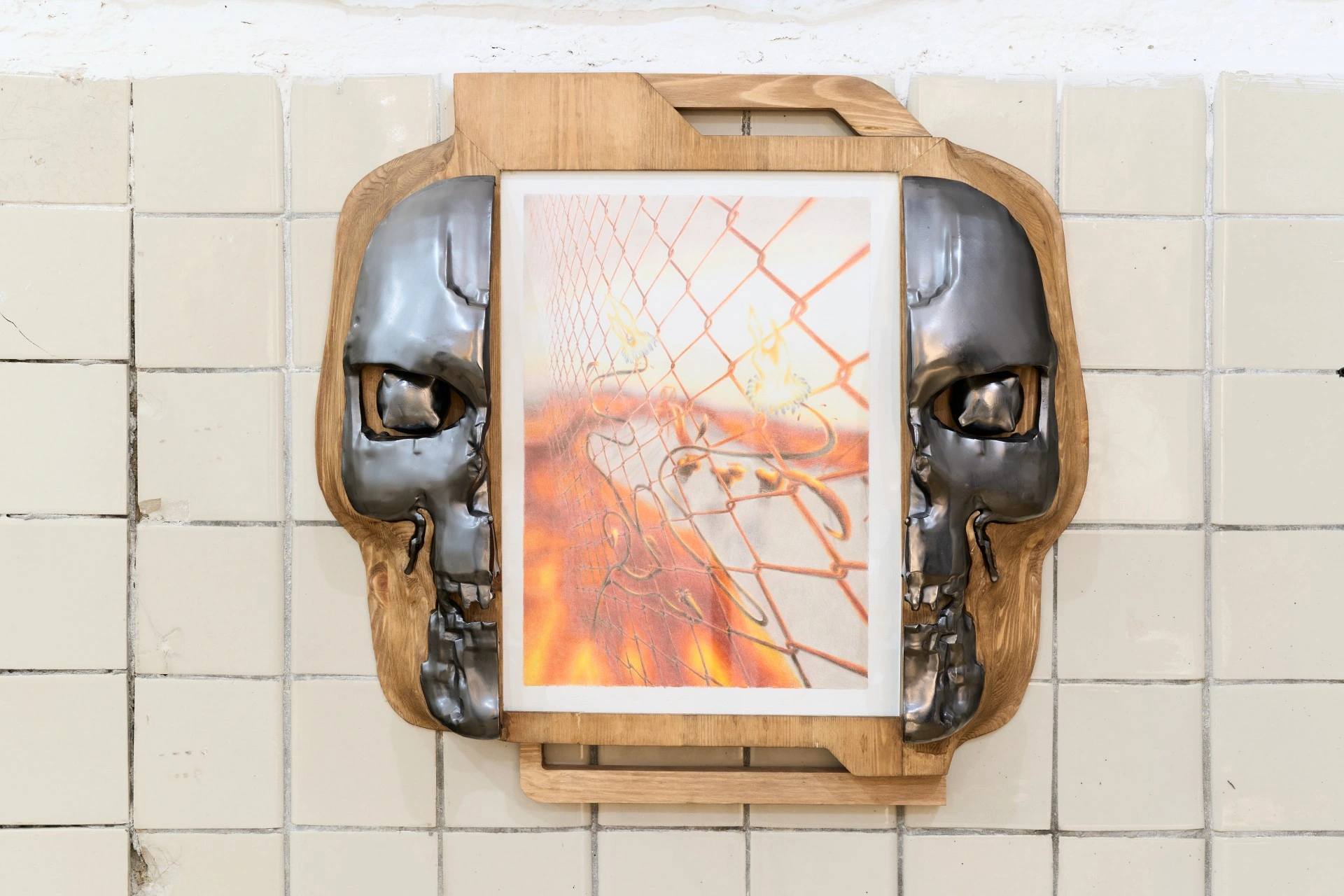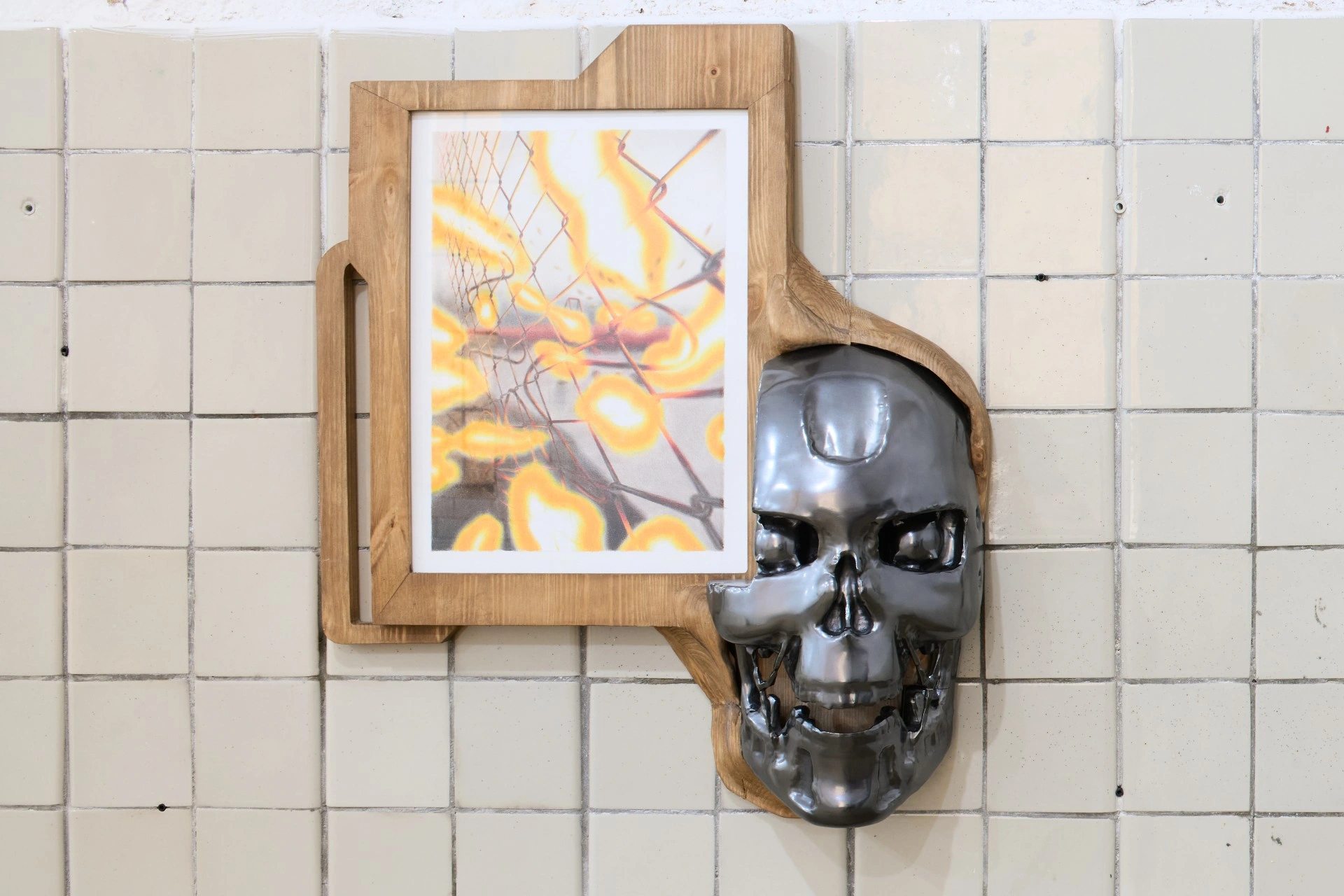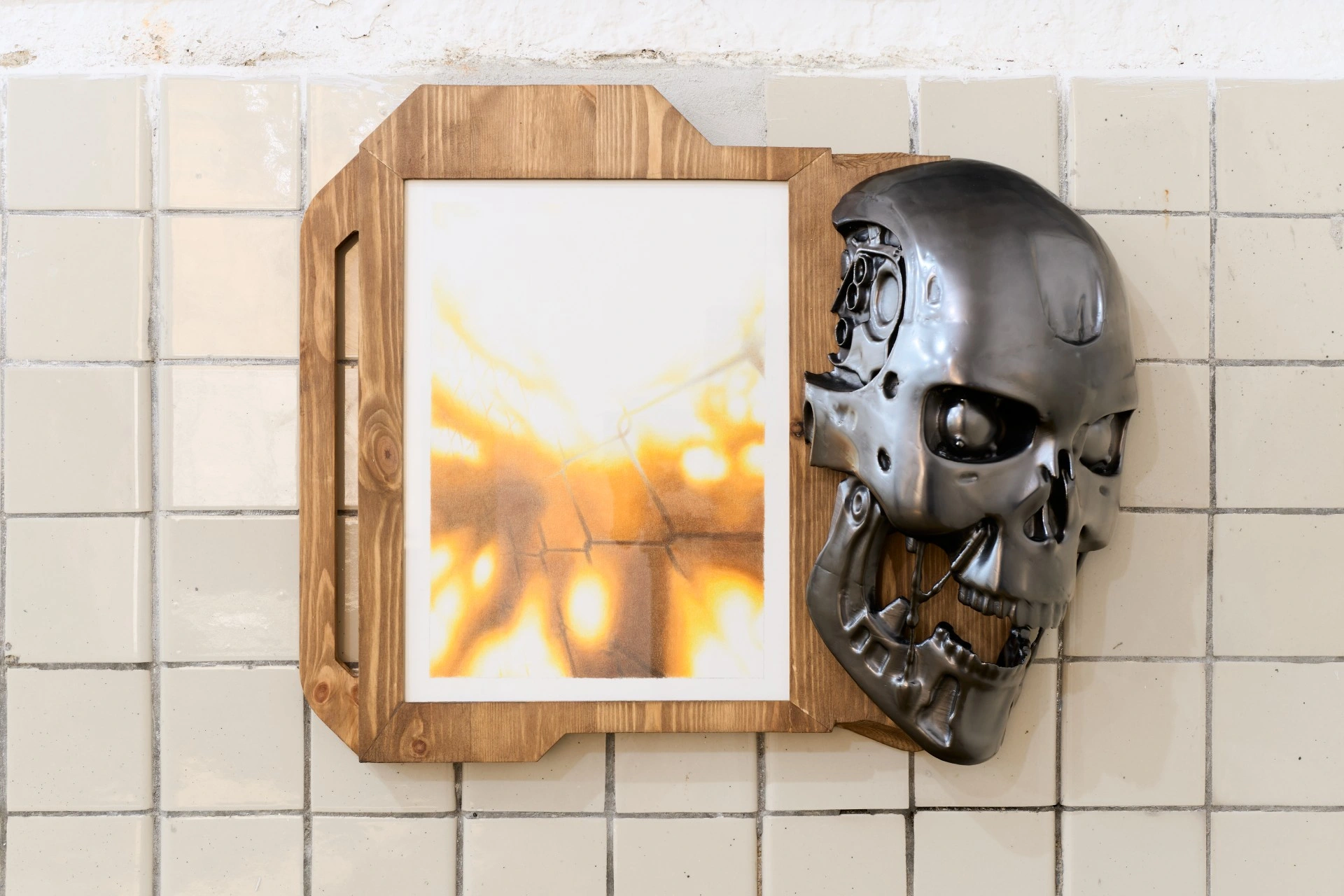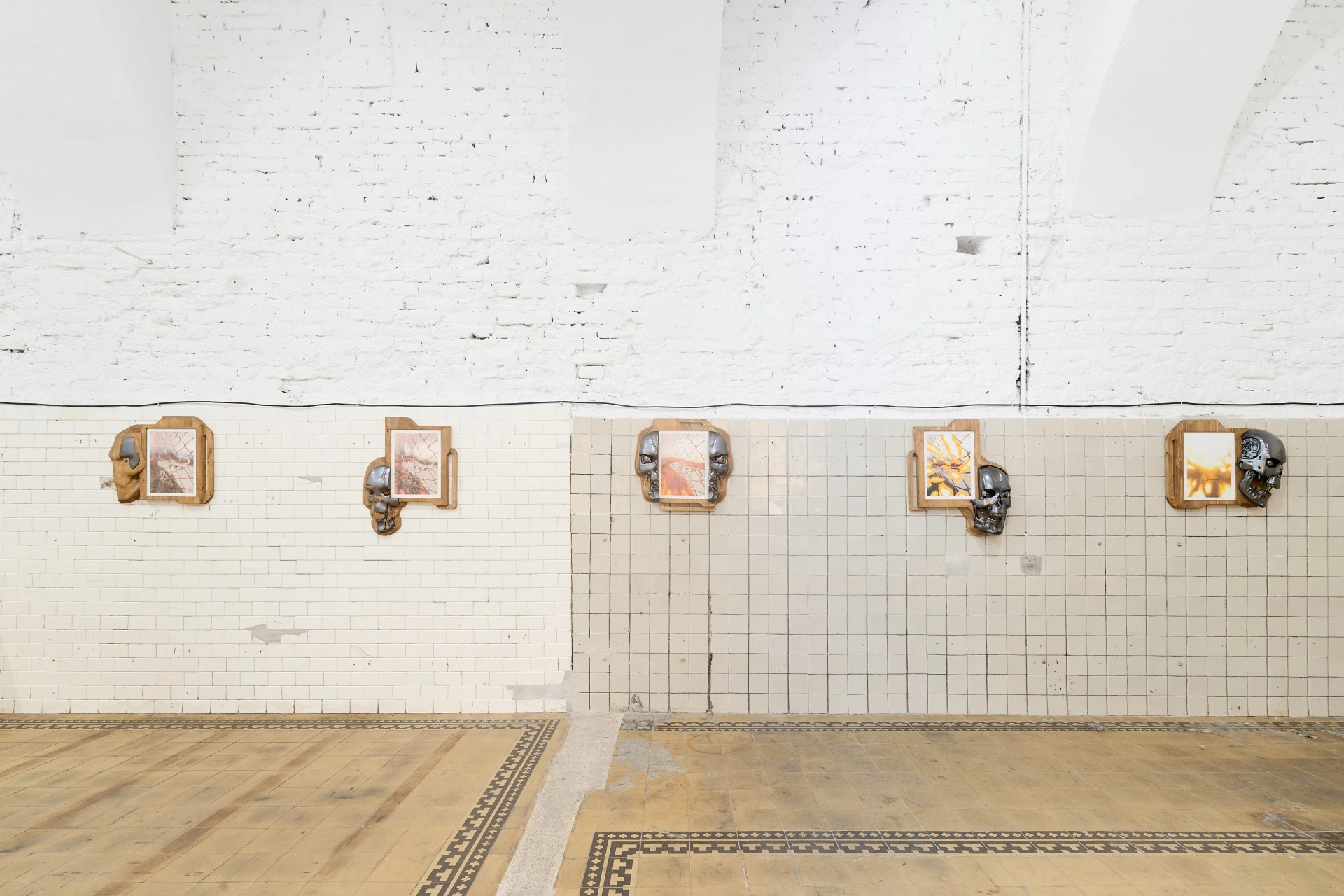
In a former bathhouse lined with cracked subway tile and encaustic floor patterns, Tristan Gac hangs a row of chrome skulls that refuse to finish dying, each one gripping a drawing of the world on fire at Galerie FaVU in Brno.
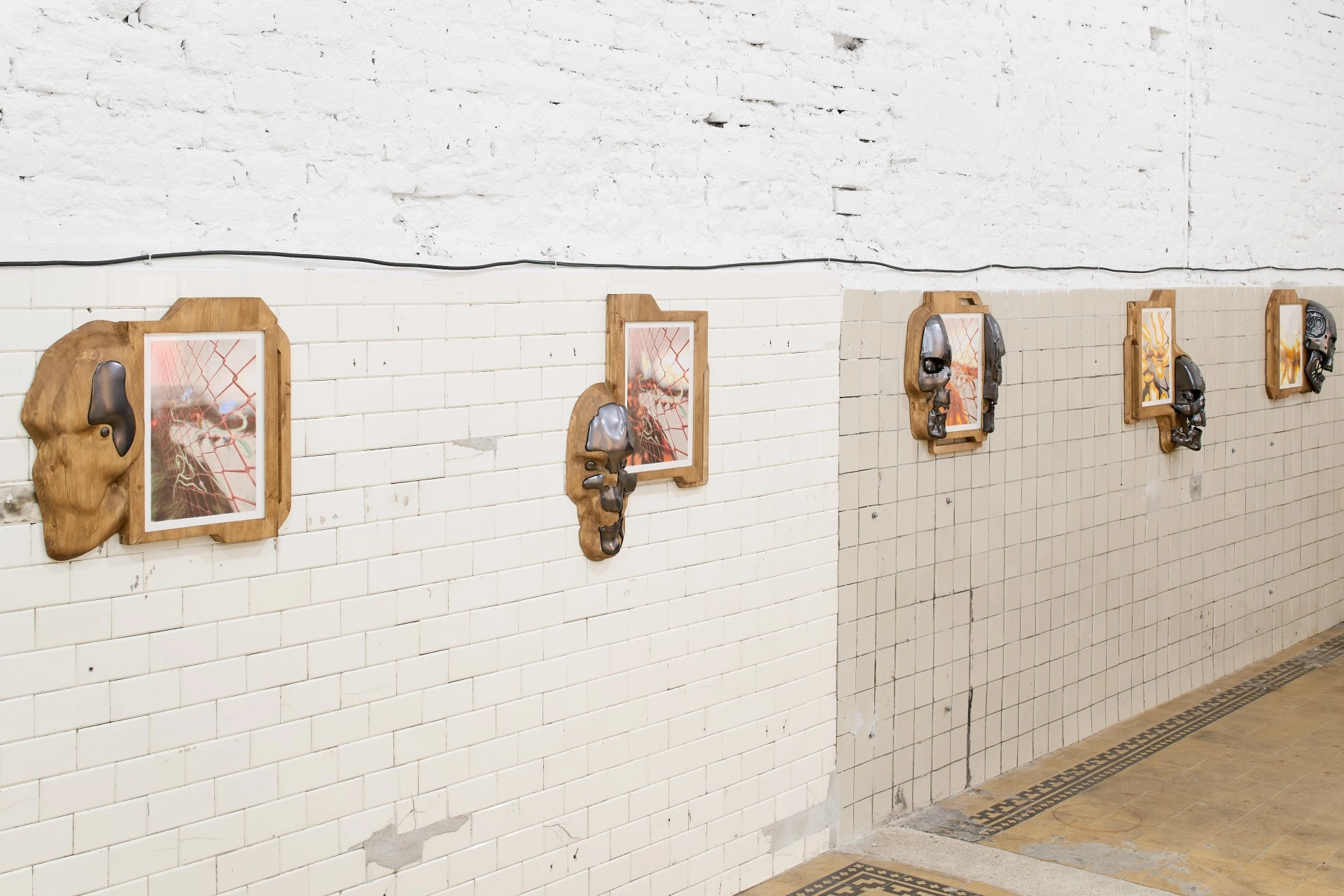
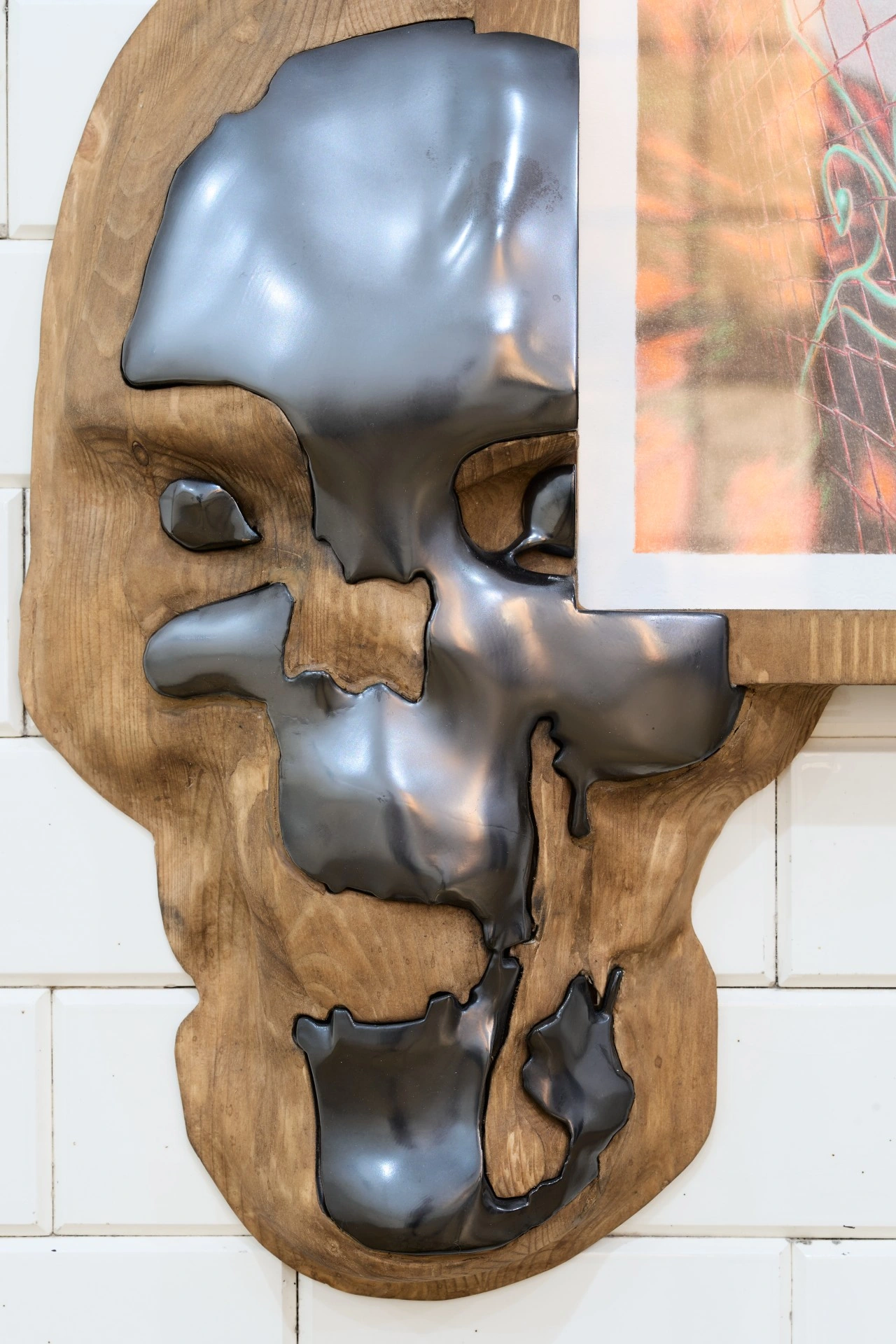
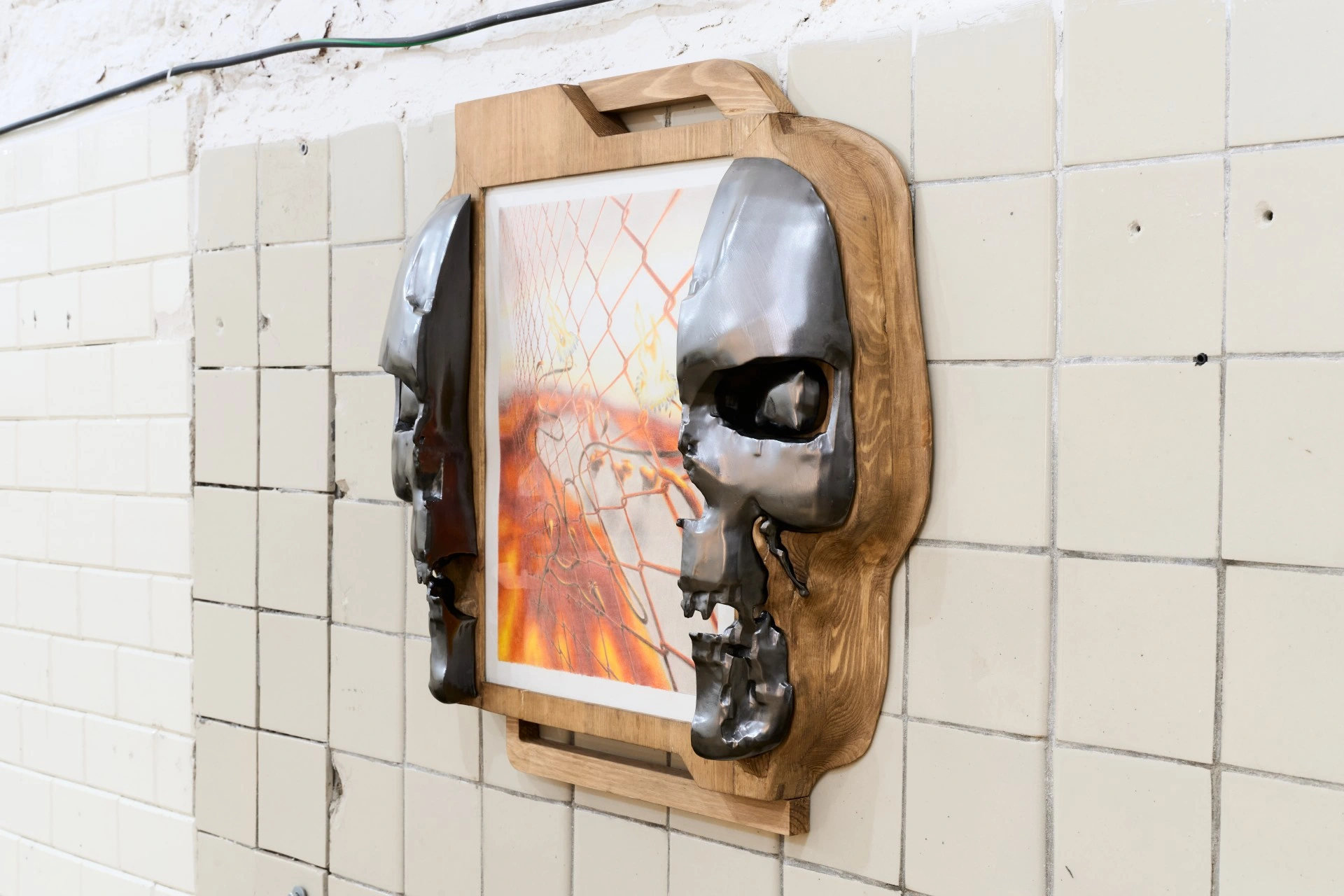
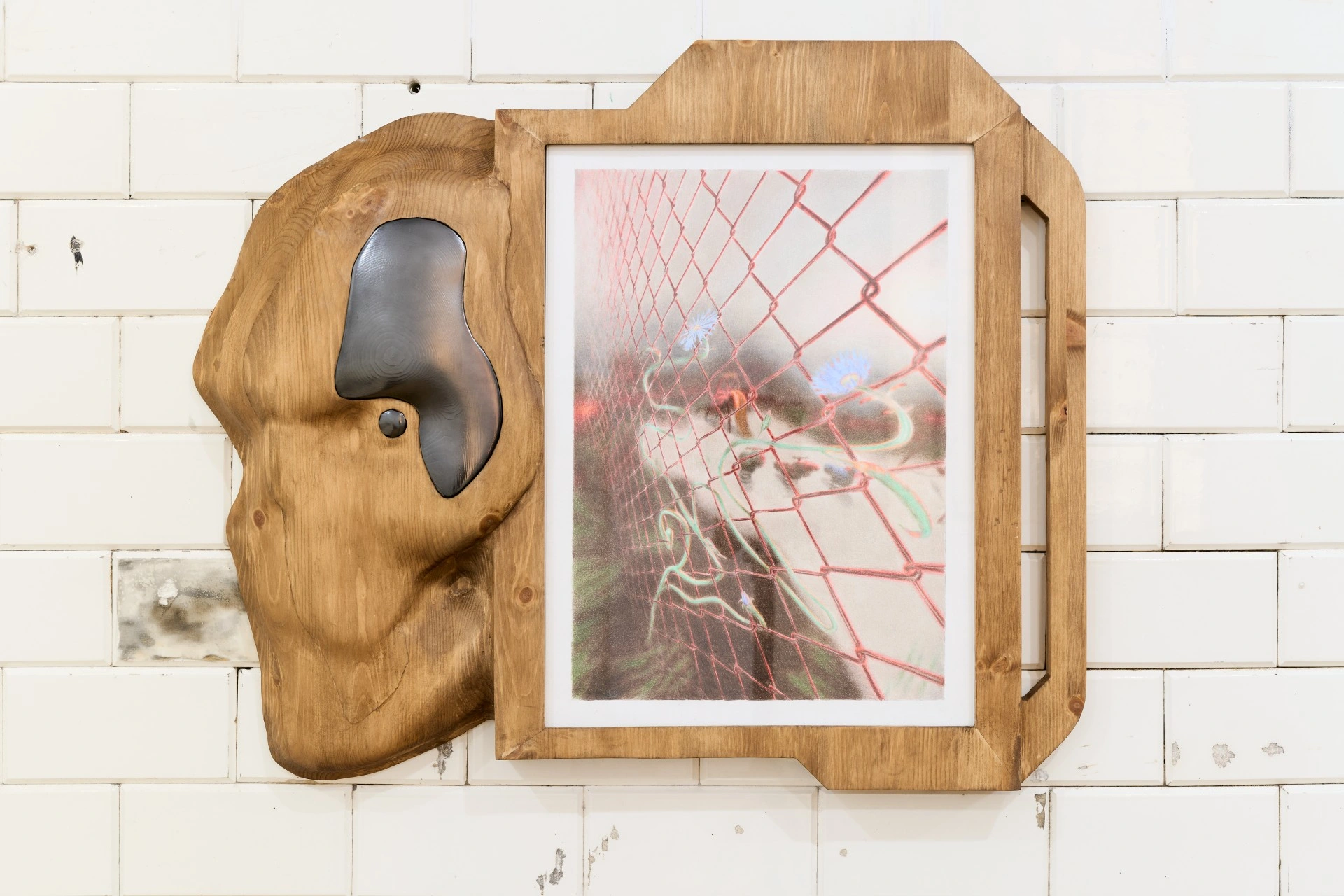
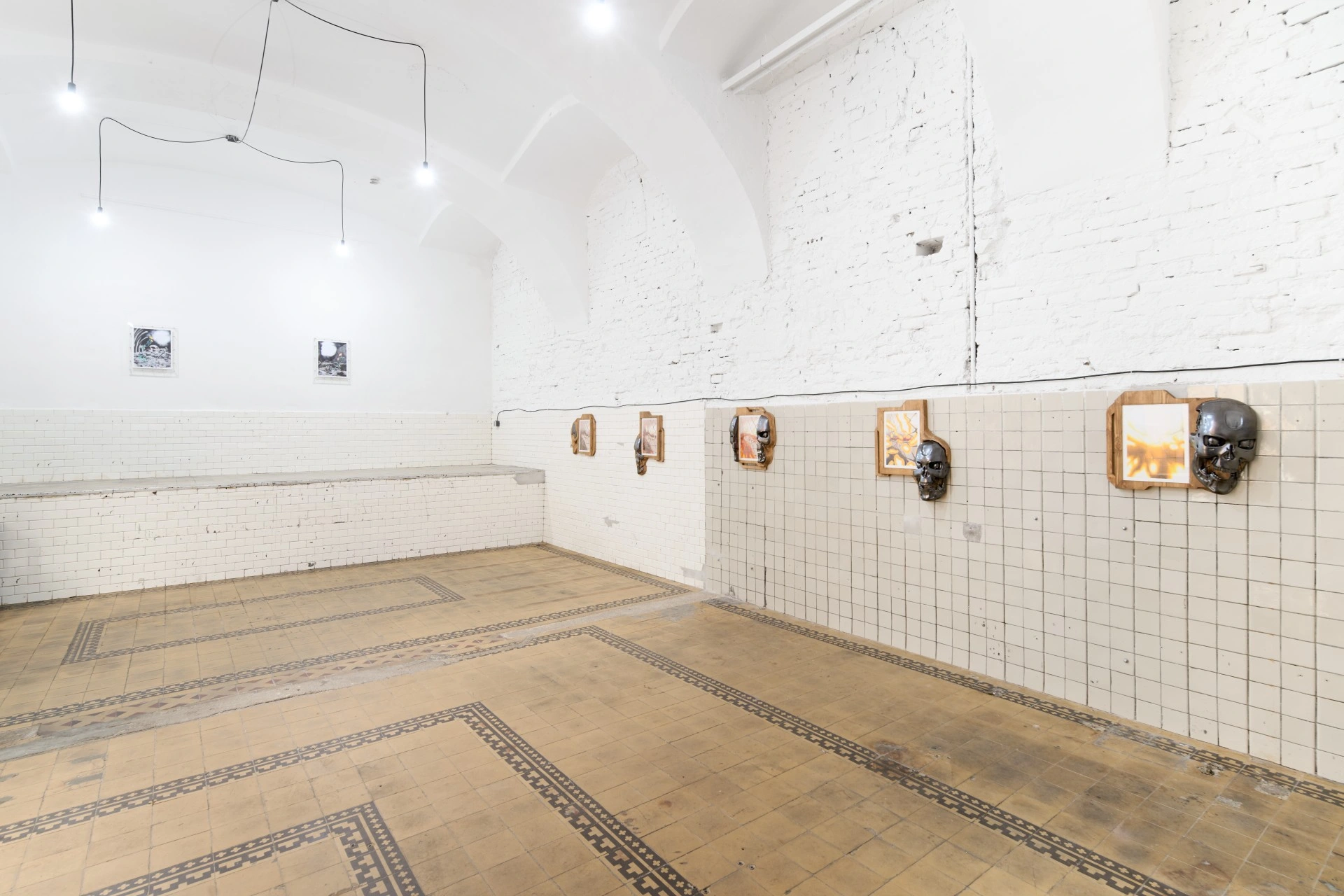
The room does half the work before a single drawing is read. Whitewashed vaulted brick above, white tile wainscoting below, a floor of worn ochre tiles laced with a dark meander border: a space built for water and hygiene, now dry and clinical, faintly funereal. Along the tiled register the works hang low, at the height of a body rather than an eye. Each is a slab of raw pine, live edge intact, carved so the grain swells around a cast metal skull that seems to have been poured into the wood and left to set.
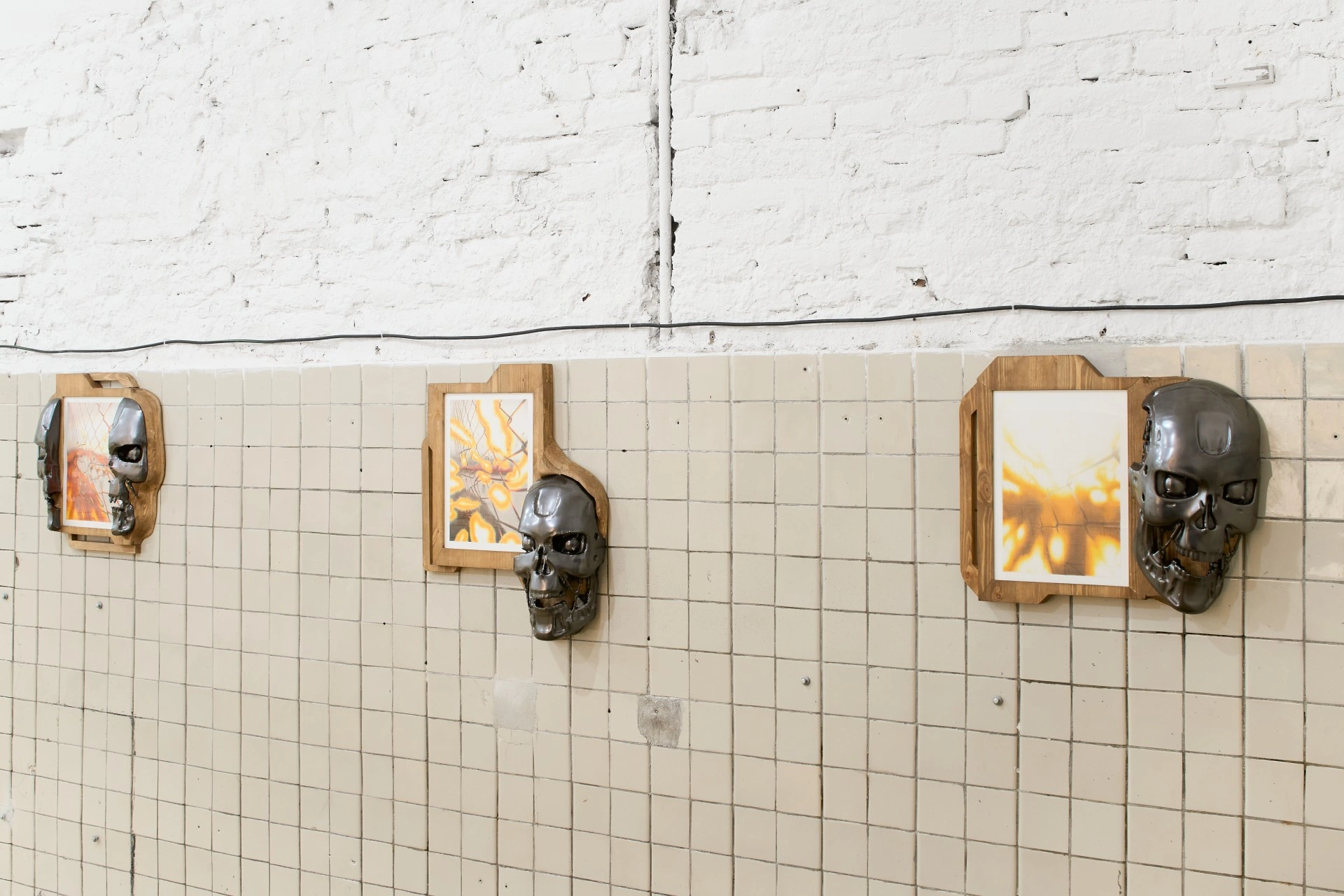
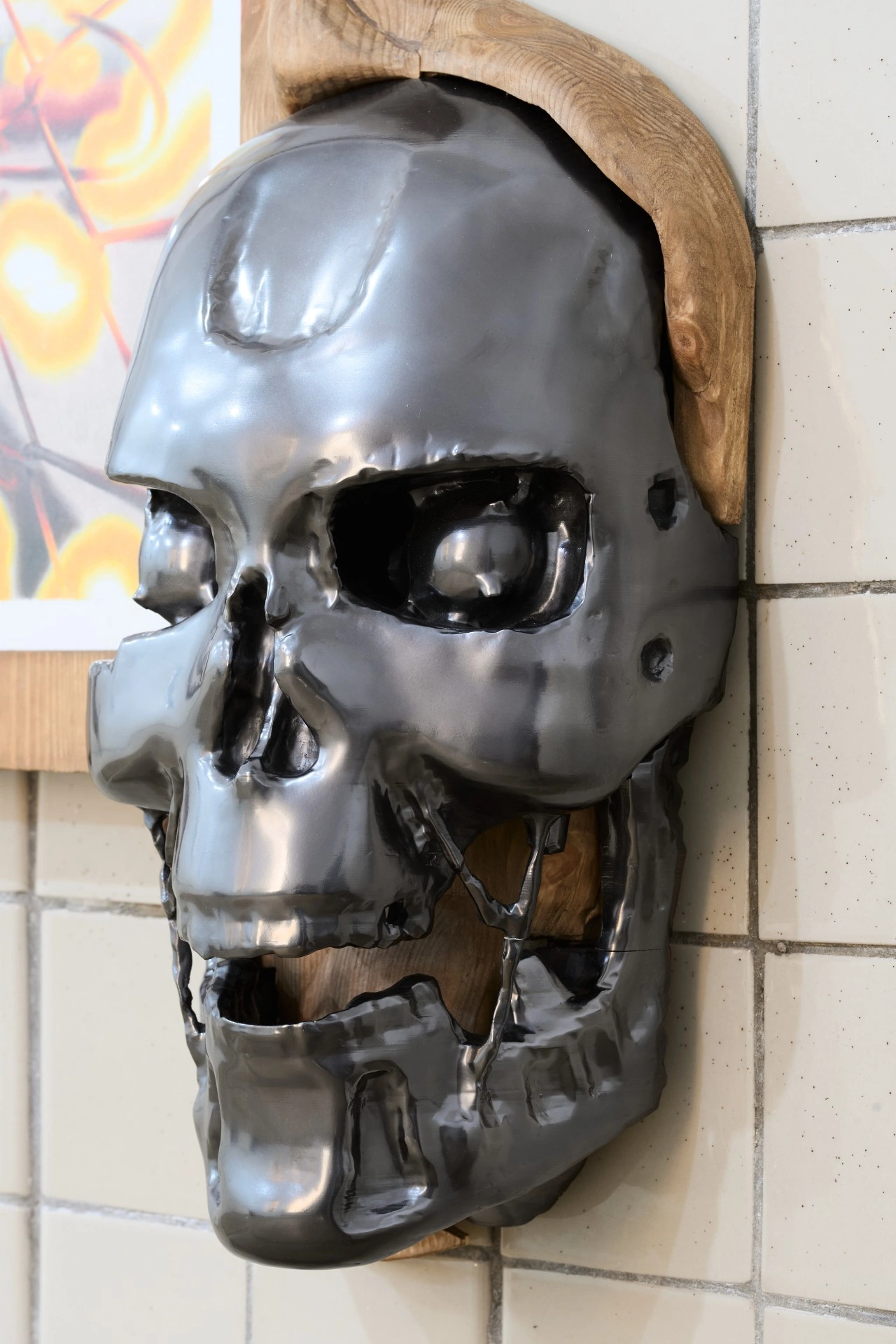
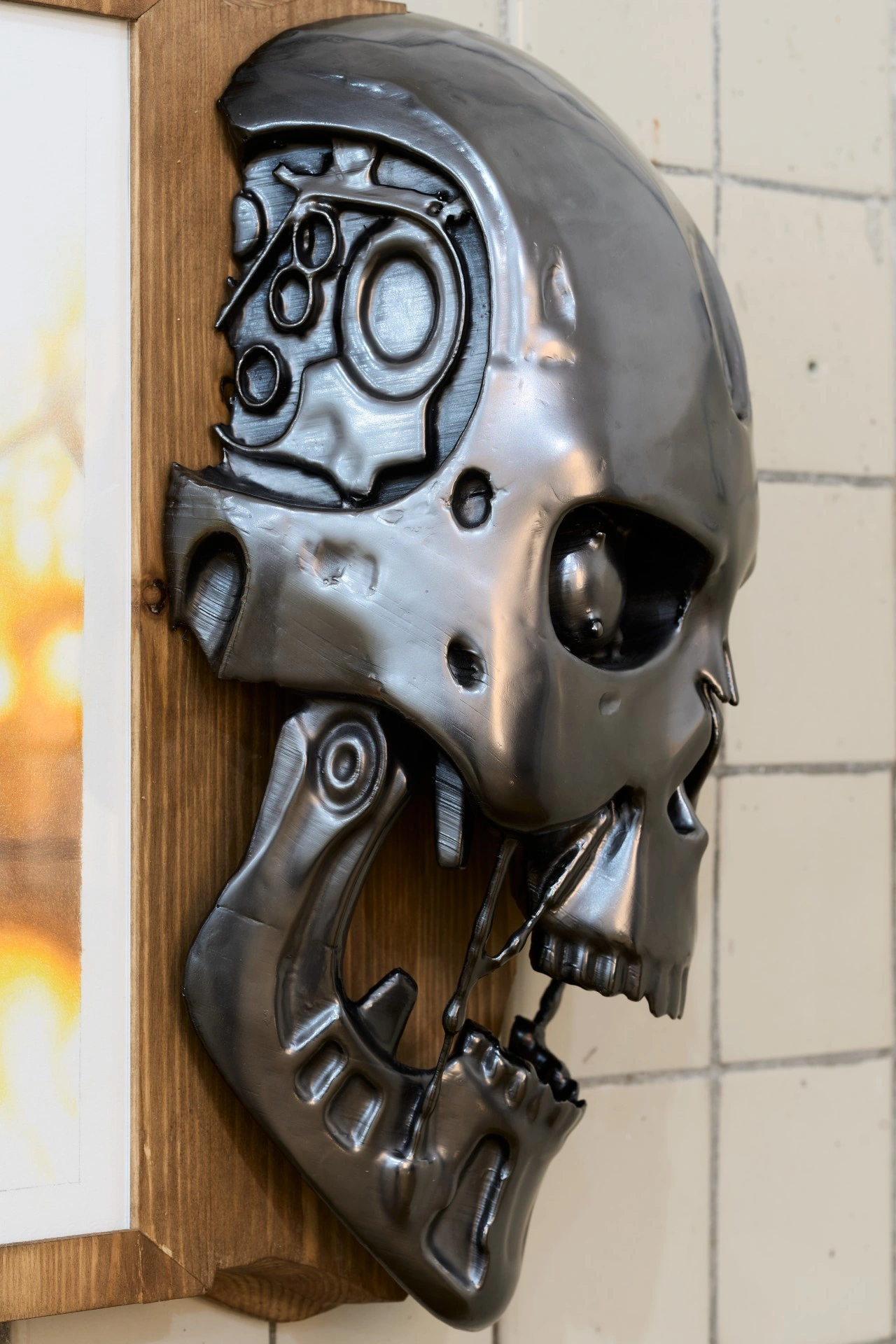
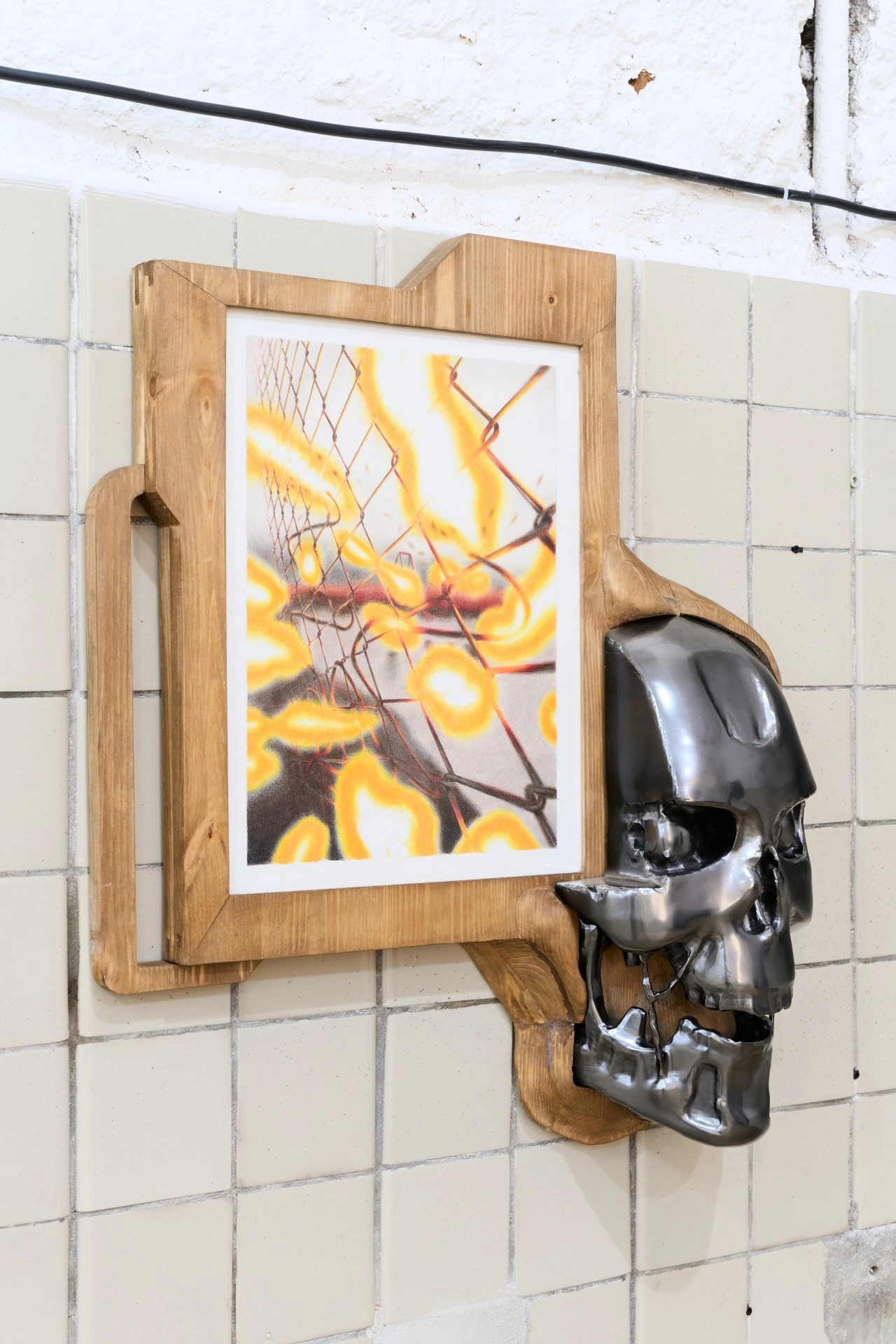
The skulls are Terminator endoskulls, gunmetal and mirror-black, some whole and grinning with hydraulic jaws, some sheared to a half-face that dissolves back into the board. In one work the metal is barely a skull at all, only a poured black blob caught mid-slump, as if the casting gave up on anatomy. The pine brackets double as frames, their carved handles gripping sheets of glass that hold the drawings. Skull and drawing lean into each other, one object, one gesture. The endoskull does not observe the image. It clenches it.
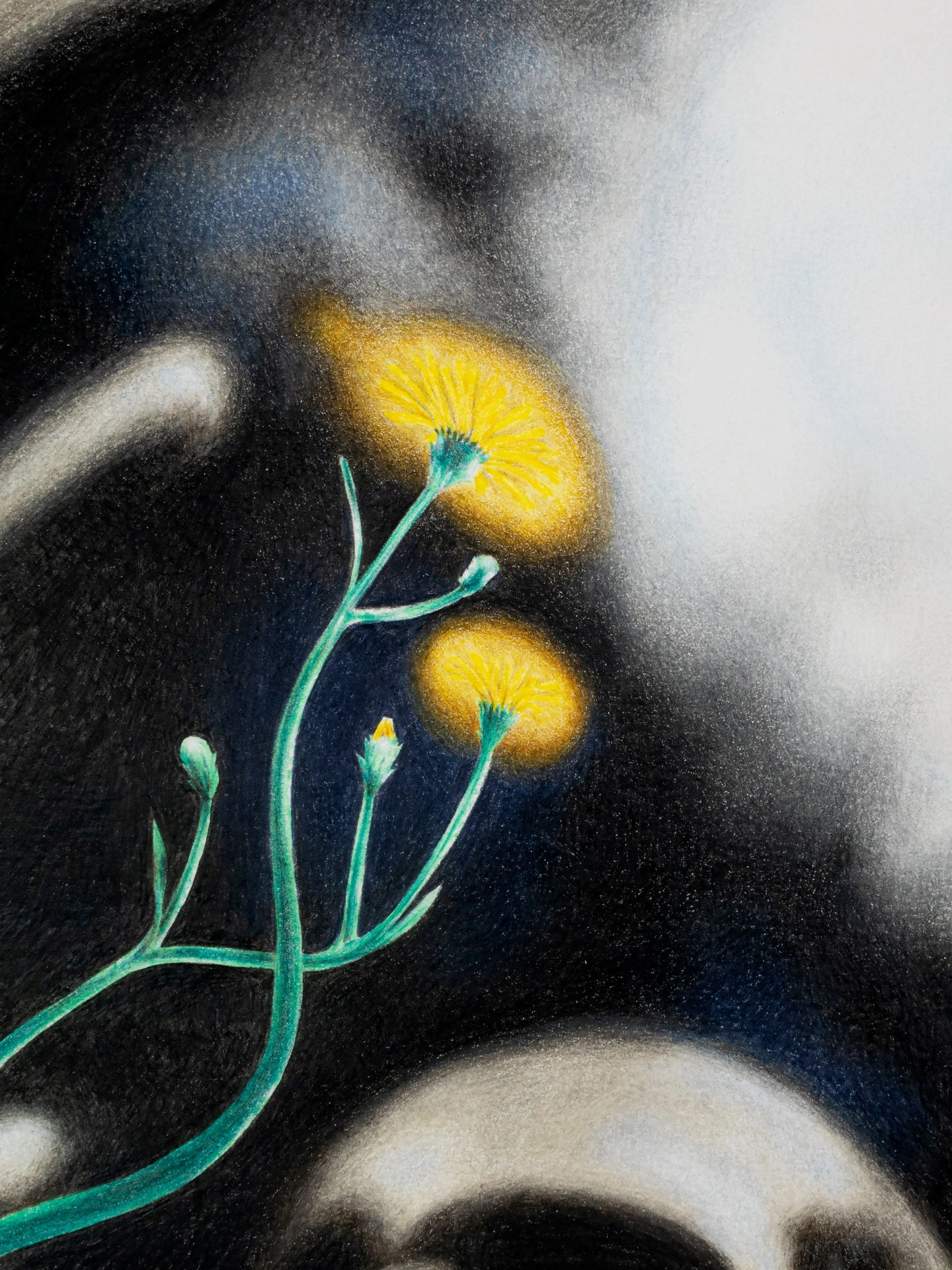
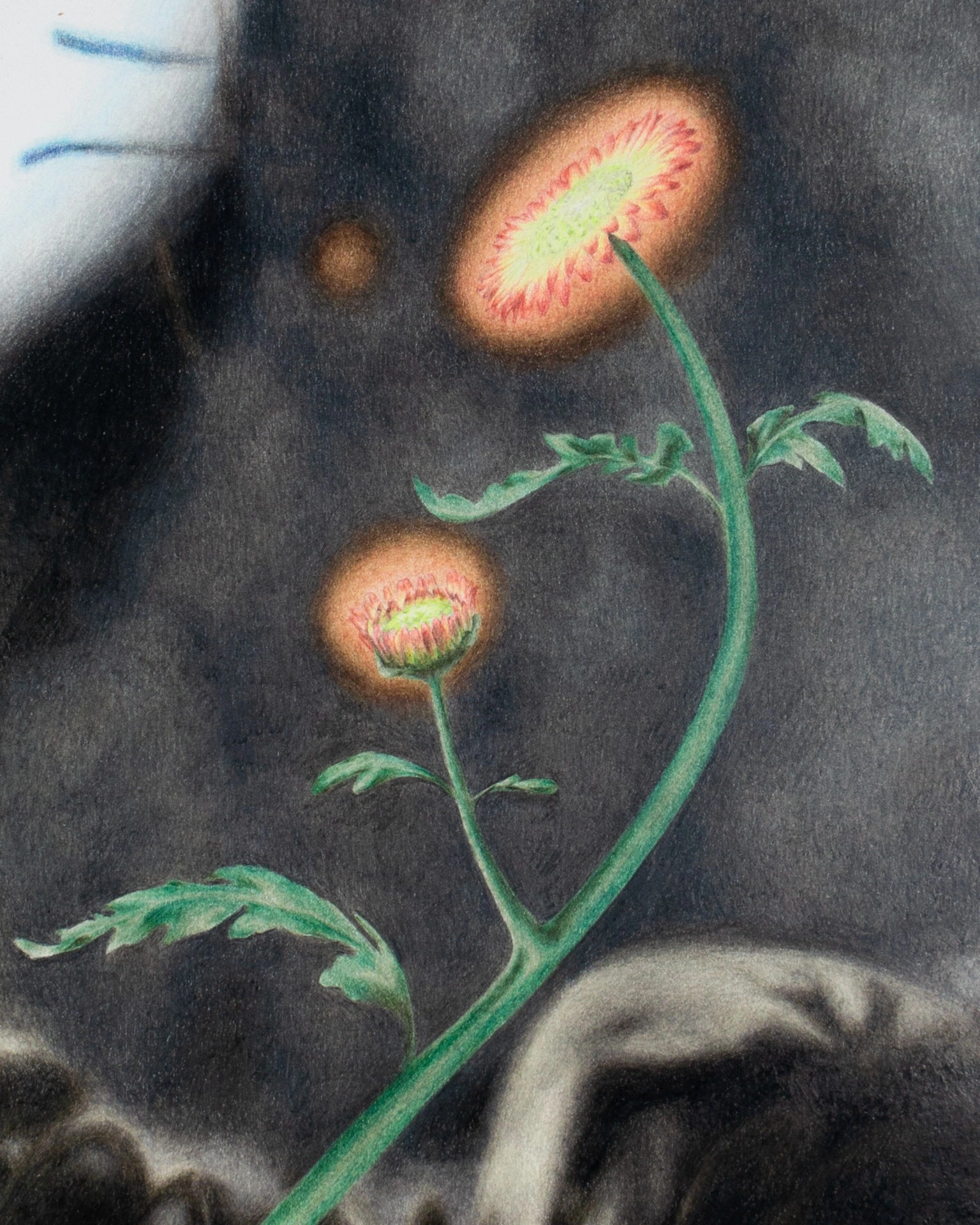
Those drawings are where Gac's hand goes quiet and precise. Through what the artist calls a post-digital integration of 3D rendering into detailed and laborious pencil drawing, chain-link fence recedes toward a horizon of flame, the diamond mesh rendered soft and photographic, the fire behind it blooming in orange lens-flare halos. Threaded through the wire, drawn in acid greens and blues that do not belong to any burning, are flowers. Dandelion, chrysanthemum, a stem's tendril looping through the links. The show takes its title from the words Sarah Connor knifes into a table in Terminator 2 after dreaming a playground vaporised: her fingers laced in a fence as the blast turns her arms to bone and then to dust. Here it is the flowers that take the fence, not the fingers.
Gac's source is a piece of Hollywood so convincing that, in the curators' account, the Federal Testing Nuclear Labs called it “one of the most accurate depictions of a nuclear blast ever created for the screen.” The apocalypse enters through cinema and stays as fact. But the drawings will not let the blast be a single flash. Sarah's dream stretches and thickens time, and so does the room: the same fence, the same flare, the same recovering flower, repeated down the wall like frames of a loop that has lost its ending. As the press text puts it, the apocalypse “dissolves into repetition: the future is known, yet it cannot be changed.”
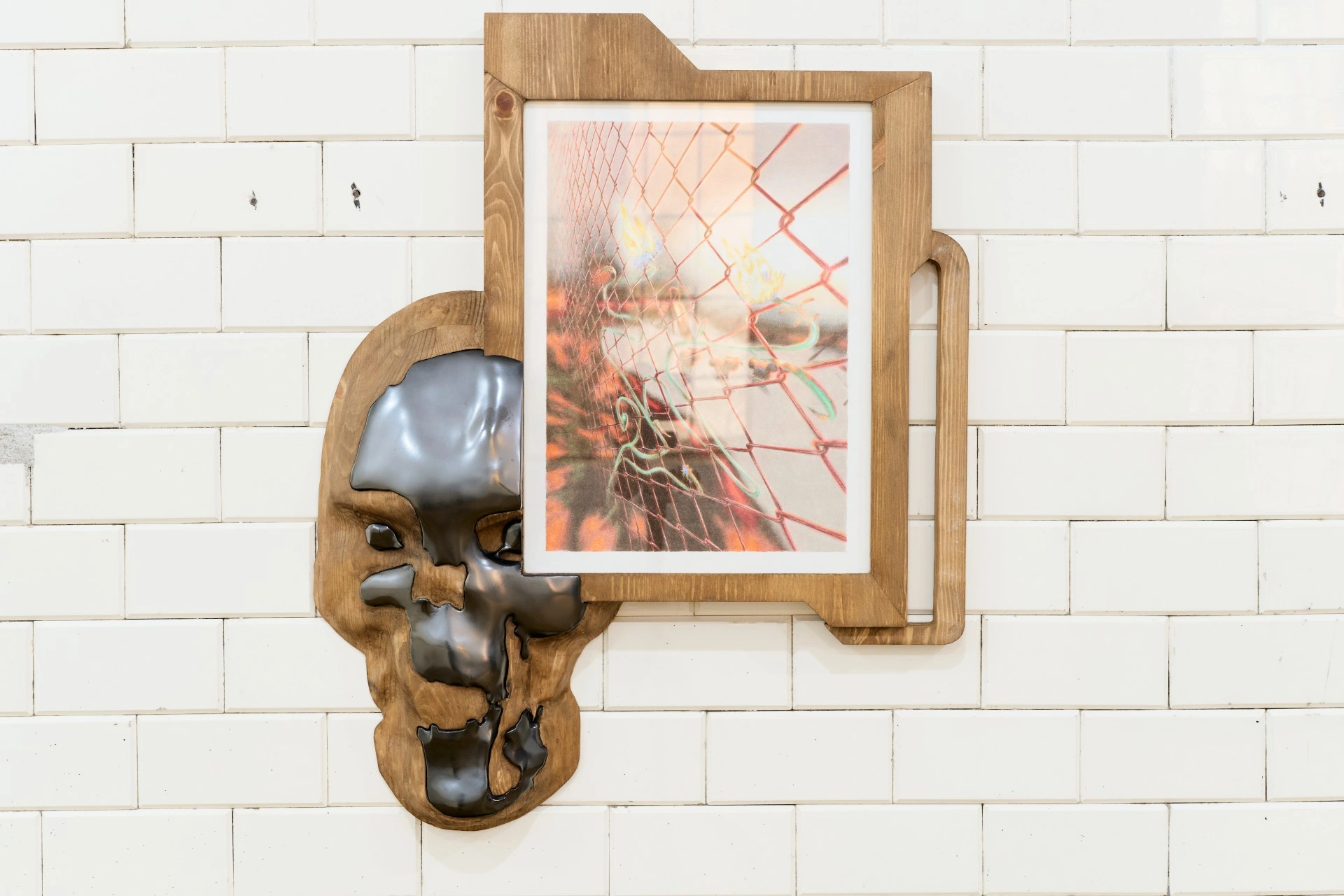
This is where the Romantic argument surfaces. Against the technocapitalist faith in unlimited gradual progress, the fantasy of CEOs freezing themselves toward immortality, Purkrábková and Sirůček set the older cyclical dread of the Romantic period, the fear that modernity's smoke and steel would circle back to ruin. Not transcendence, then, but transience accepted as the condition of things. The skull beside the fading flower is the oldest arrangement in European painting; Gac reads the Terminator's chrome cranium and the dandelion as a vanitas for the age of generative machines and automated landscapes, a memento mori issued to a species that no longer expects to bury itself once.
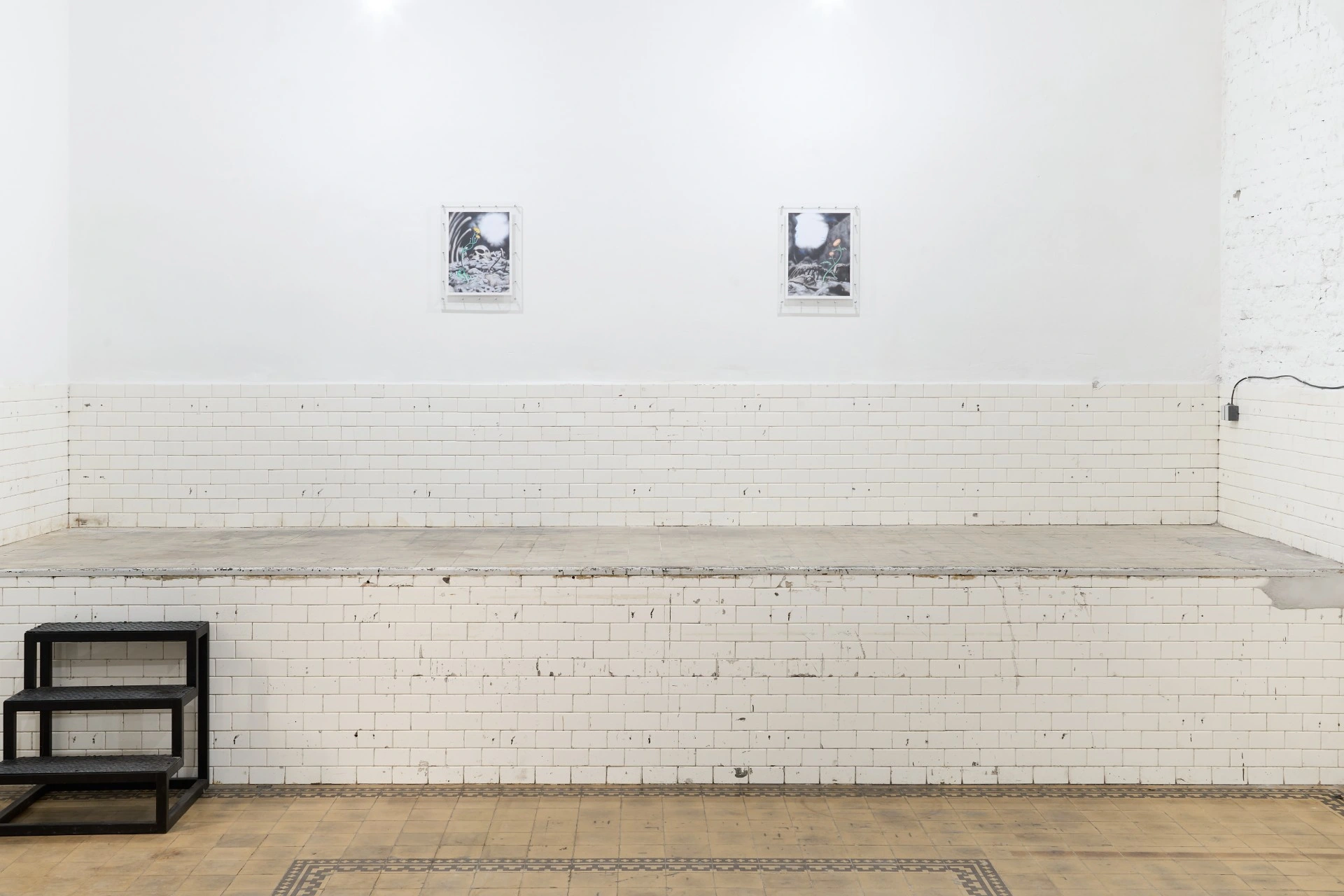
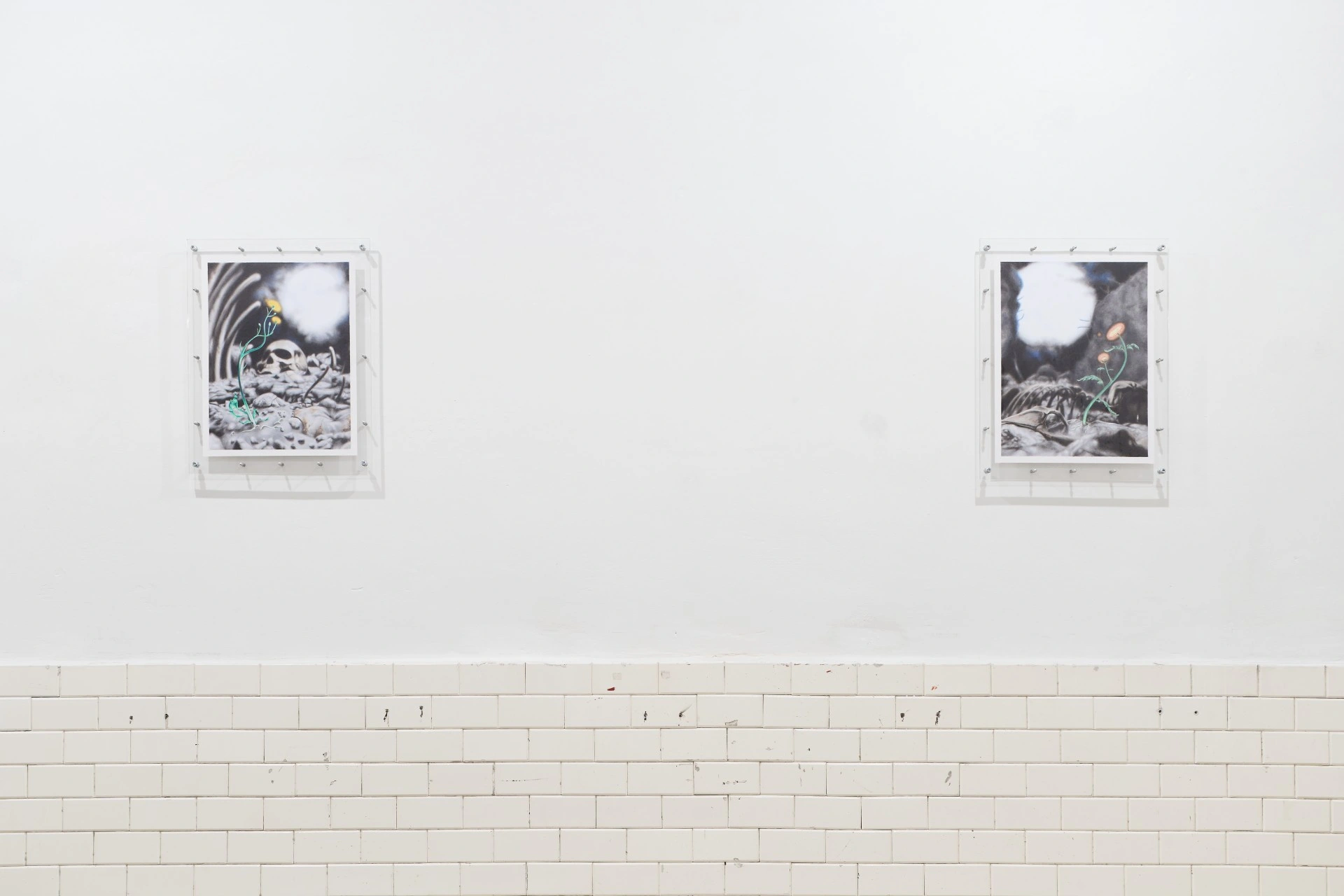
A small pair of acrylic-sandwiched drawings breaks the rhythm on the plain wall above the tile. In them the fence is gone. A weedy dandelion and a scorched poppy rise from a field of grey rubble and half-buried skulls, under a white sun that could be dawn or detonation. These are the calmest works and the most unresolved. Nothing here promises the flower will return next time. It simply has, this time, again.
The end is not an event here but a climate, a condition the room keeps stepping back into. Disaster, the curators remind us, means “a structural loss of footing rather than simple despair,” the astronomical undoing folded into dis-astrum, a wound that linearity cannot heal and that always gapes open. Gac leaves the loop running and the flower where the bones were. Whether it roots there next time, the tile floor does not say.