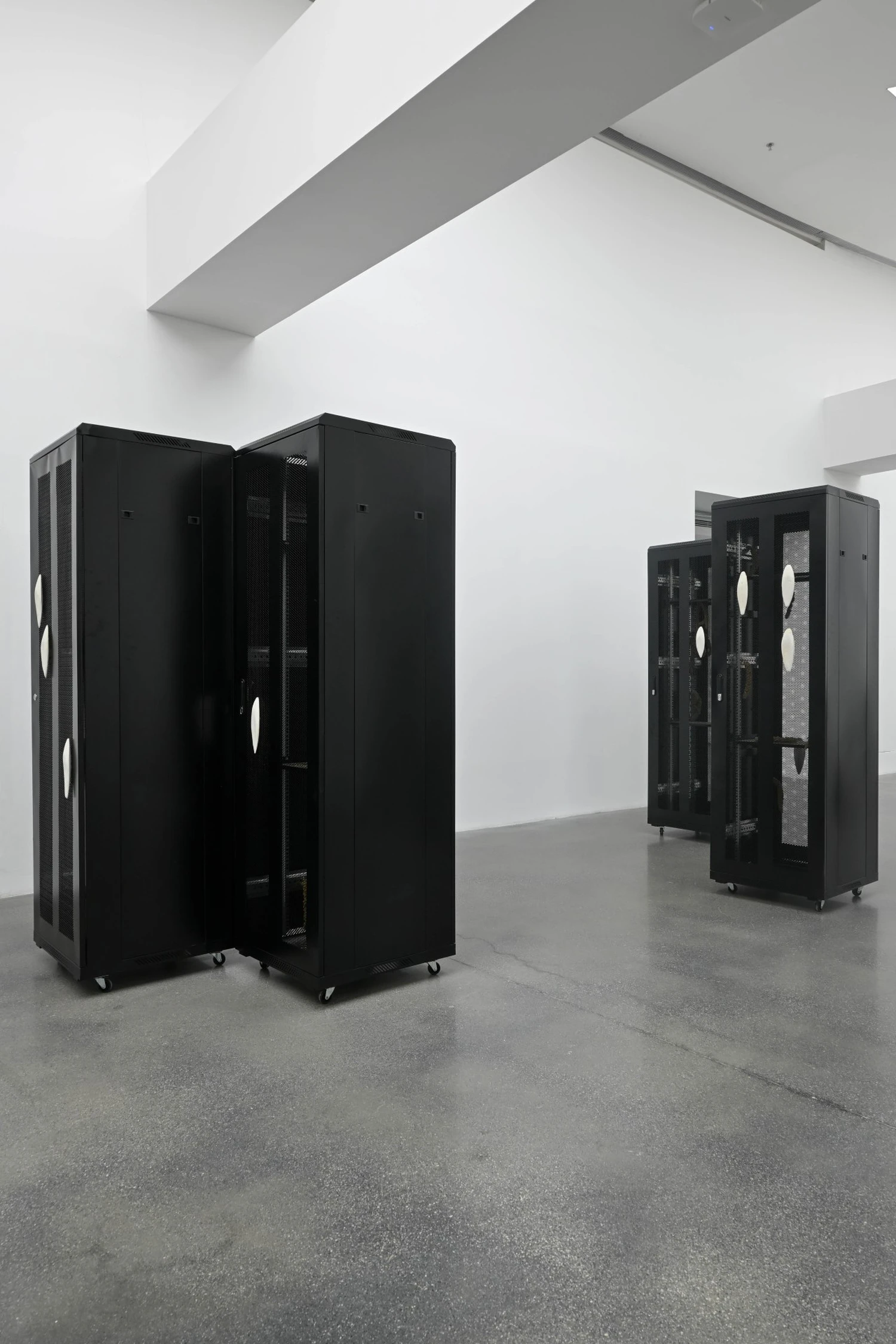
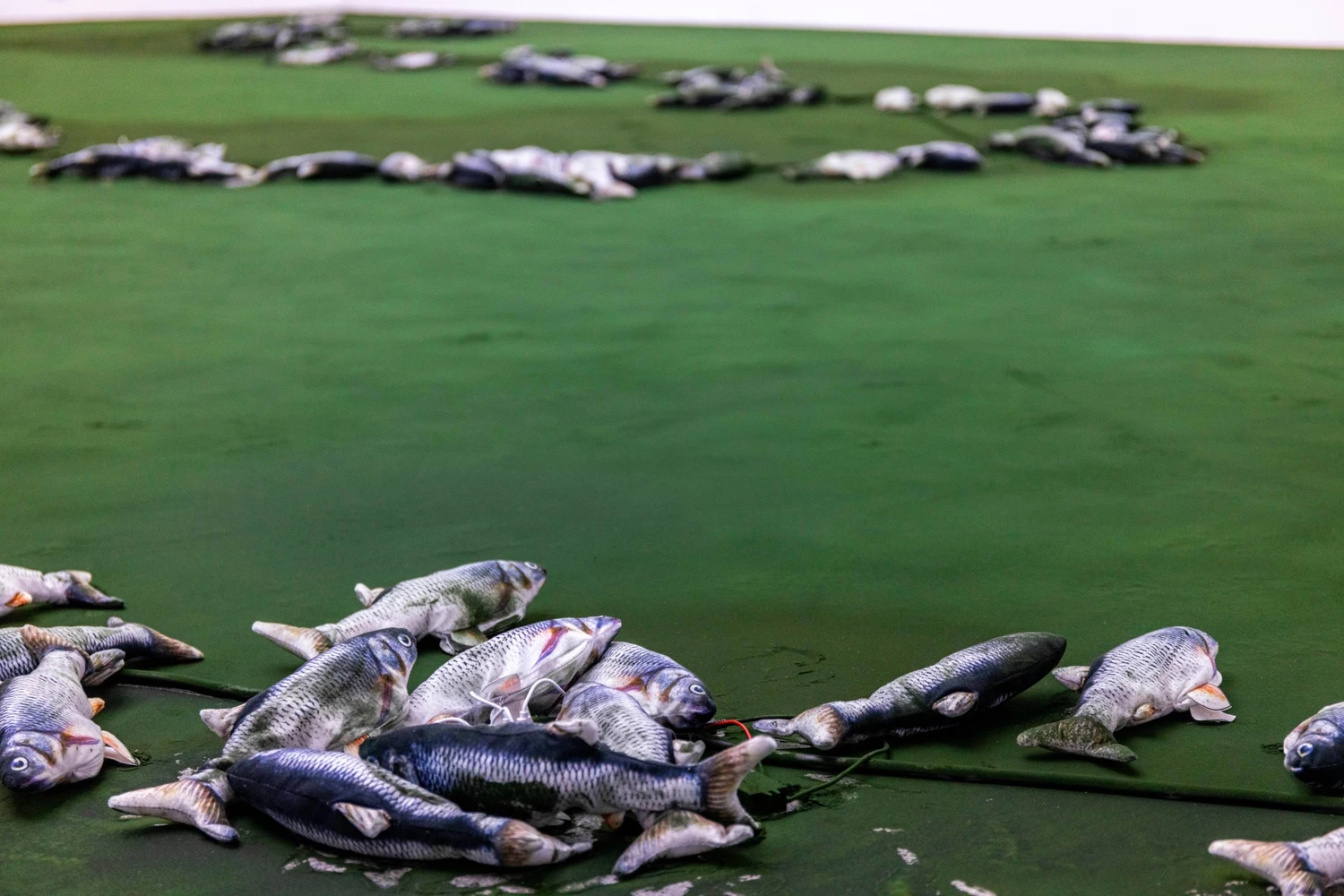
In the exhibition space of Songshan Lake Boxes Art Museum in Dongguan, a voice assistant stutters endlessly, uselessly. Nearby, mechanized carp thrash in spirulina, a drone circles with uncertain intention, and alphabet installations await digestion by pigs whose lives are now piloted by artificial intelligence. There is something almost ceremonial about these failures, these breakdowns, these moments when the machine refuses to perform its appointed function.
The Chinese character 兆, chosen by artist Rémi Lécussan to title this exhibition, functions as a hinge between two systems of meaning: it can signify omens, marks that carry narratives, traces that prophesy futures yet to come. But what exactly is being prophesied here? What do we hear when we listen to the stutter of a malfunctioning voice assistant? What do we read when we confront a mechanical carp endlessly replaying "the ascent of the Amur River"?
Lécussan's practice operates as a systematic interrogation of the contemporary equation between energy and intelligence. We attribute understanding, insight, and consciousness to systems that function through statistical manipulation of language. Meanwhile, we systematically deny comparable faculties to the living organisms with whom we share the planet. The pig, whose cognitive capacities rival those of primates, is reduced to a body to be managed, optimized, and eventually converted into battery-cervelas—a disturbing sculptural work that transforms the recycling bin into something undeniable, a physical manifestation of the contradiction between what we claim and what we do.

The exhibition unfolds what might be described as "an ecology of low energy and ephemeral memory," functioning as a critical counterpoint to contemporary computational inflation. Lécussan engages in sophisticated sabotage, using low-cost bricolage to hybridize technological apparatus with practices of domesticating living beings—feeders, aviaries, fish farms—in ways that deliberately derail what he calls "overly well-calibrated language machines." The exhibition space becomes a deviant and fictional production system, a zone where the technological imperative encounters friction and failure.
Consider the stuttering voice assistant. In ordinary experience, this would be a defect to be corrected. But here, the stutter becomes a form of resistance, a refusal of the transparency that Silicon Valley insists is the hallmark of design. The assistant will be of no help; it has no answers. What remains is gesture spun into void, repetition without purpose. And somehow, in its failure, the device becomes more honest than any smoothly functioning AI could ever be.
Lécussan's broader argument articulates the asymmetry between economic cost and environmental cost in computational-linguistic machines. The mining extractivism required to produce silicon chips, the rare earth minerals excavated, the water consumed—these costs are externalized. The living beings mobilized to justify and operate these systems pay invisible costs. The exhibition refuses this invisibility, staging the living in the foreground, insisting that we acknowledge "the living that AI silently mobilizes."
The 兆 character becomes a marker of emergence, a trace of futures not yet determined. In a moment when computational inflation seems to have reached apotheosis, Lécussan's fragile entities—the stuttering assistant, the thrashing carp, the algorithm-piloted pig—offer a counter-position. They do not work well; they do not produce the promised optimization. But in their failure, their vulnerability, they speak a truth that seamless technology cannot access. Intelligence has never been a solitary phenomenon; it emerges from relationship, from entanglement with the living world, from the acceptance of our fundamental dependencies.