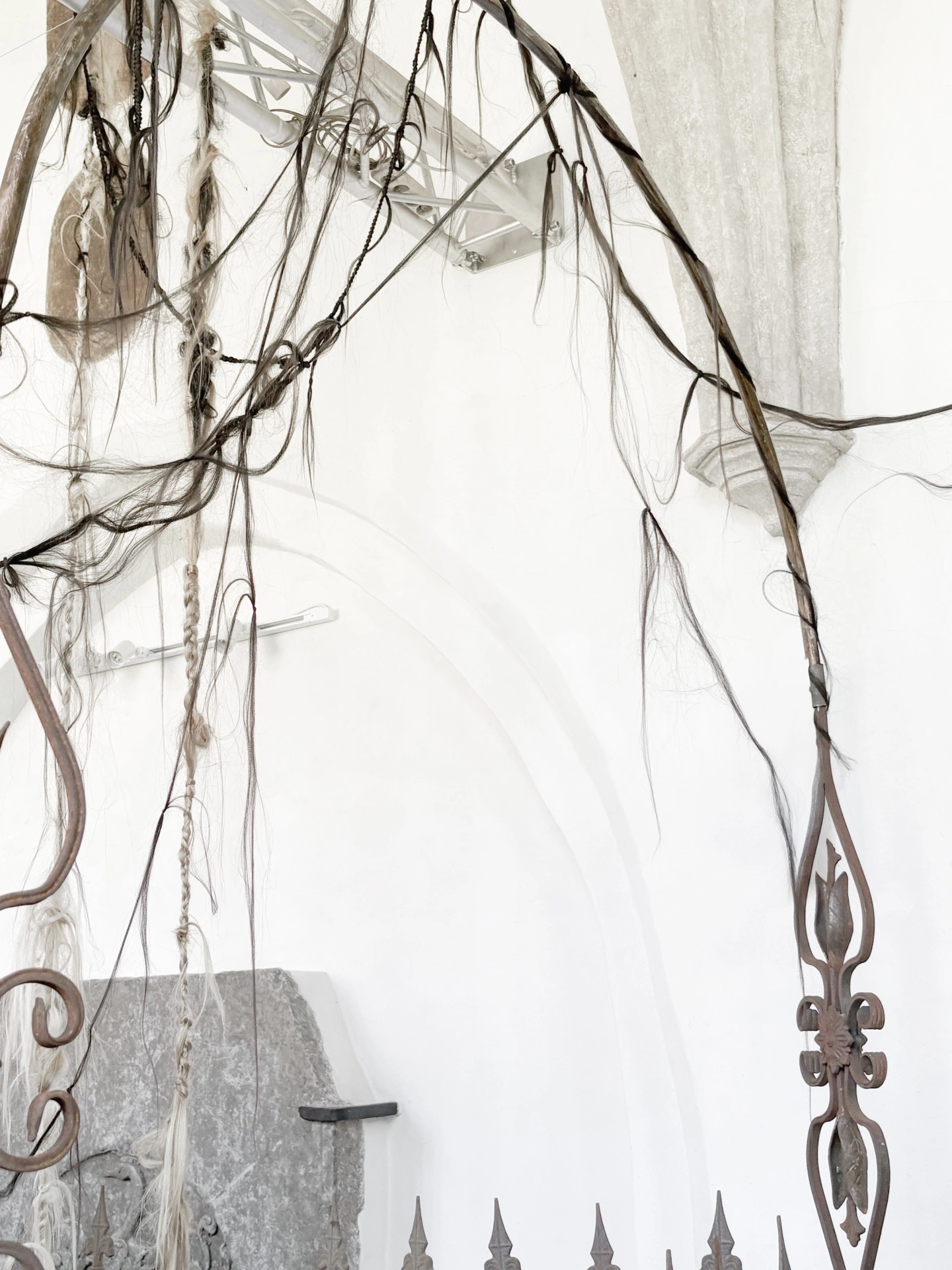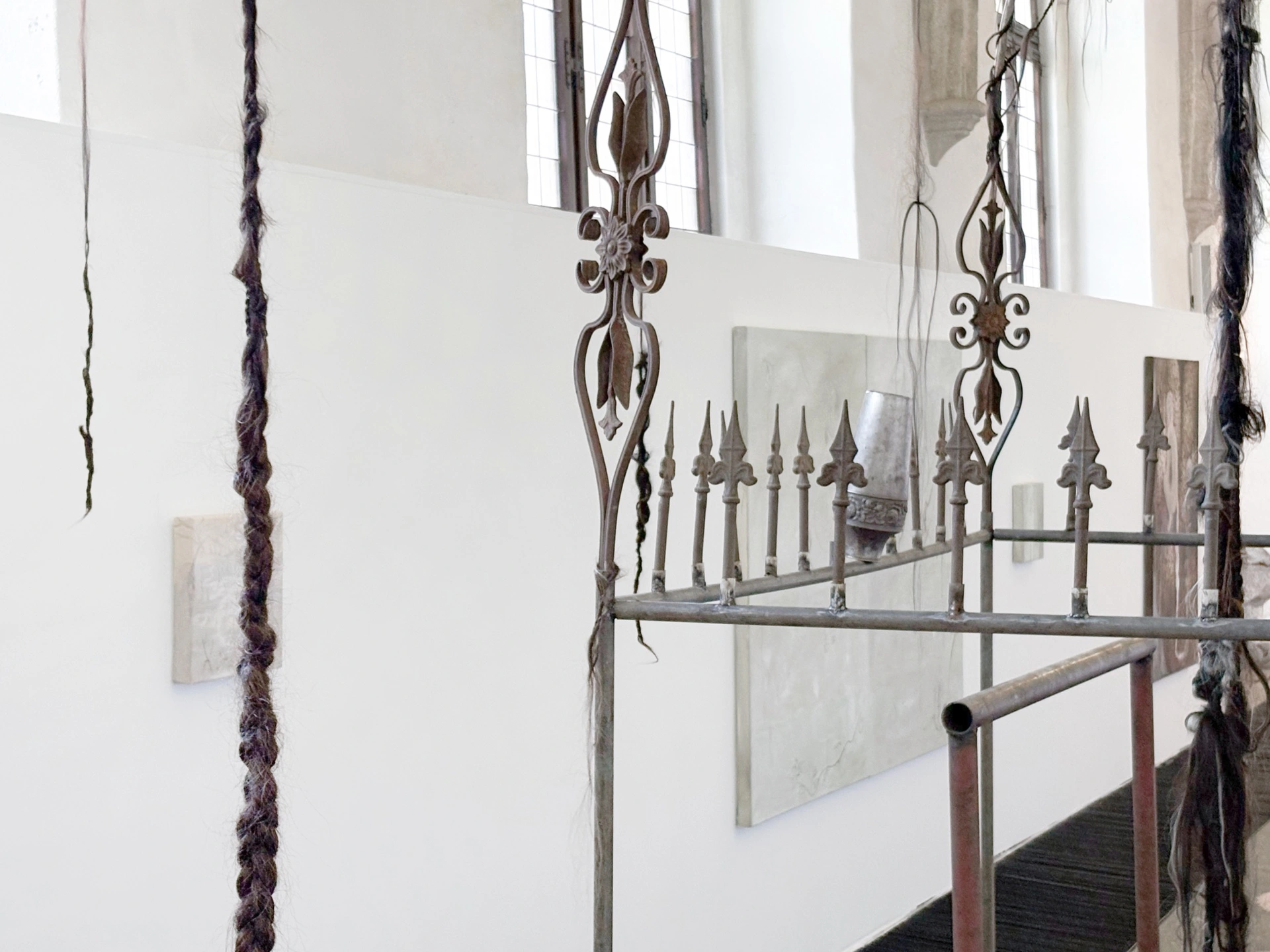
Inside a deconsecrated Dominican church in Elbląg, Angelika Puff hangs pale paintings and braided hair across medieval tomb slabs, letting Galeria EL become the reliquary her exhibition has been describing all along.
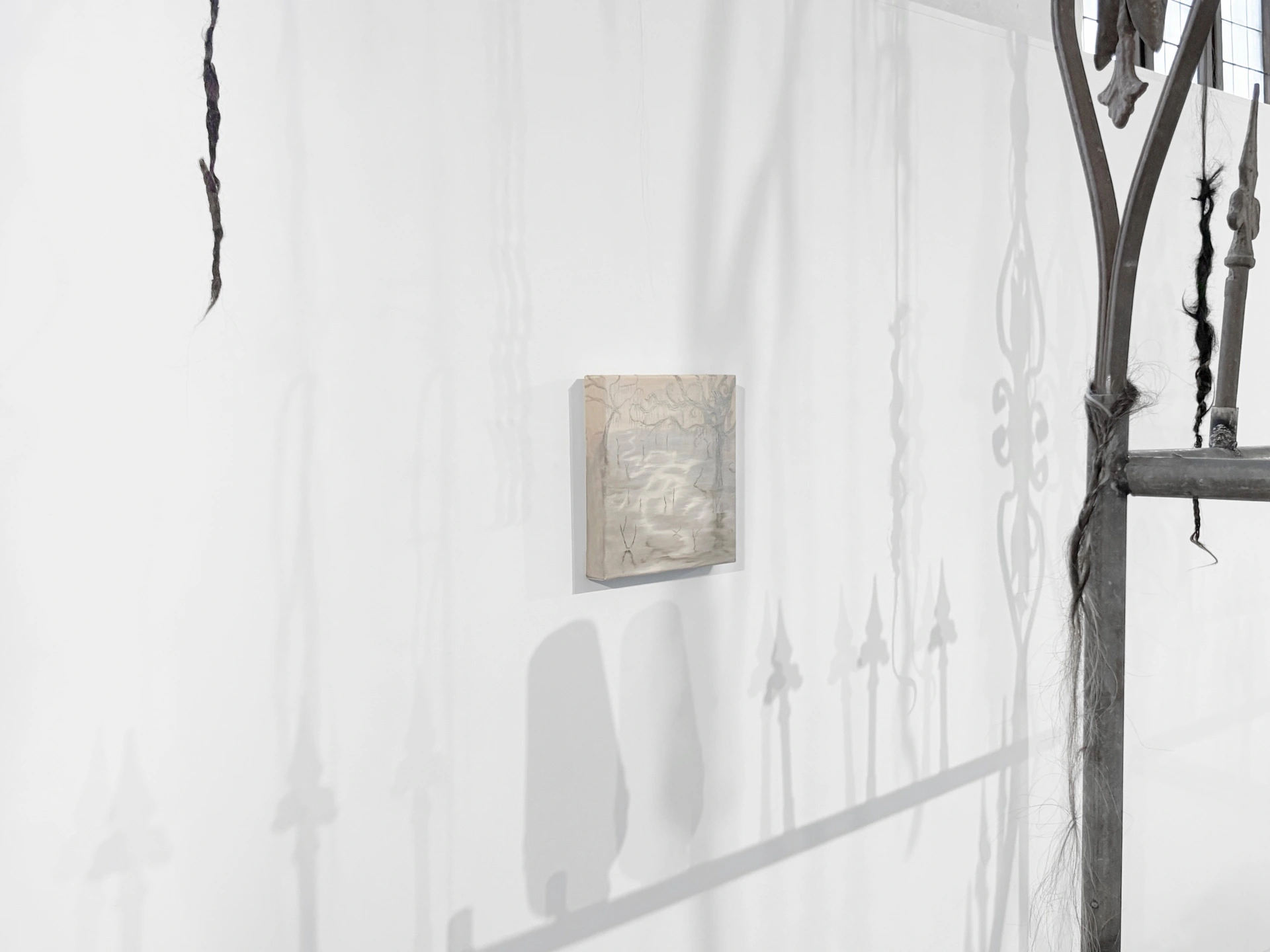
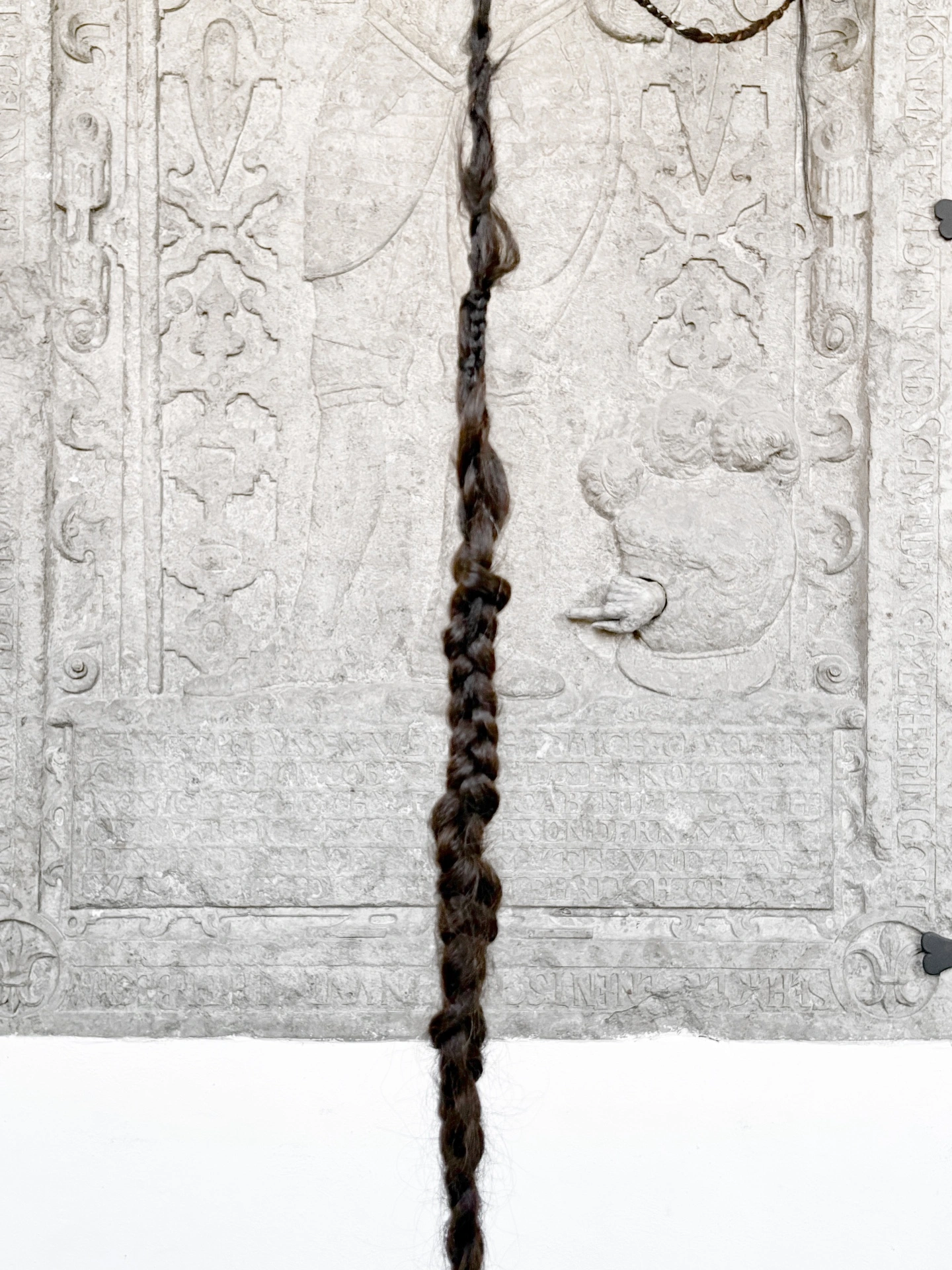
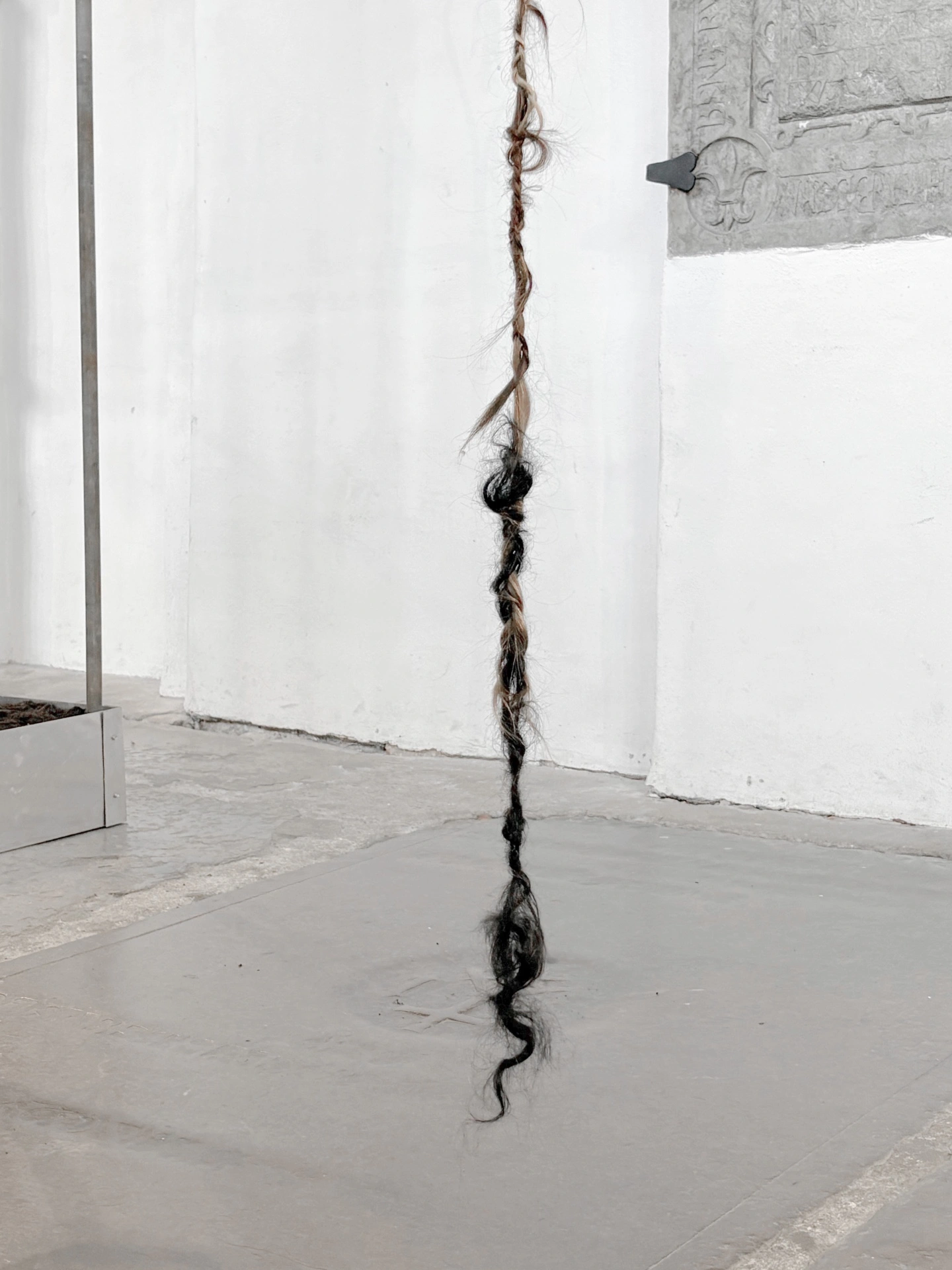
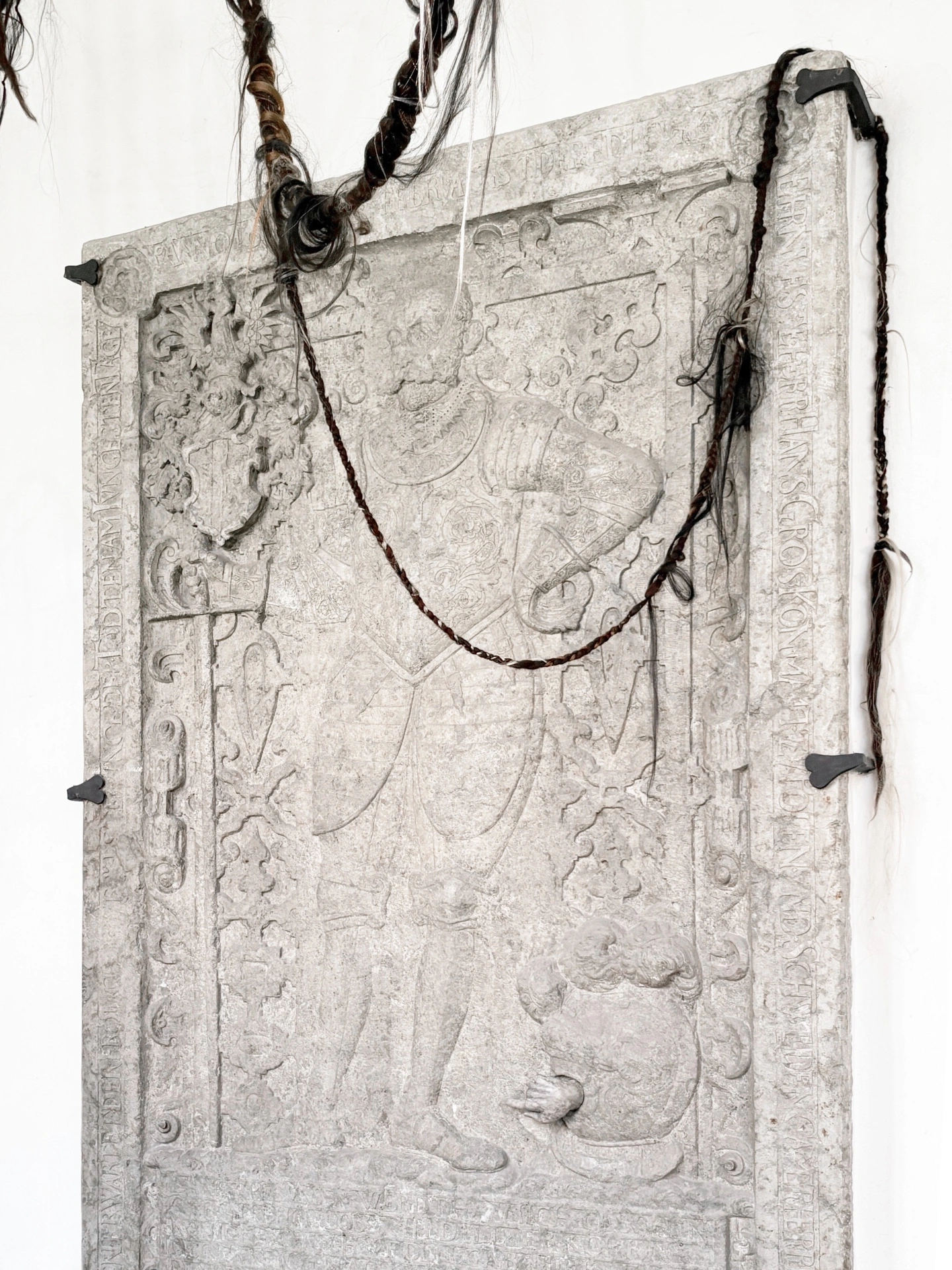
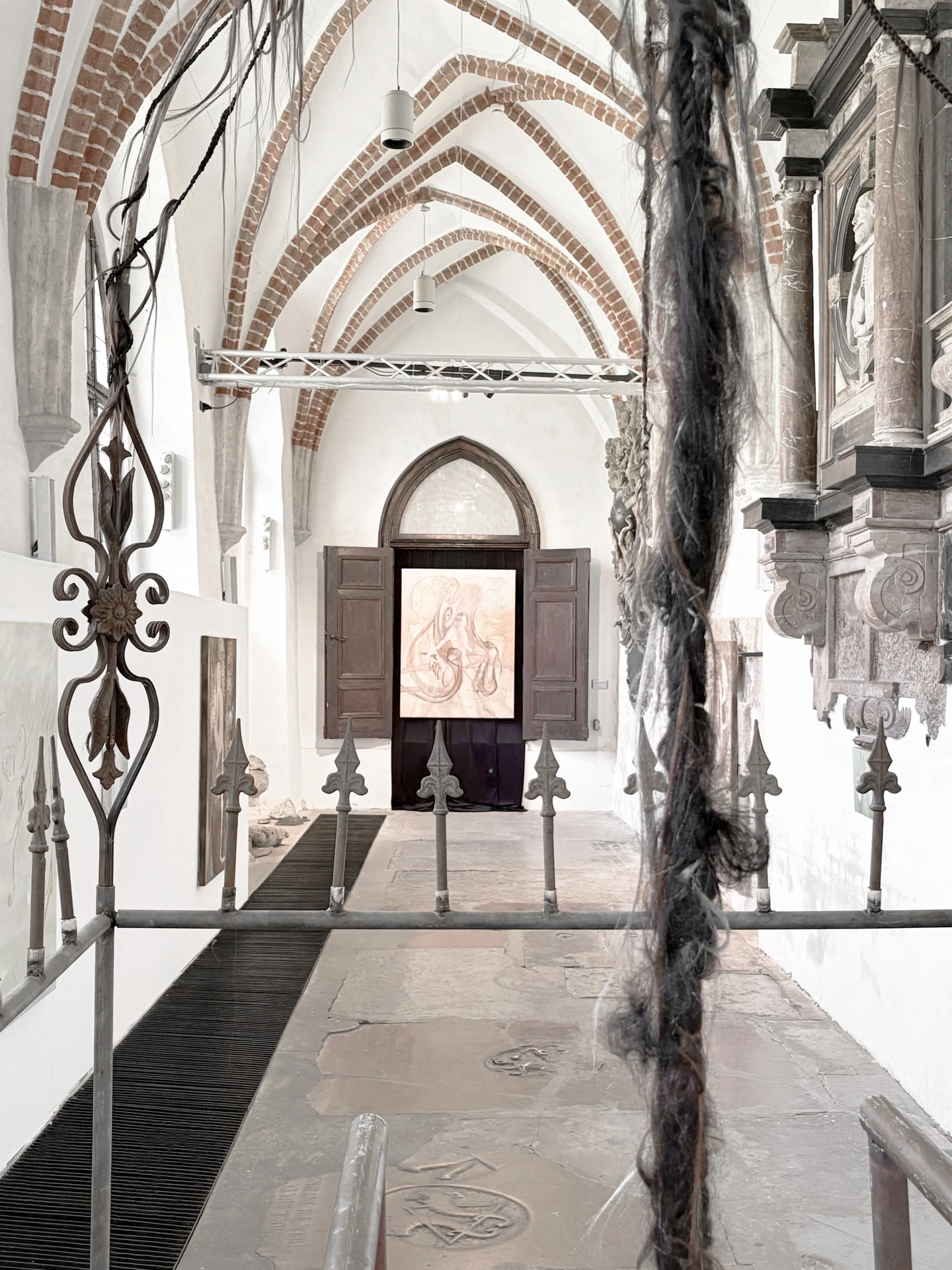
The braid falls the full height of the nave. It begins somewhere in the brick vaulting, thickens into a rope of dark and ash-blond hair, and pools on the polished floor above the incised knights of the church's funerary slabs. You register it before you register any painting: a single strand of the body, spun into architecture, dropped like a plumb line through a space built to house the dead. It is not decoration. It is a measurement of how far a person reaches after they are gone.
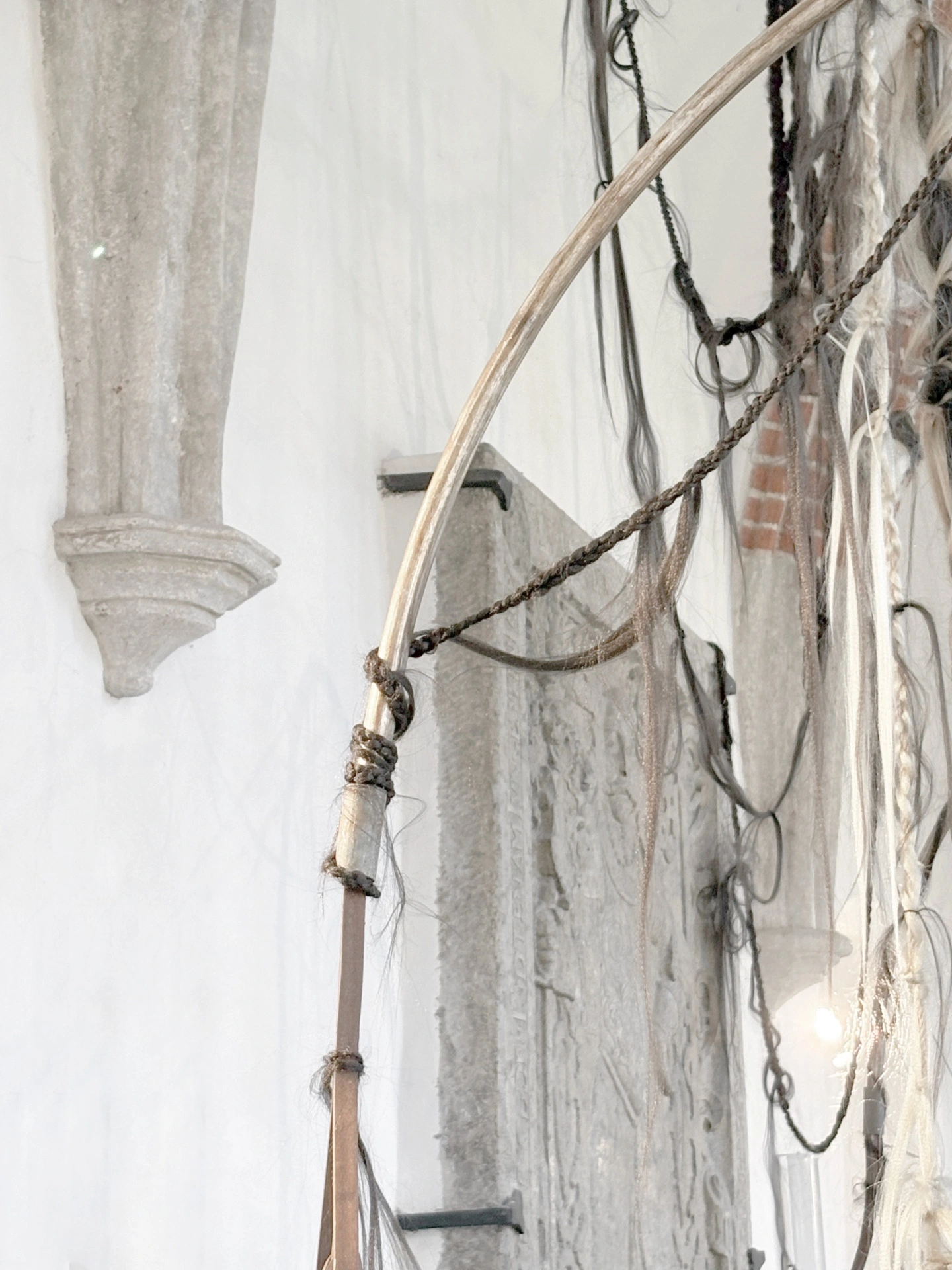
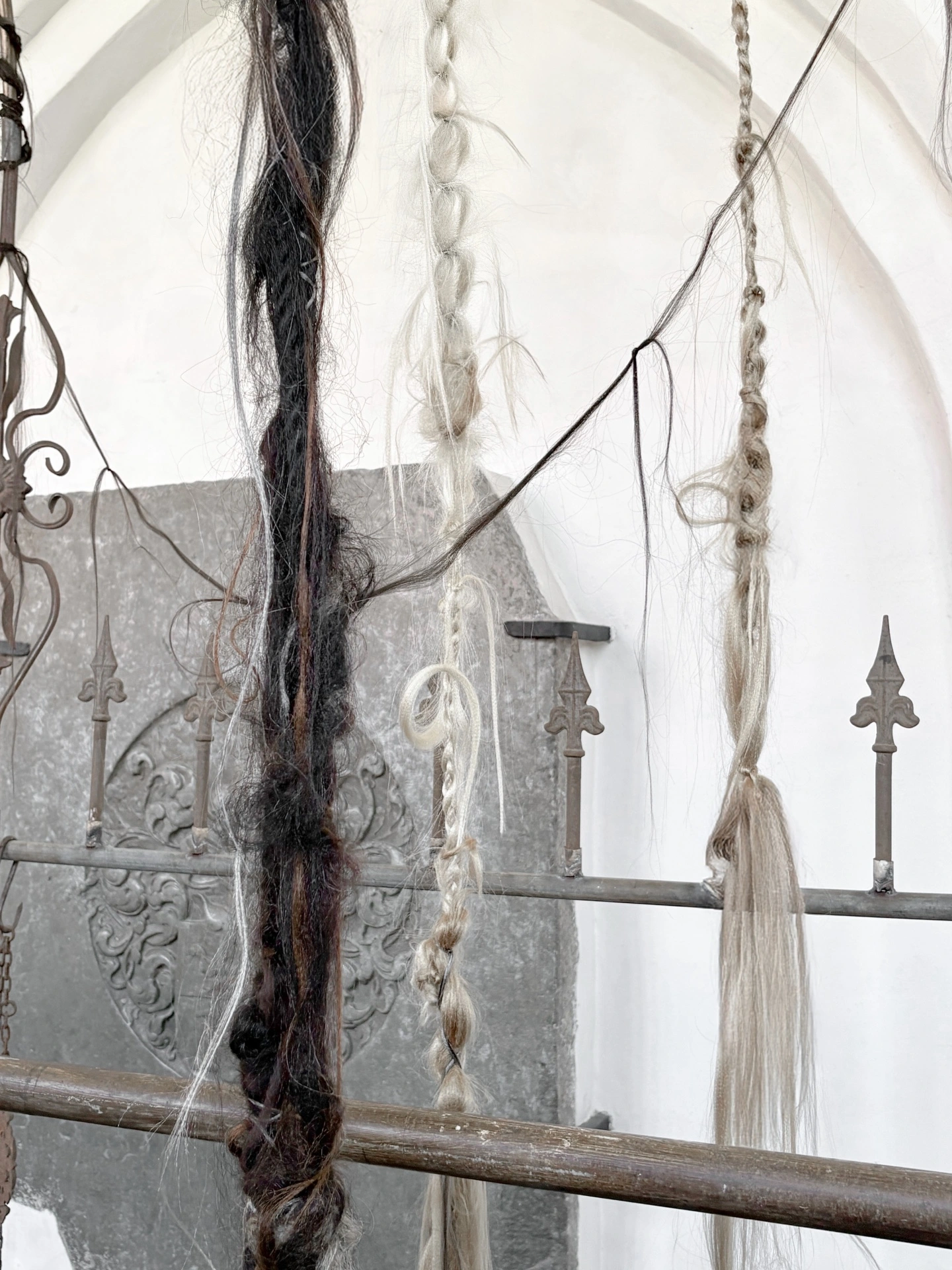
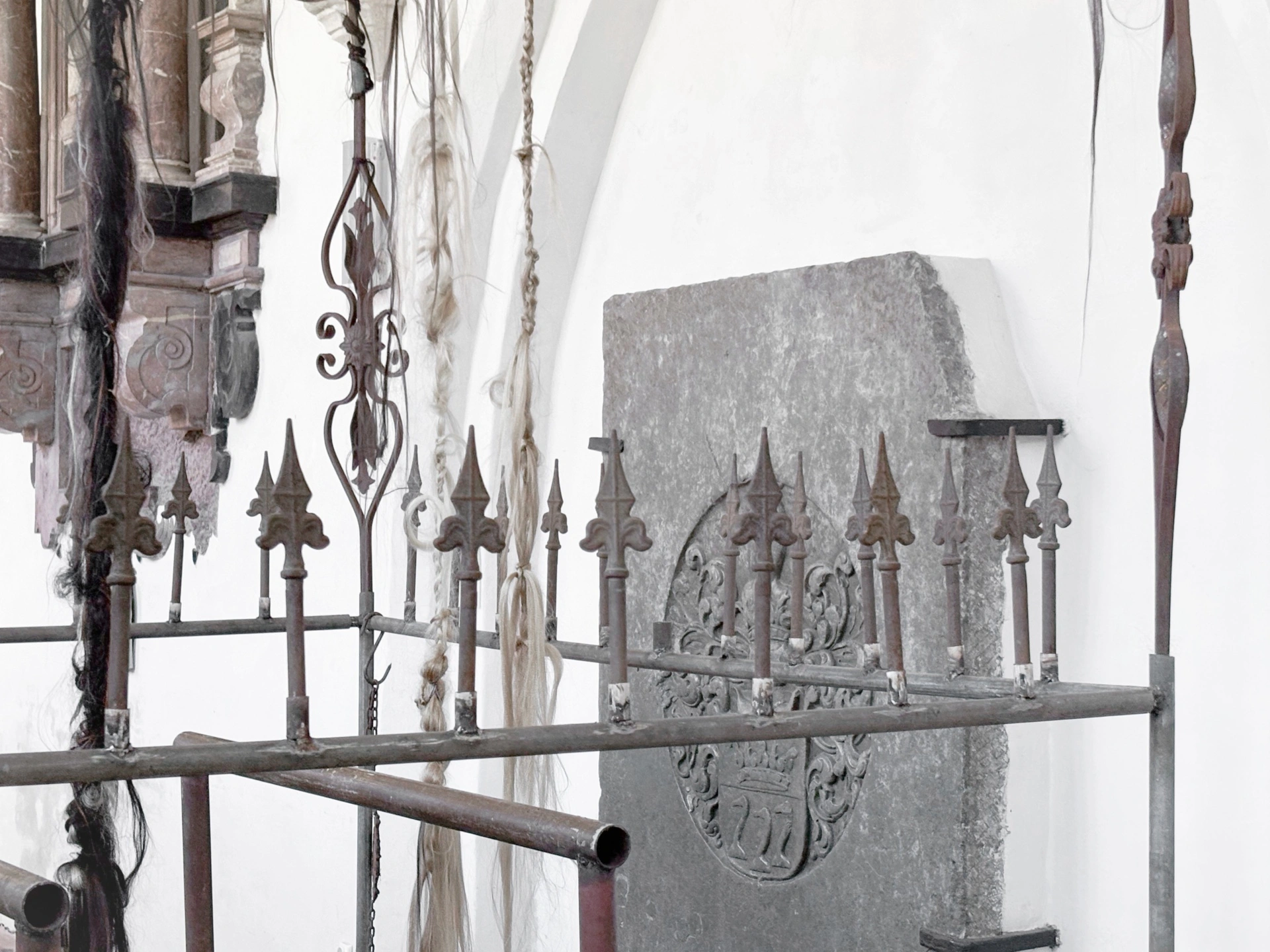
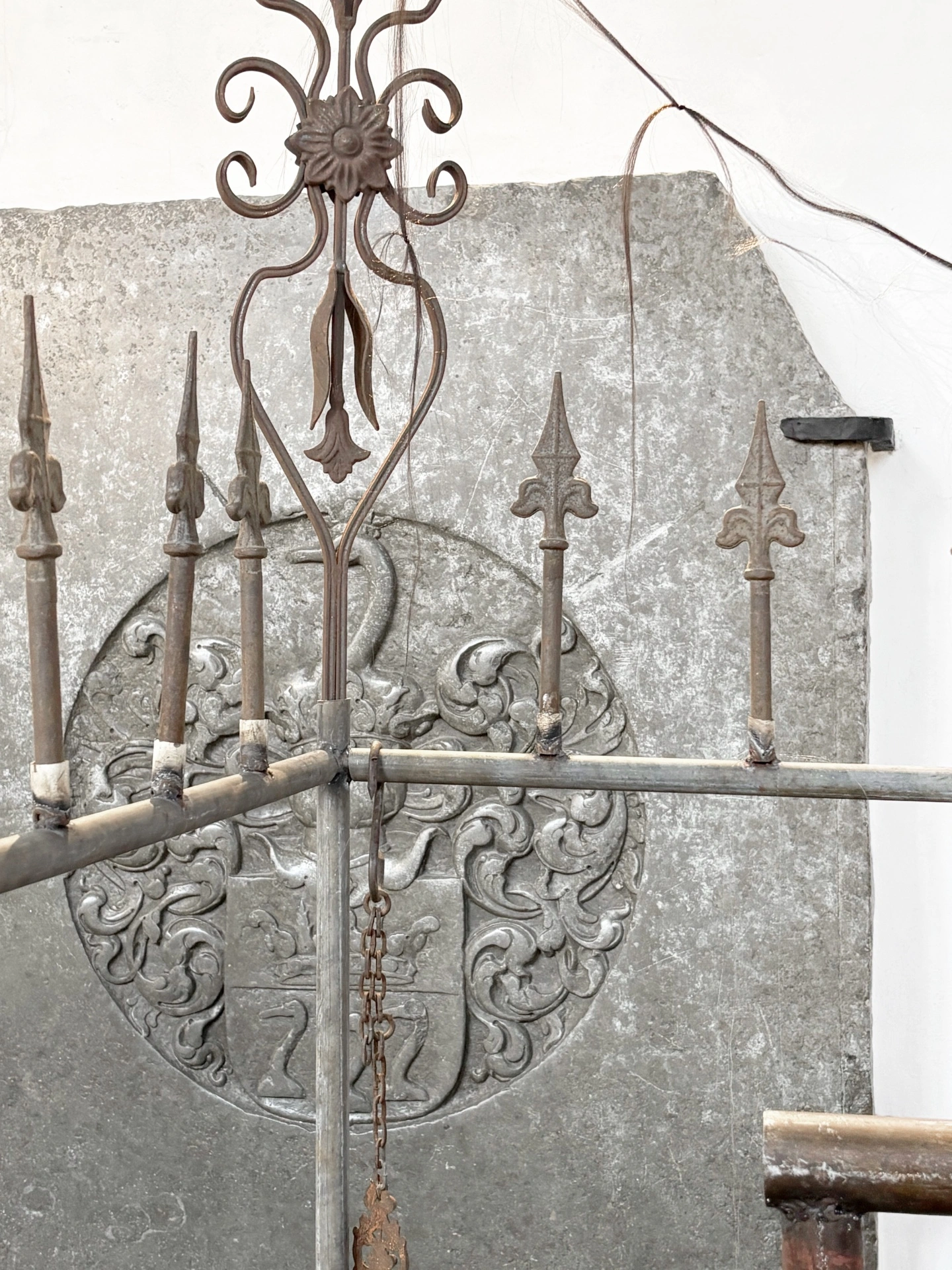
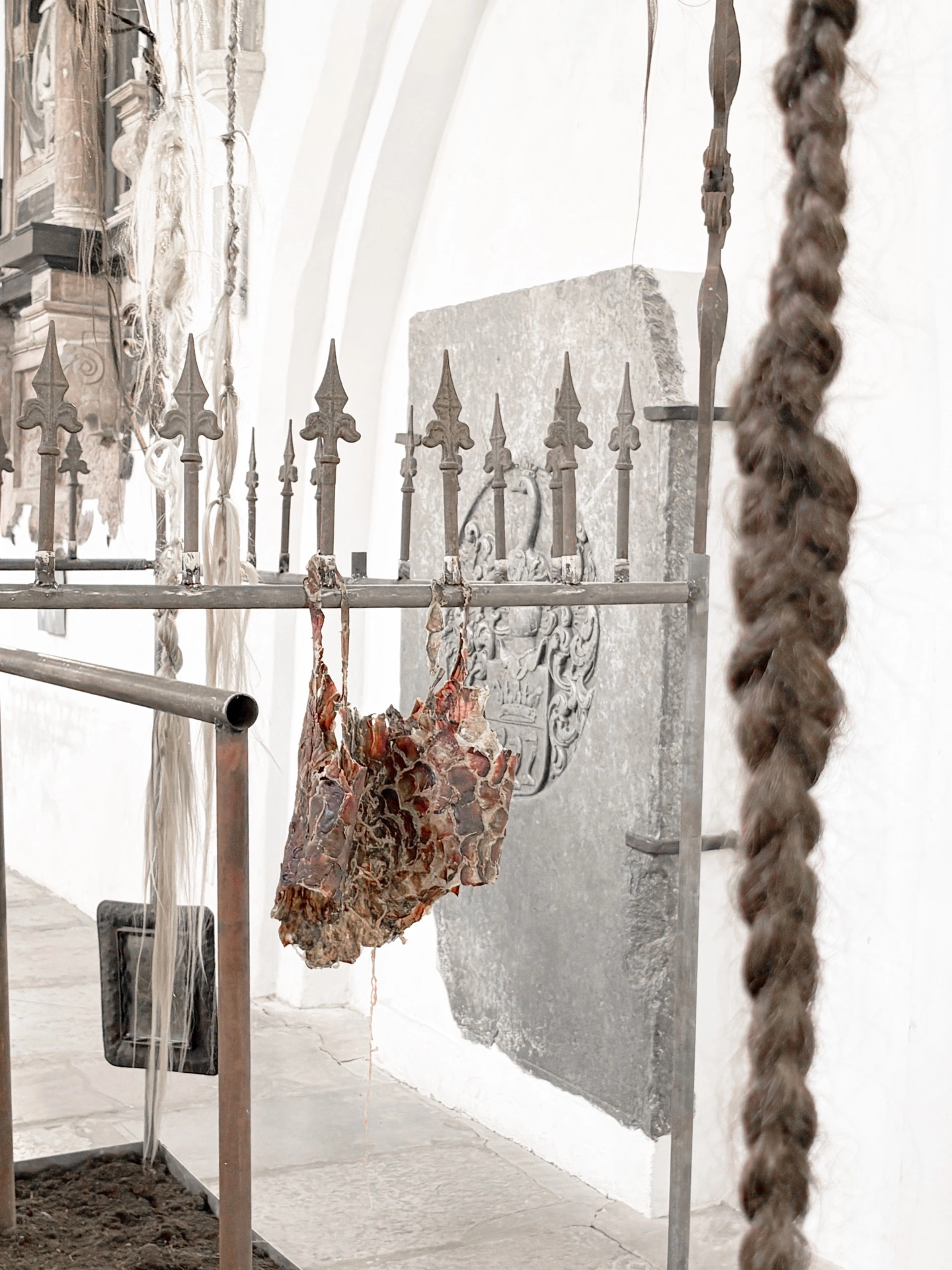
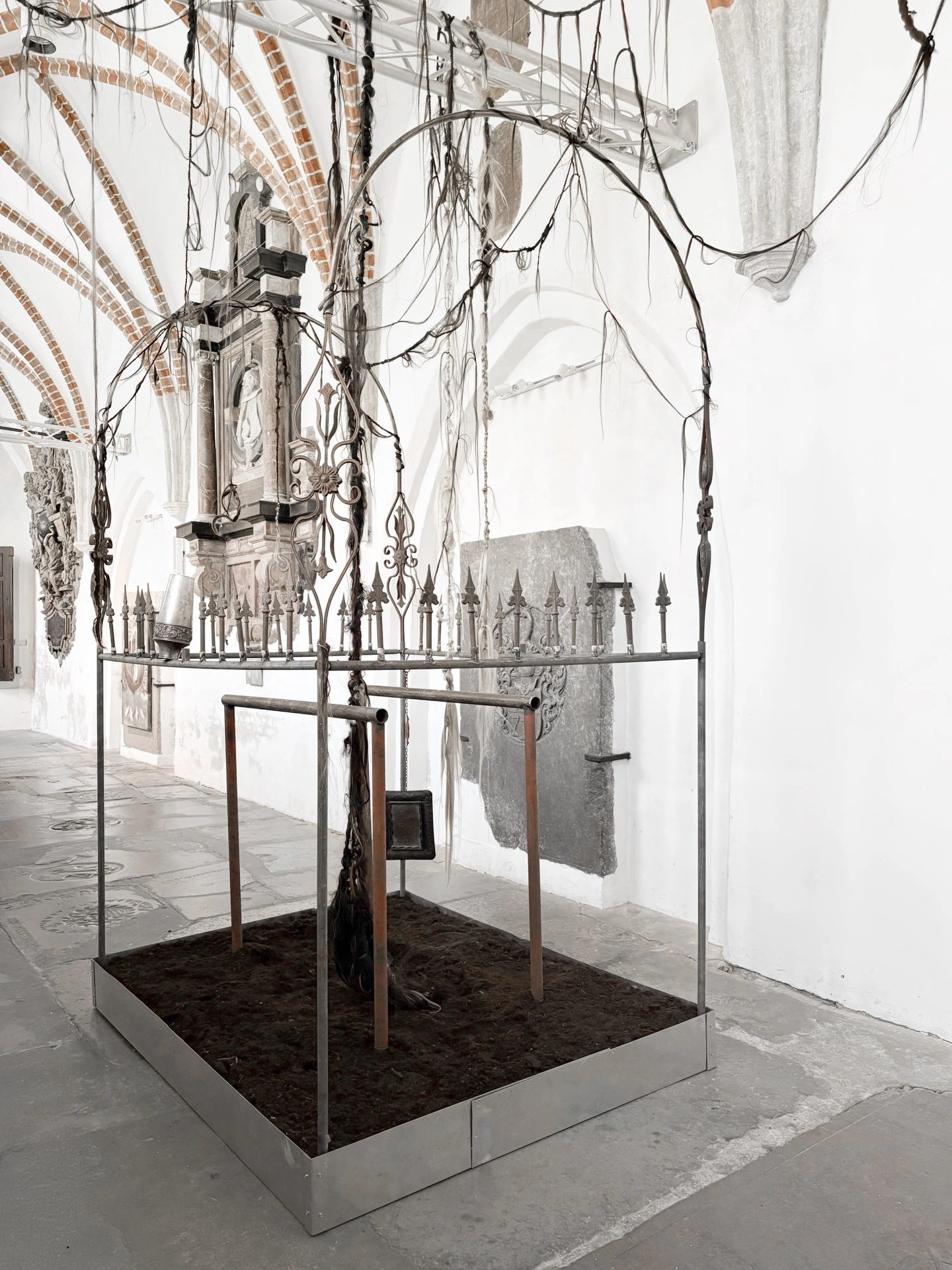
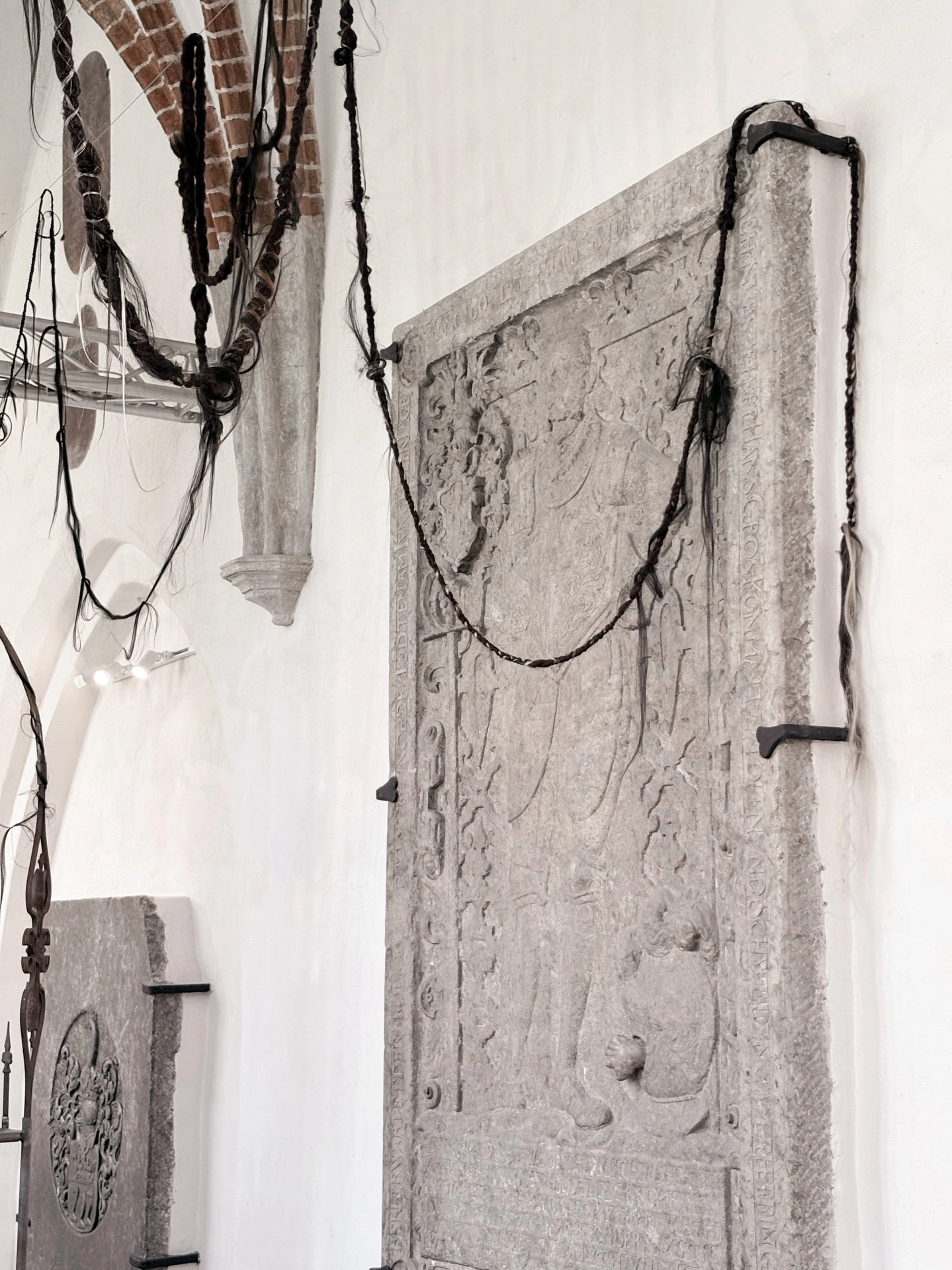
Puff calls the sculpture Bird Cage, a wrought-iron gate strung and knotted with human hair, chains of plait draped across a sixteenth-century tombstone the way a rosary is draped over a coffin. Blond, brown, silver, the strands are braided, matted, left to fray at their ends. Some are taut as wire; others hang loose and cobwebbed, catching the light of the arched windows. The gate promises enclosure and delivers none. What contains the body here is not the iron but the hair, and hair holds nothing shut.
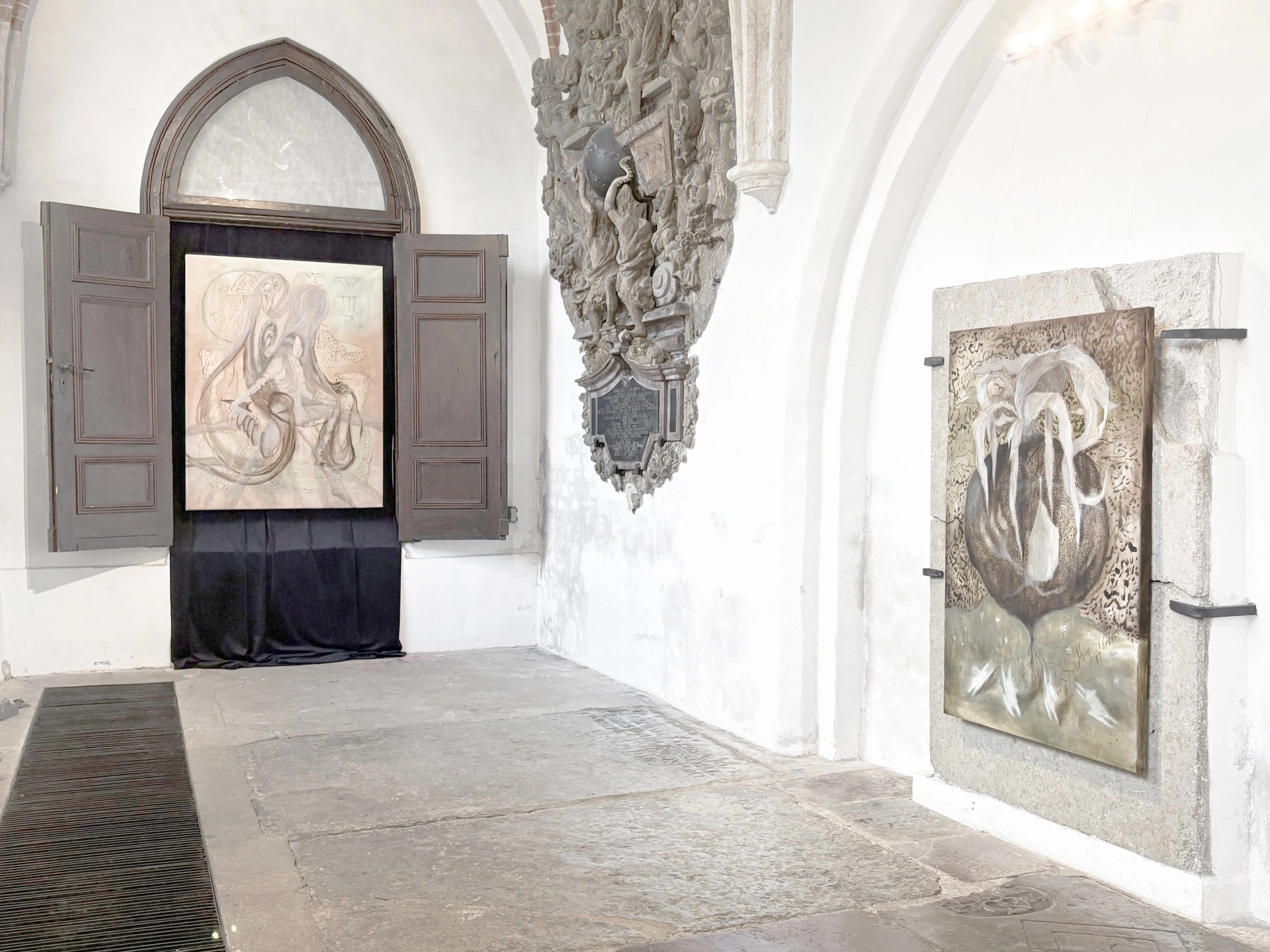
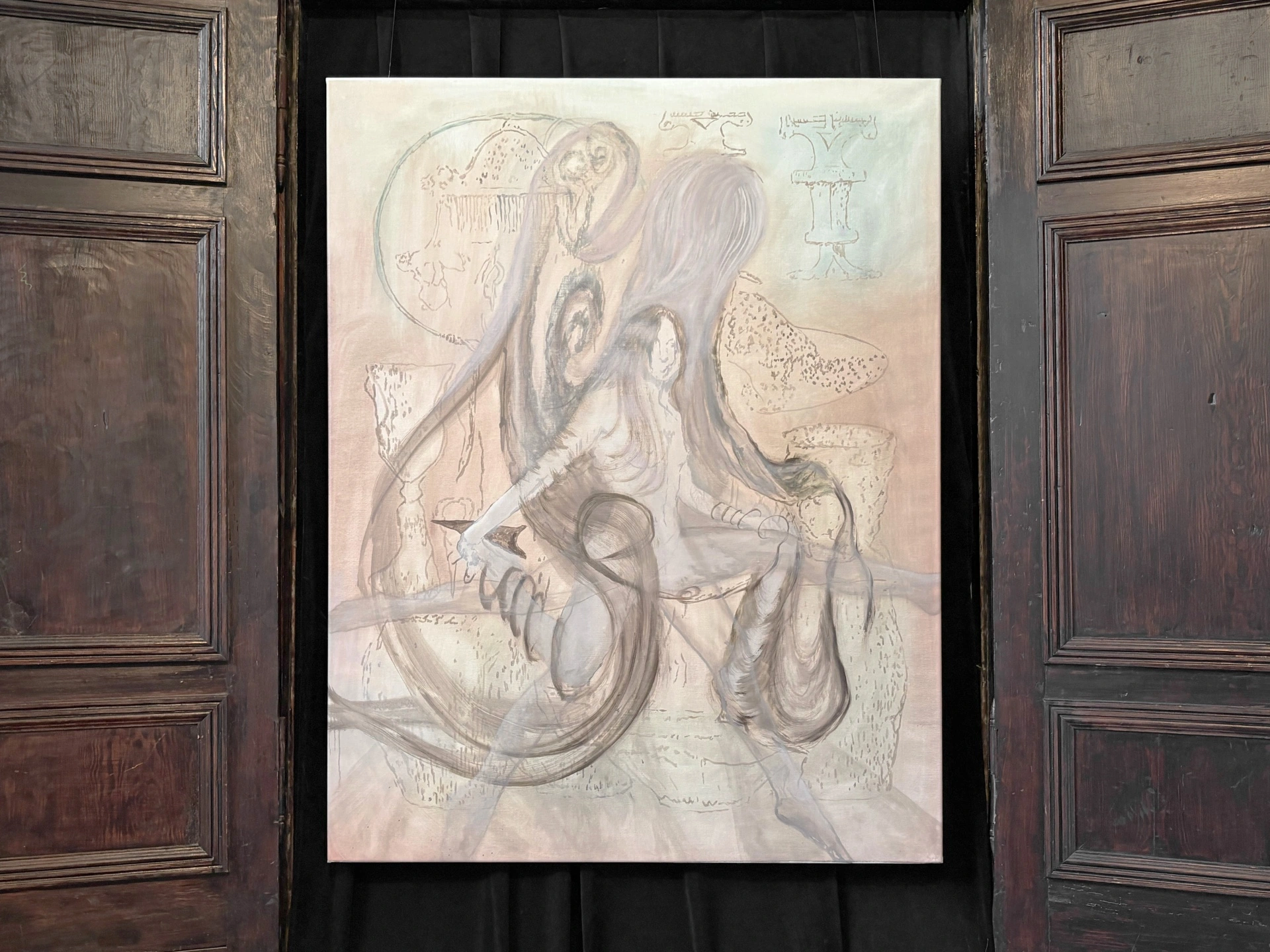
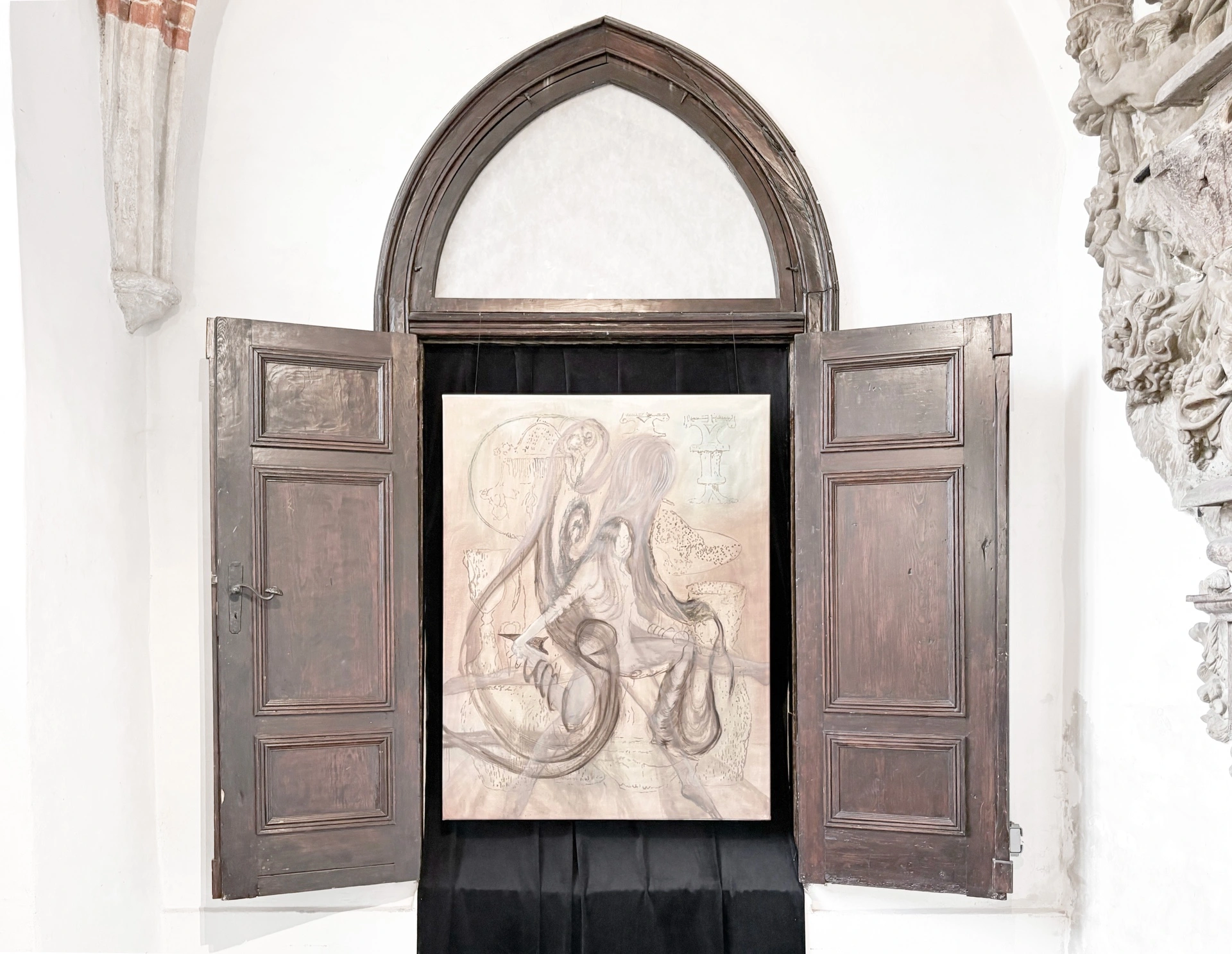
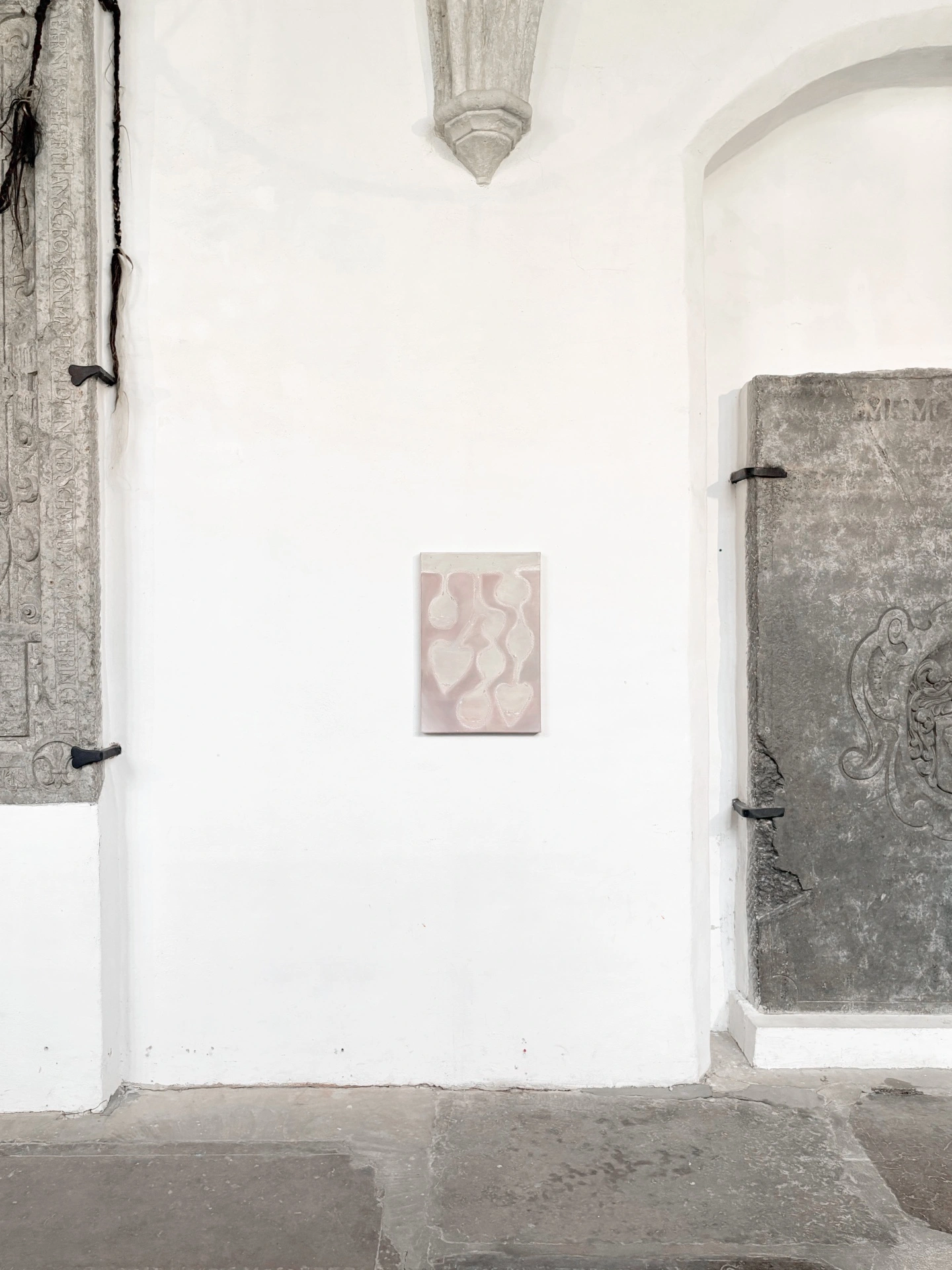
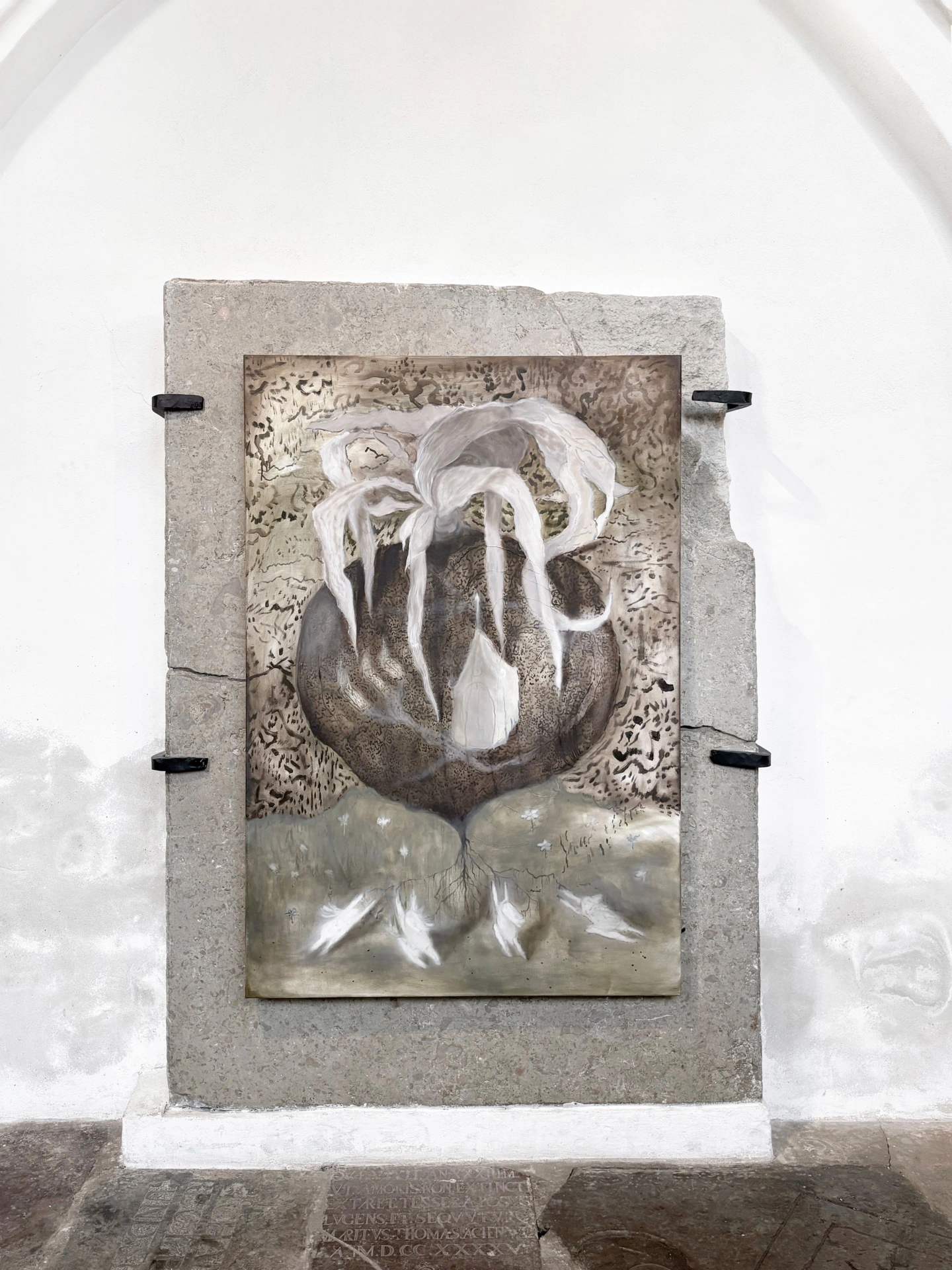
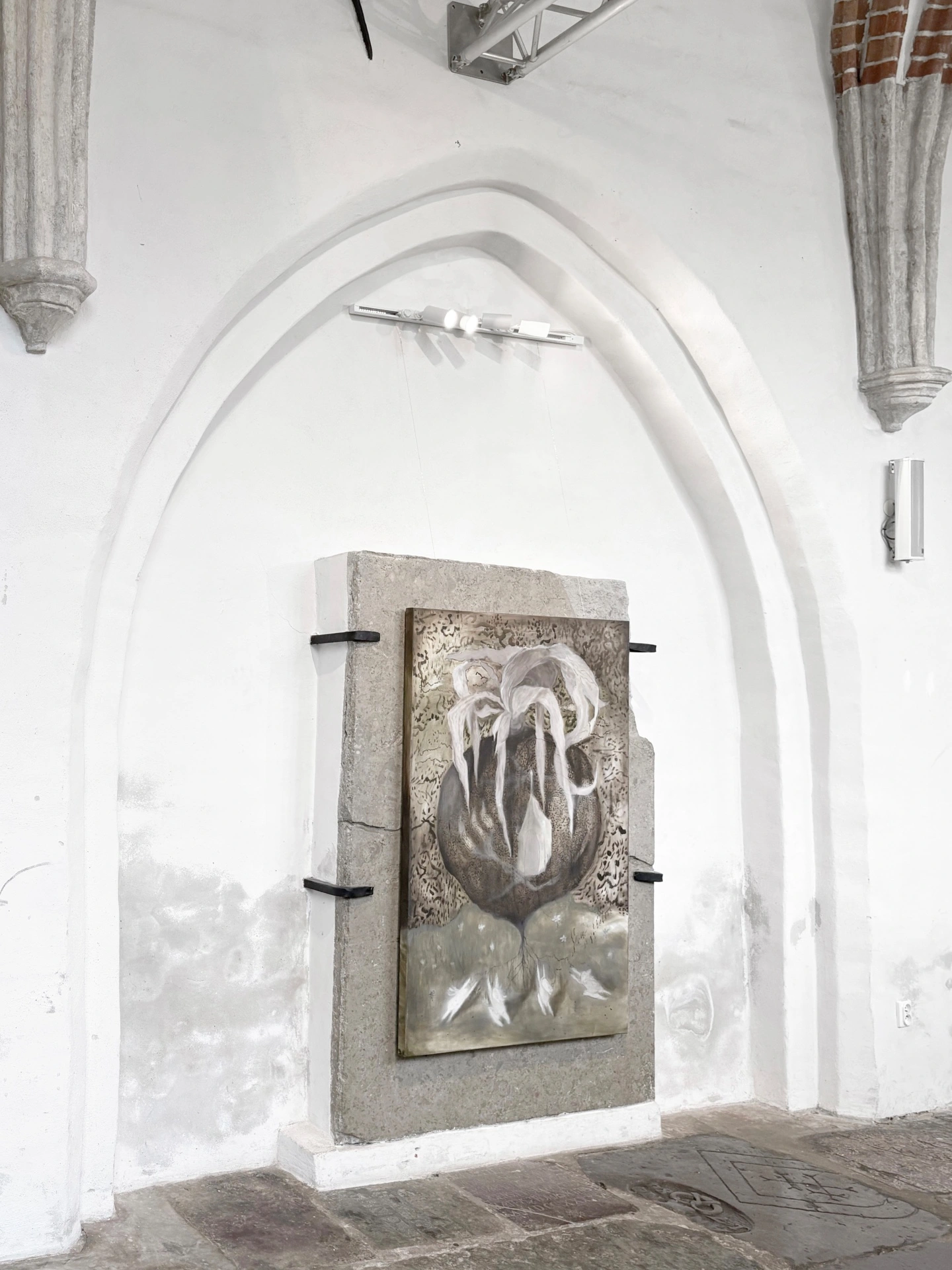
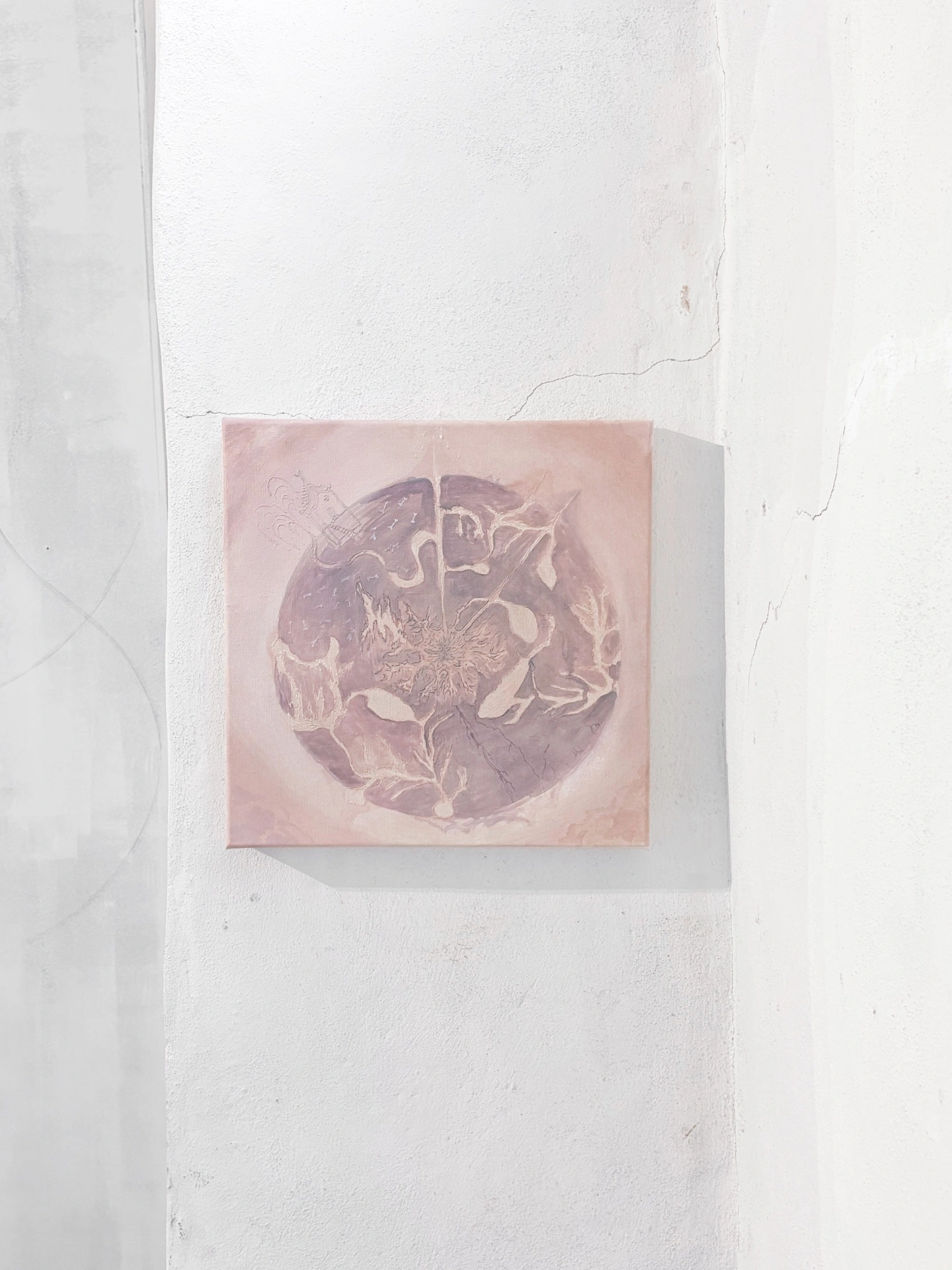
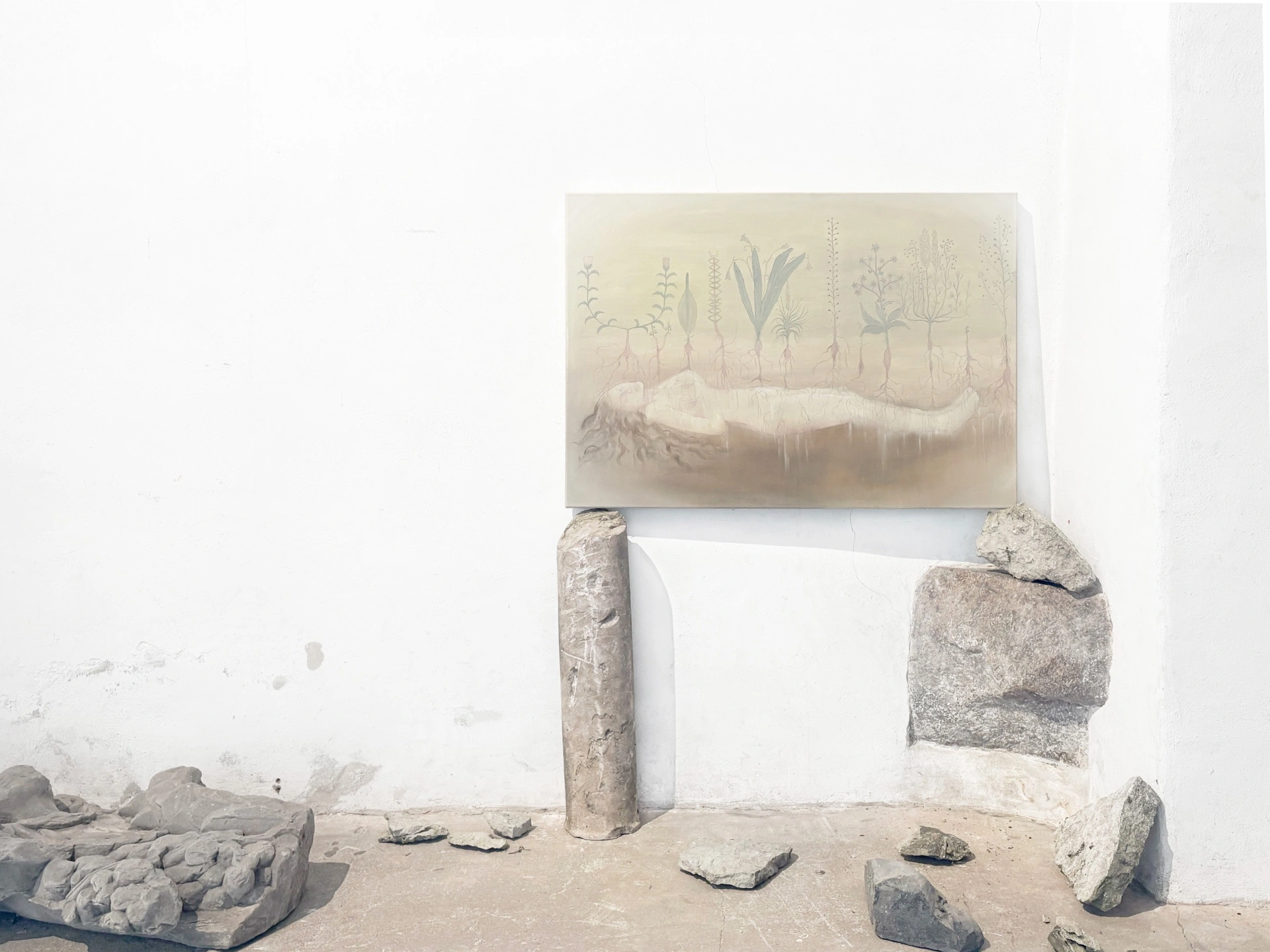
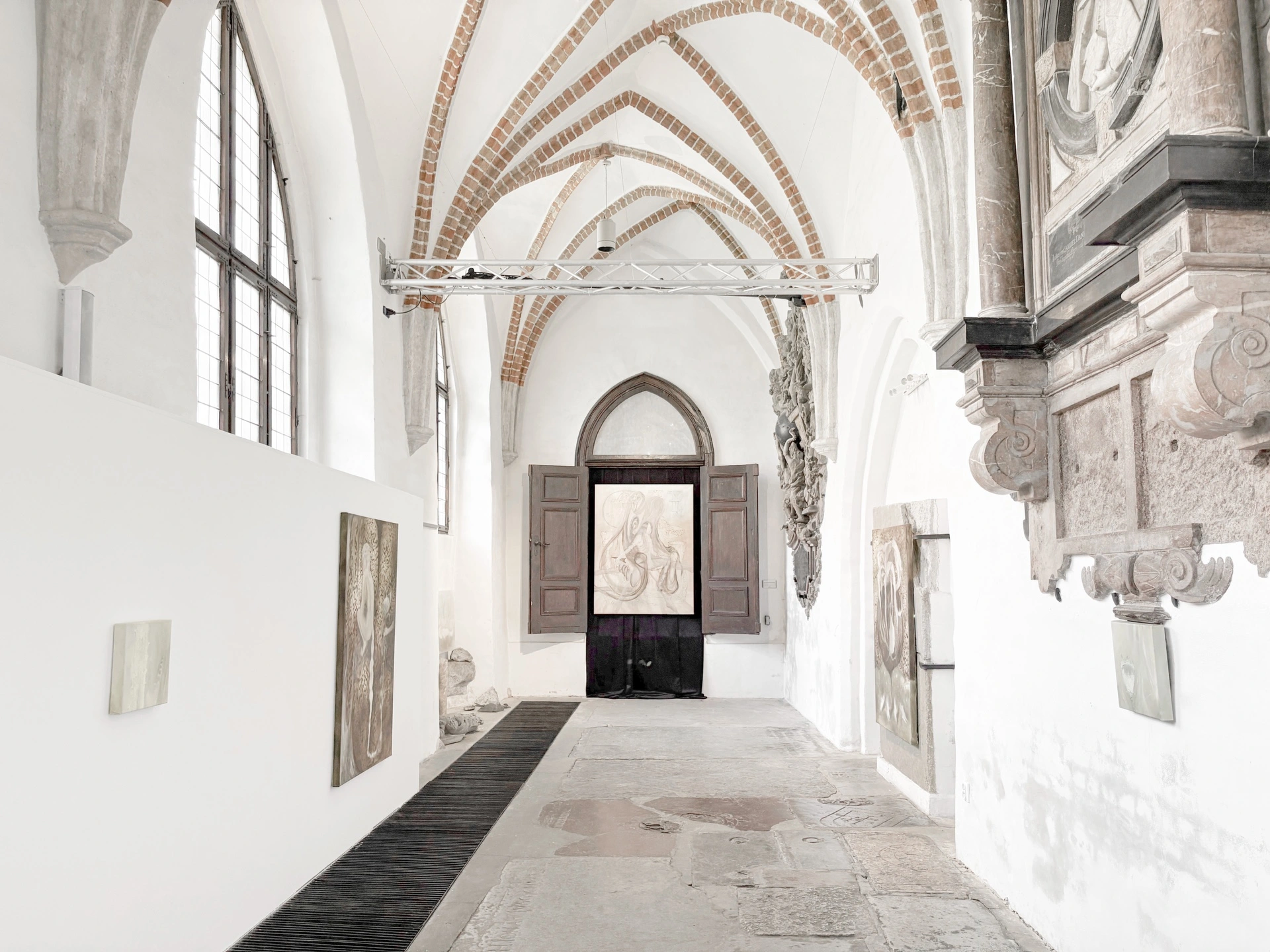
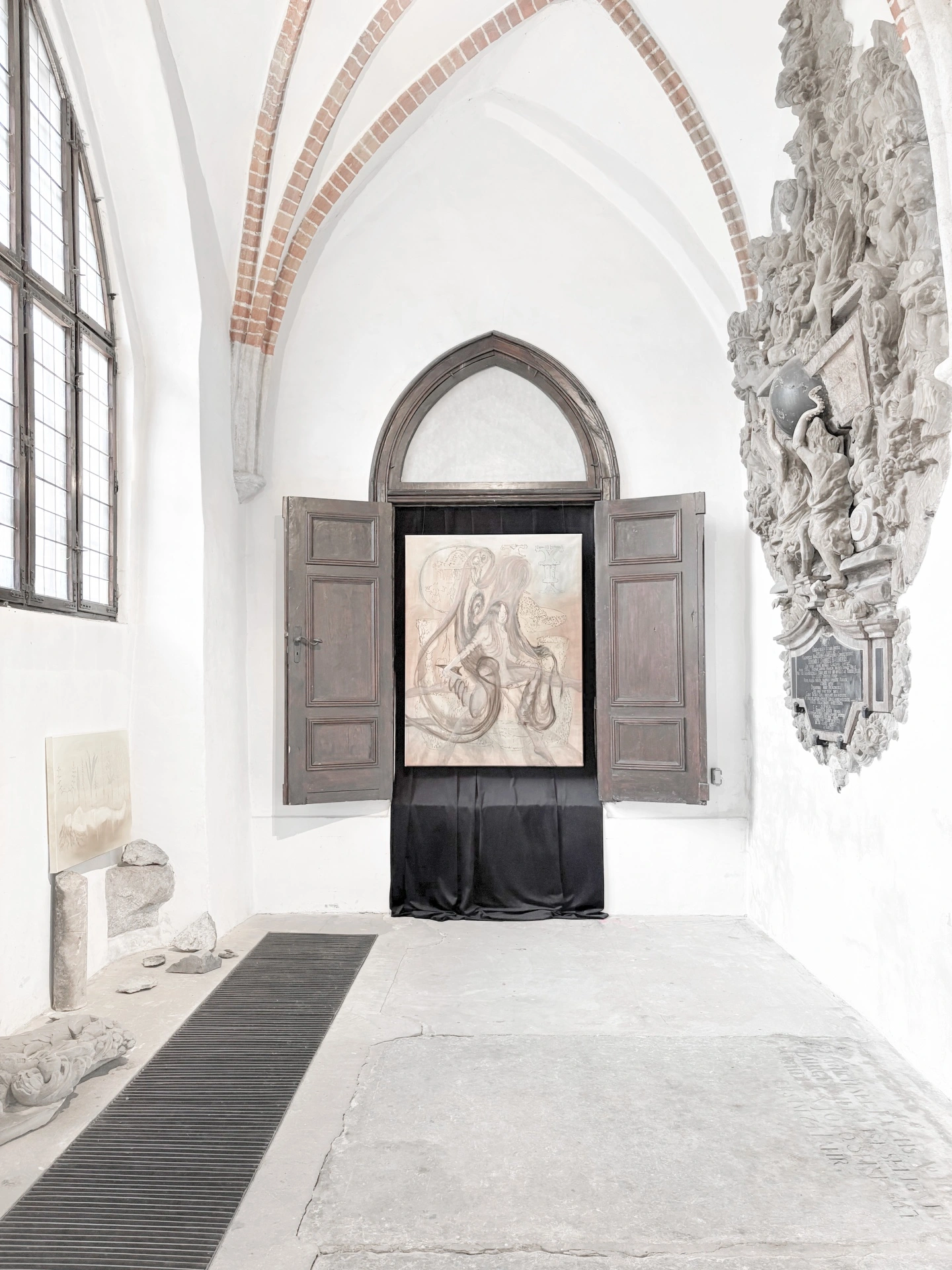
The paintings answer the sculpture in a lower register. Worked in oil and modeling paste, they are almost bloodless, washed to the color of old ivory and bruised rose, their figures dissolving as you approach. In Zveny Gor, a seated woman turns her back, her hair unspooling into serpentine coils that overwrite the diagrammatic marks around her, part astrological chart, part anatomical study. Elsewhere, in Sanctuary, a pale mass sprouts long filaments and feathers, hovering between a seed, an organ, and a shroud. The surfaces are raised, scarred, built up in paste and then abraded back, so that the image feels excavated rather than painted.
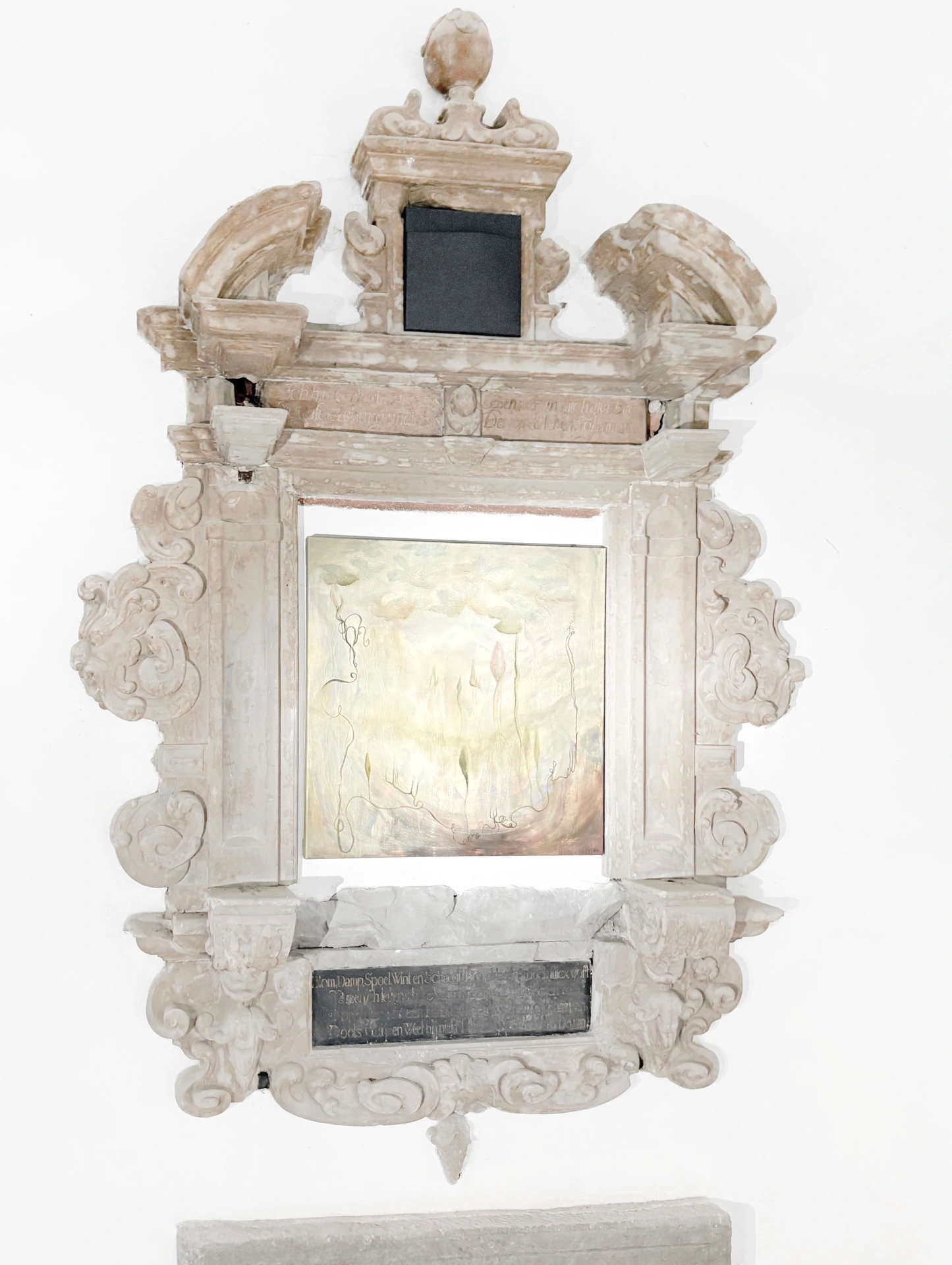
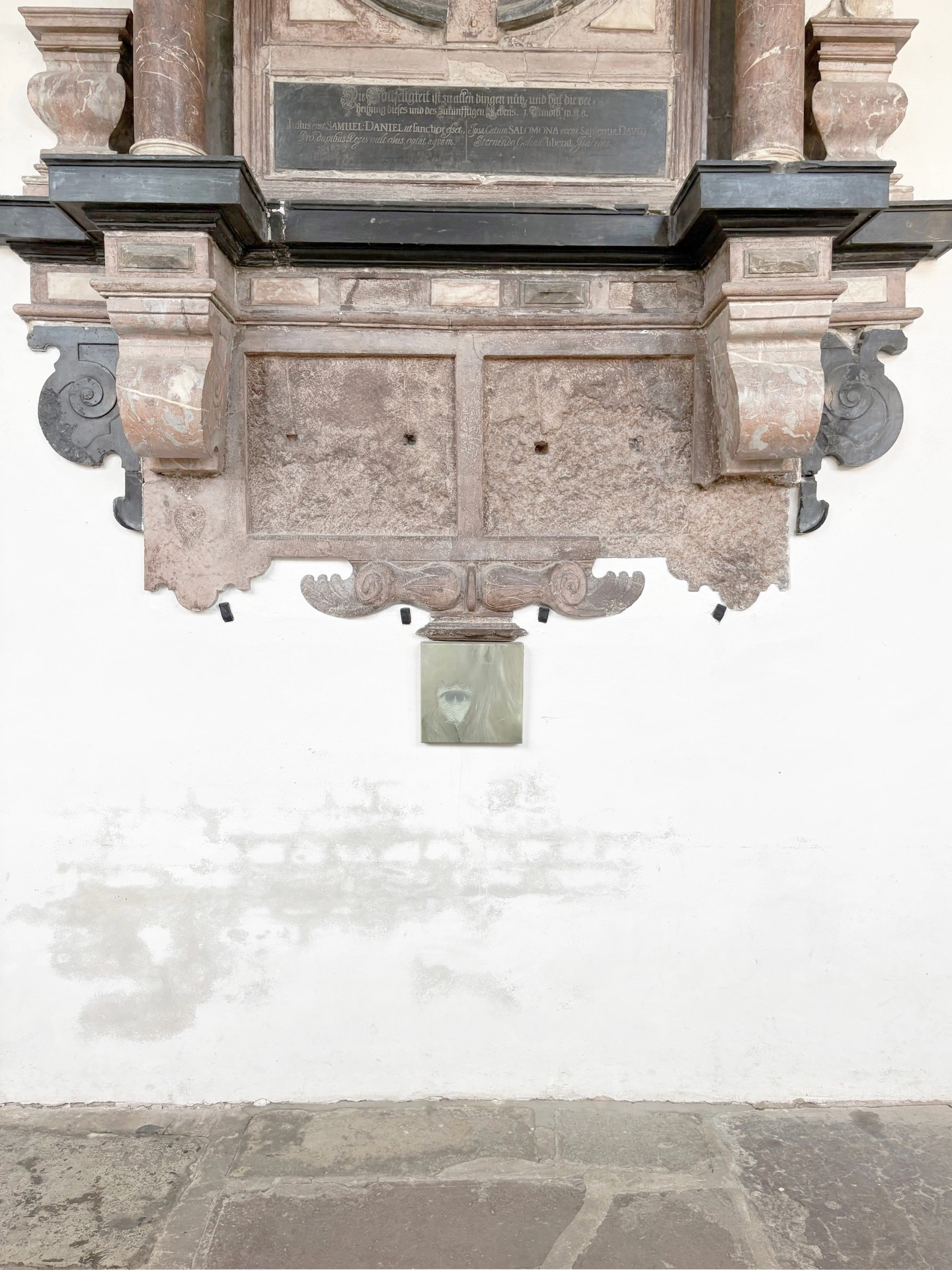
Puff installs them against the church's own memorial apparatus rather than in flight from it. Small canvases are wedged into the carved stone cartouches of Baroque epitaphs, occupying the niche where a portrait of the deceased once sat. A large work is mounted on a slab of raw granite propped like a mantel; another is curtained in black and set inside a pair of opened wooden doors, framed and veiled at once, a painting behaving like a relic in a shrine. The gesture is exact. Across cultures, as the curator Emilia Orzechowska writes, hair “has served as a symbol of strength, femininity, and social status, but also as an instrument of control, humiliation, and subjugation.” Here it is offered up the older way: “preserved in lockets, and placed in reliquaries alongside the remains of saints.”
What makes the show more than a meditation on mortality is the title's double edge. A hairline is the border where hair meets the face, the threshold of a person; a hairline crack is the fracture so fine you feel it before you see it. The exhibition lives in that pun, and it takes it seriously. “Hair continues to grow even when it seems that everything else has already been lost,” the curatorial text begins, and the sculptures test the claim against fracture: the frayed ends, the loosened plaits, the strands that snap and drift. Growth and rupture are not opposites here. They are the same line, read from two directions.
Set inside a Gothic hall stripped of its liturgy, whitewashed, floored with the worn faces of the buried, the work borrows the church's grief without borrowing its consolation. There is no resurrection on offer, only persistence: the keratin that outlasts the flesh, the braid a mother might have kept, the inheritance that arrives strained and knotted and undeniable. This is what the show finally proposes, in Orzechowska's phrase, “the bonds that, even when strained or fractured, never disappear entirely.”
Not a monument, then, and not a mourning. A line held under tension between two hands that let go at different times. Hair keeps growing in the dark after the body stops, the way love keeps arriving after the person is gone, addressed to no one, refusing to end.