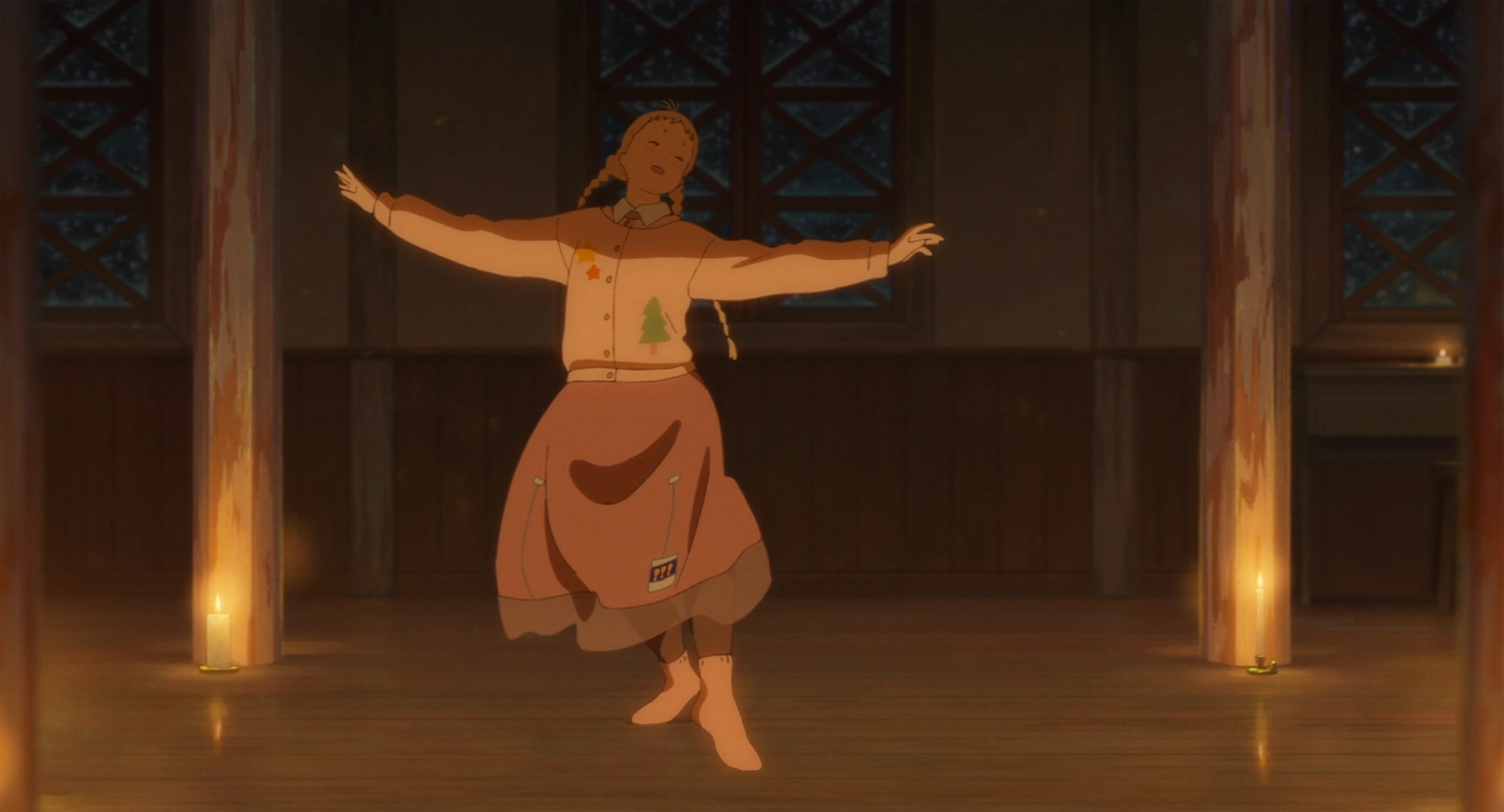
With Science Saru, Naoko Yamada leaves the crystalline edges of Kyoto Animation behind and composes a film that unfolds the way watercolour spreads on wet paper, a music-driven coming-of-age study in which the ordinary mechanics of high school (classrooms, dodgeball, a ferry timetable) are suspended inside something closer to a private liturgy.
The film opens inside a church, inside a shaft of rose-gold light falling across a madonna and child. The vertical bars of a stained window strobe warm and cool against her veil. The statue is not the object of worship. The light is. Yamada's camera reads the architecture of Catholic devotion the way a believer reads it, from the knees up, attentive to the way a room prepares a body to kneel. This is the ground the rest of the film will stand on. Not a plot about faith, but a grammar borrowed from it.

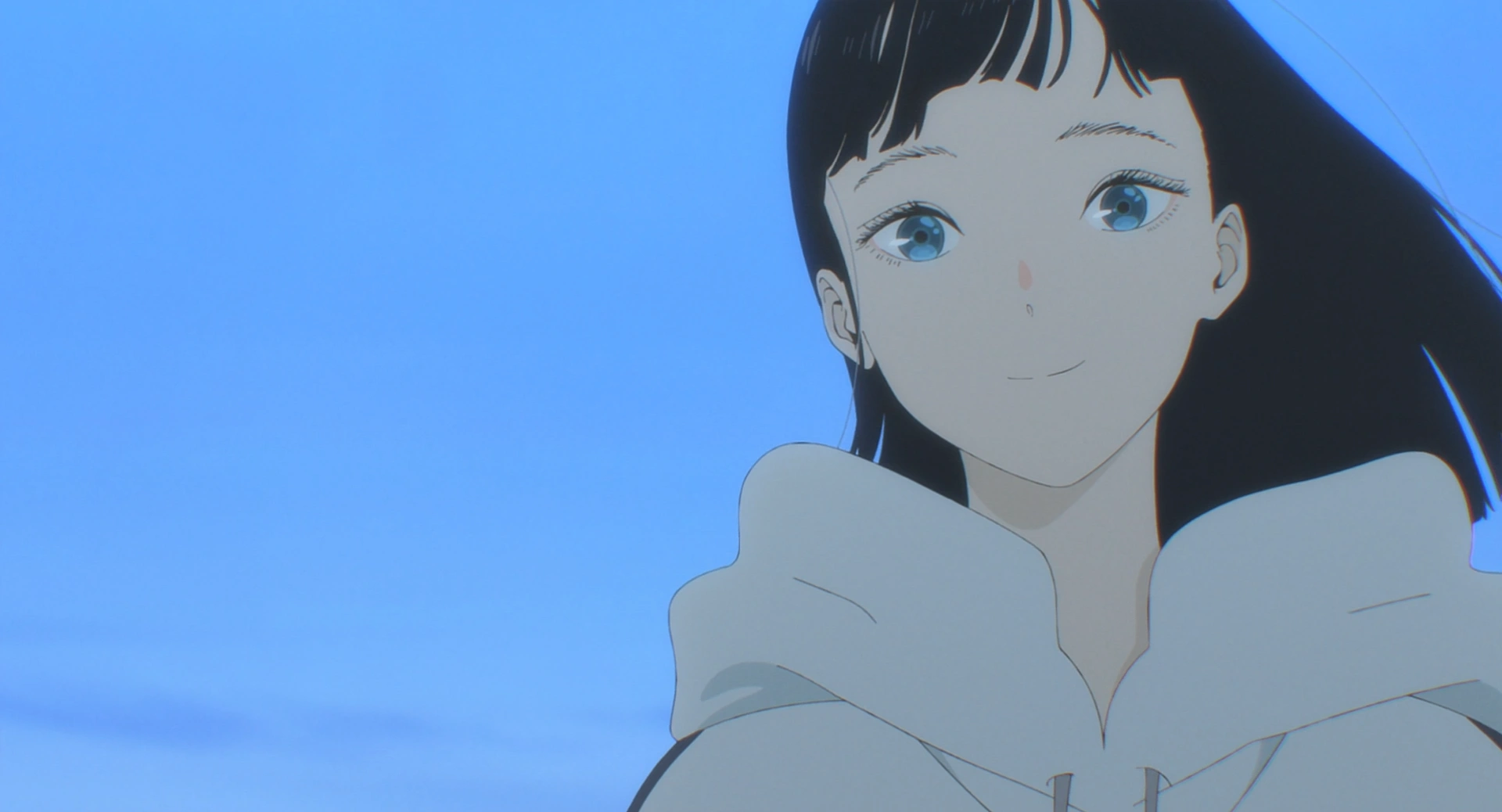
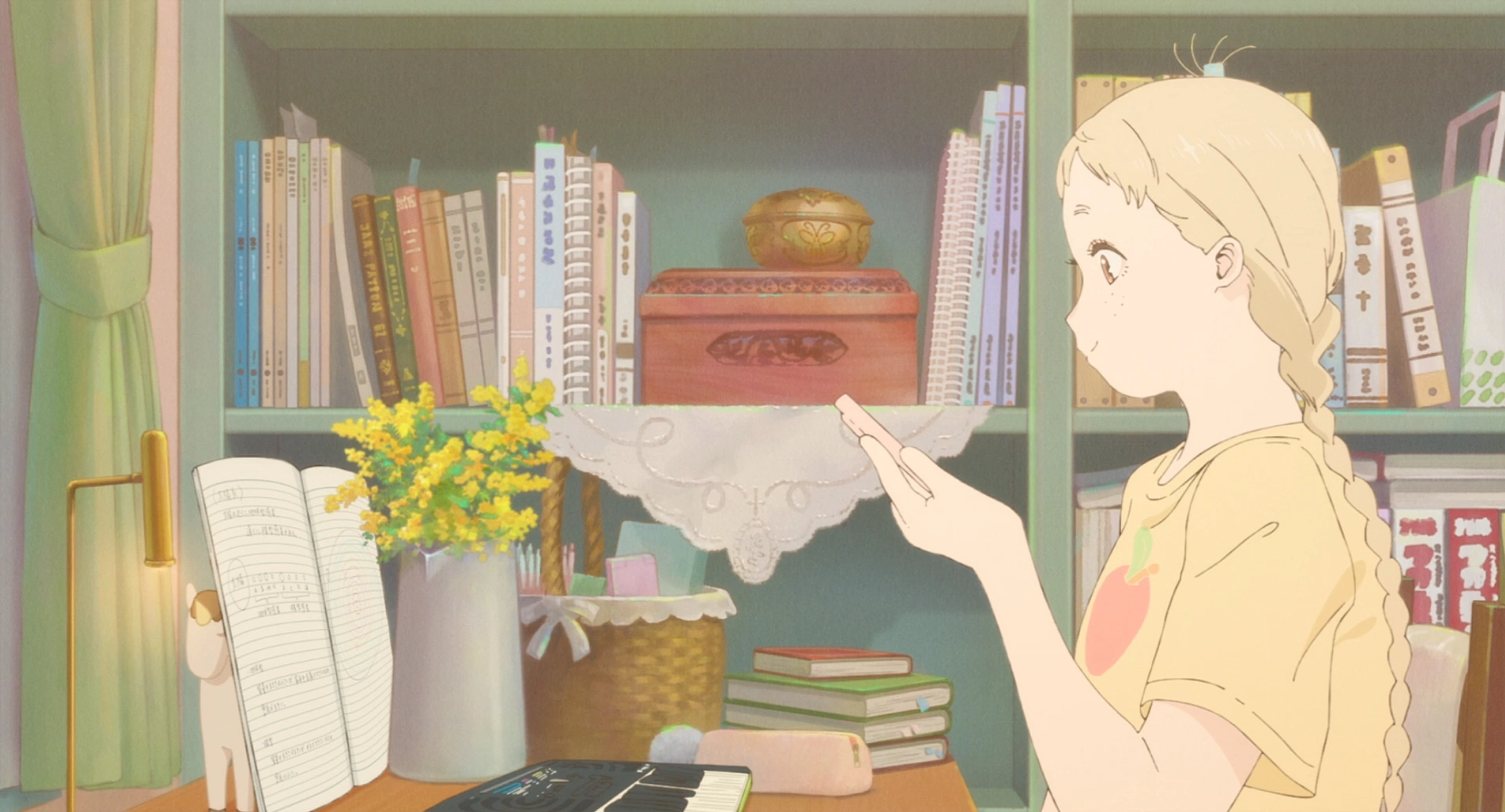
Her protagonist, Totsuko, kneels in a cavernous sanctuary of mint-green columns and a magenta aisle carpet, a blonde girl alone in the pews, head bowed. She prays the serenity prayer. Since childhood she has seen people as colours. The condition is never pathologised. It is rendered as a watercolour halo her consciousness paints over the world, a second skin of pigment that lifts off certain bodies and settles on others. Kimi's blue, first encountered as Kimi walks through a corridor, is less a colour than a bell struck in another room. Rui's green arrives in the warm gloom of a used bookstore. Totsuko's own colour she cannot see.
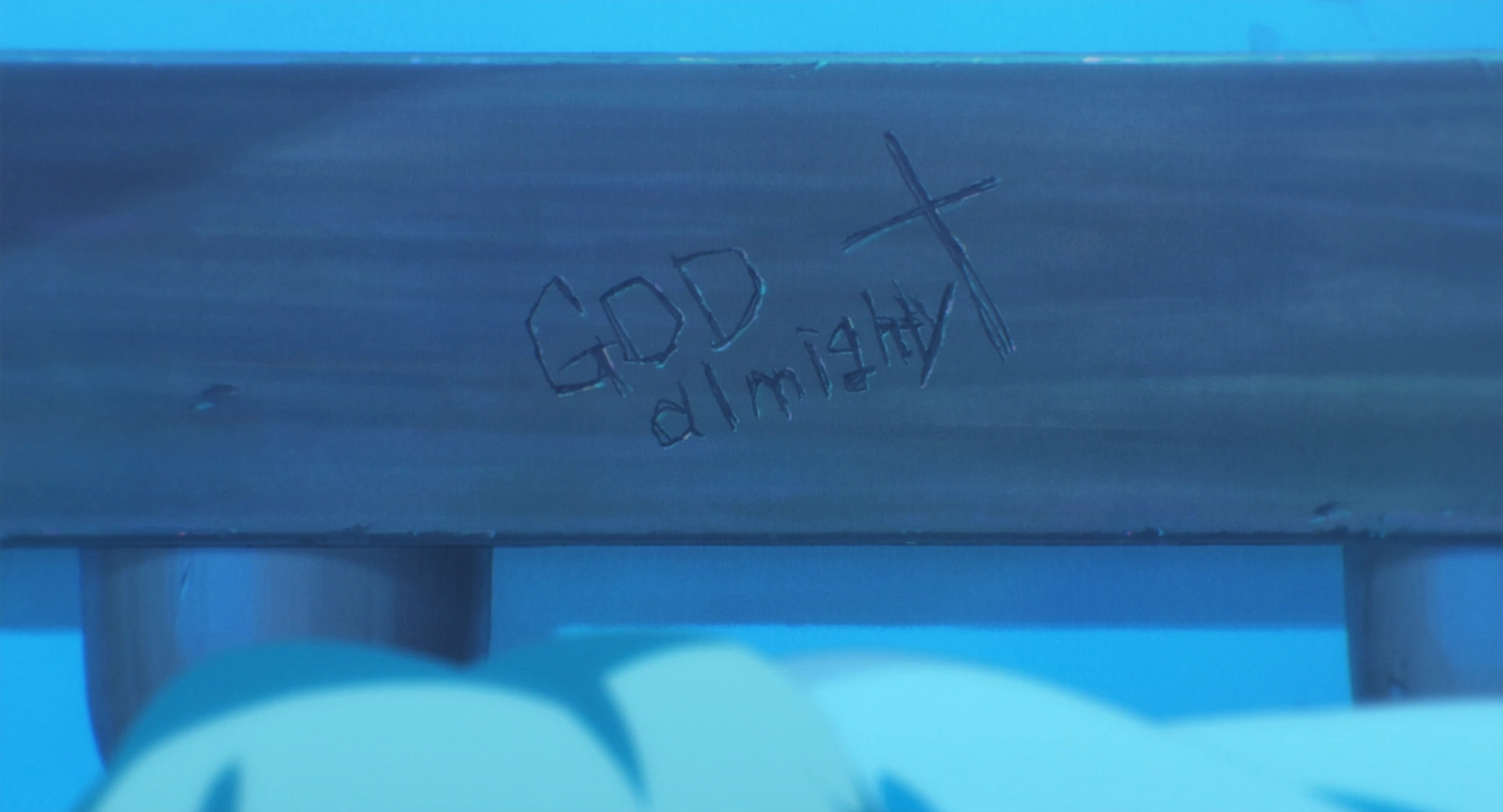
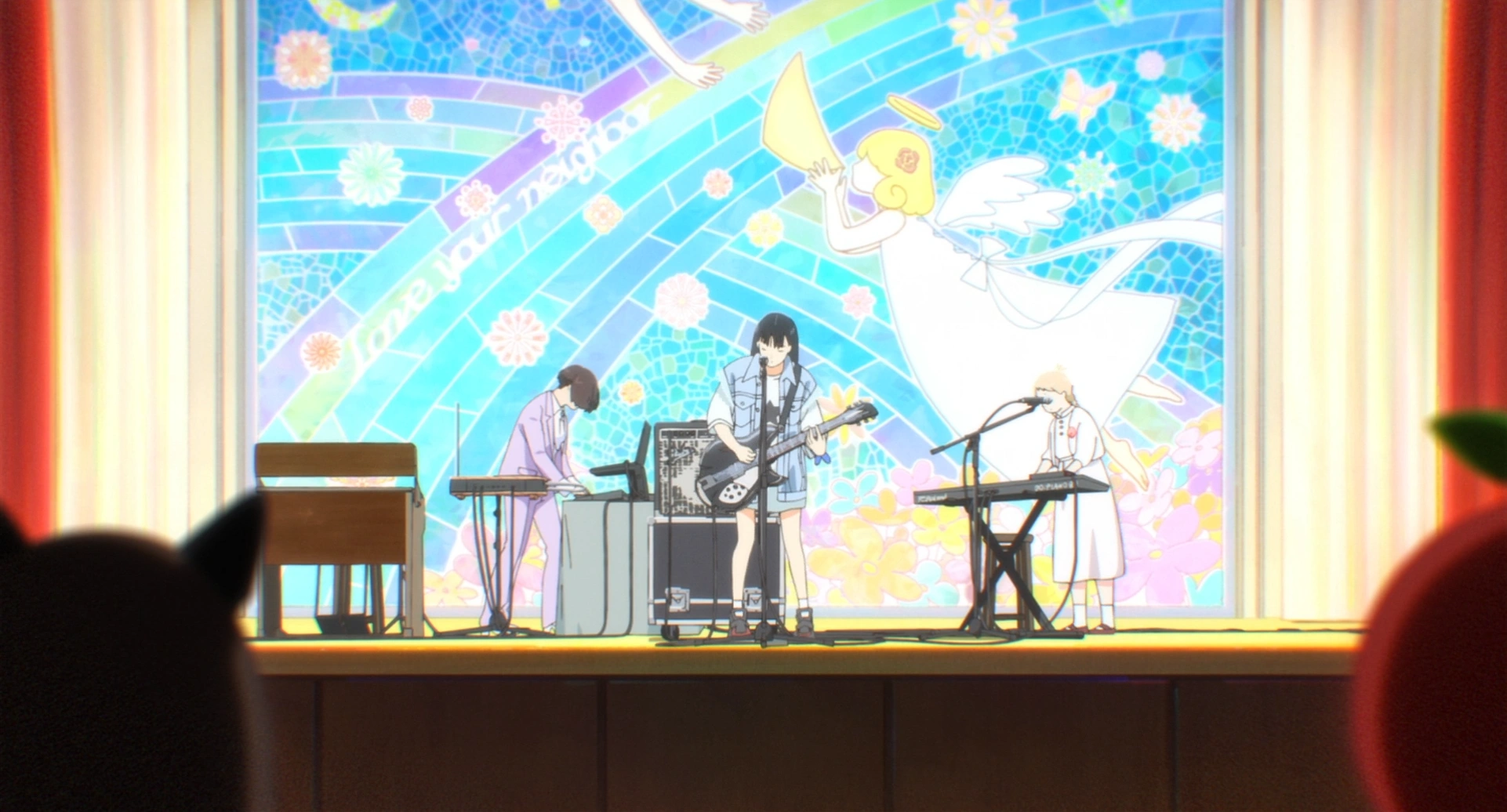
The house of their rehearsals is a small abandoned church on an island, reachable only by ferry. The band amasses amplifiers, a theremin, a roland keyboard under a stained-glass panel of a mosaic angel on a rainbow of crushed tiles. On one of the wooden pews, someone long before them has scratched god almighty with a cross beside it, in a schoolgirl's lettering. The image is the film's joke and its thesis at once. The sacred is already graffitied. Devotion is already vernacular. The church is already a rehearsal space. Yamada does not stage a conflict between catholicism and adolescence. She lets them share the same wood.

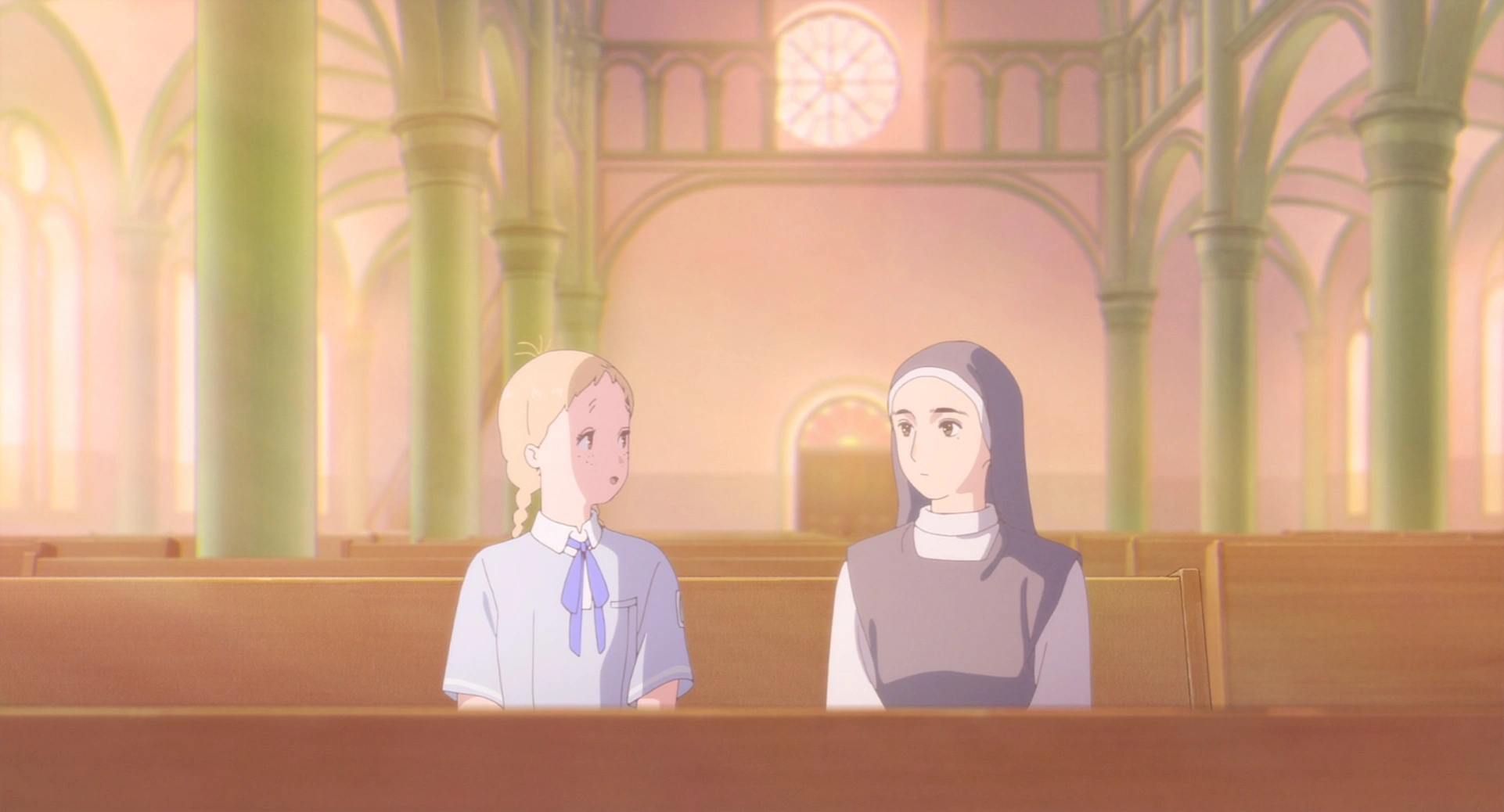
Sister Hiyoshiko, in profile against a cream wall, her veil the grey of a winter sea, is the film's quiet pivot. She counsels Totsuko on the meaning of the word “hymn”, a song, she says, that is “both a celebration of joy and a vessel for the sorrow of the soul”. The sentence could be a gloss on the whole film. Yamada positions music and religion as equivocal lanes for seeking understanding, “a hymn only as powerful as the feeling that it provokes”. The writing of the trio's setlist, Totsuko's ice-cream lyrics next to Kimi's song about anxiety's creeping specter, is not a clash of tones but two registers of the same practice. The hymn holds both.
The queer undertone is never announced and never denied. It is the texture of Totsuko's attention to Kimi, of Kimi's attention to the idea that she might have a colour of her own. Yamada's camera pulses slightly in and out of focus in intimate scenes, cuts away from dialogue on an unexpected beat, frames two girls asleep on the same pillow in a wash of cobalt moonlight with the gridded shadow of a window falling across their bodies. Nothing is articulated. Everything is palpable. This is a continuation of the ambiguous relational charge of Liz and the Blue Bird, developed here into something softer, more diffuse, closer to a collective atmosphere than a love triangle.

The last ten minutes are an uninterrupted concert. A mosaic-glass backdrop of a flying angel in banner-flower colours rises behind the trio. The audience is a crowd of anonymous silhouettes in the red-curtained hall. Kimi fronts the band in a bass guitar and a school uniform, Totsuko on keyboard, Rui on theremin. The sequence is not a showcase of musical proficiency. It is an image of three temperaments briefly fused without losing themselves, a small act of communion that the film has been preparing all along. The screen resolves into the three of them, then into nothing. Not a conversion, but a permission. Not transcendence, but the grace of a few minutes in which each of them is visible in their own colour, and the colours for the first time agree.