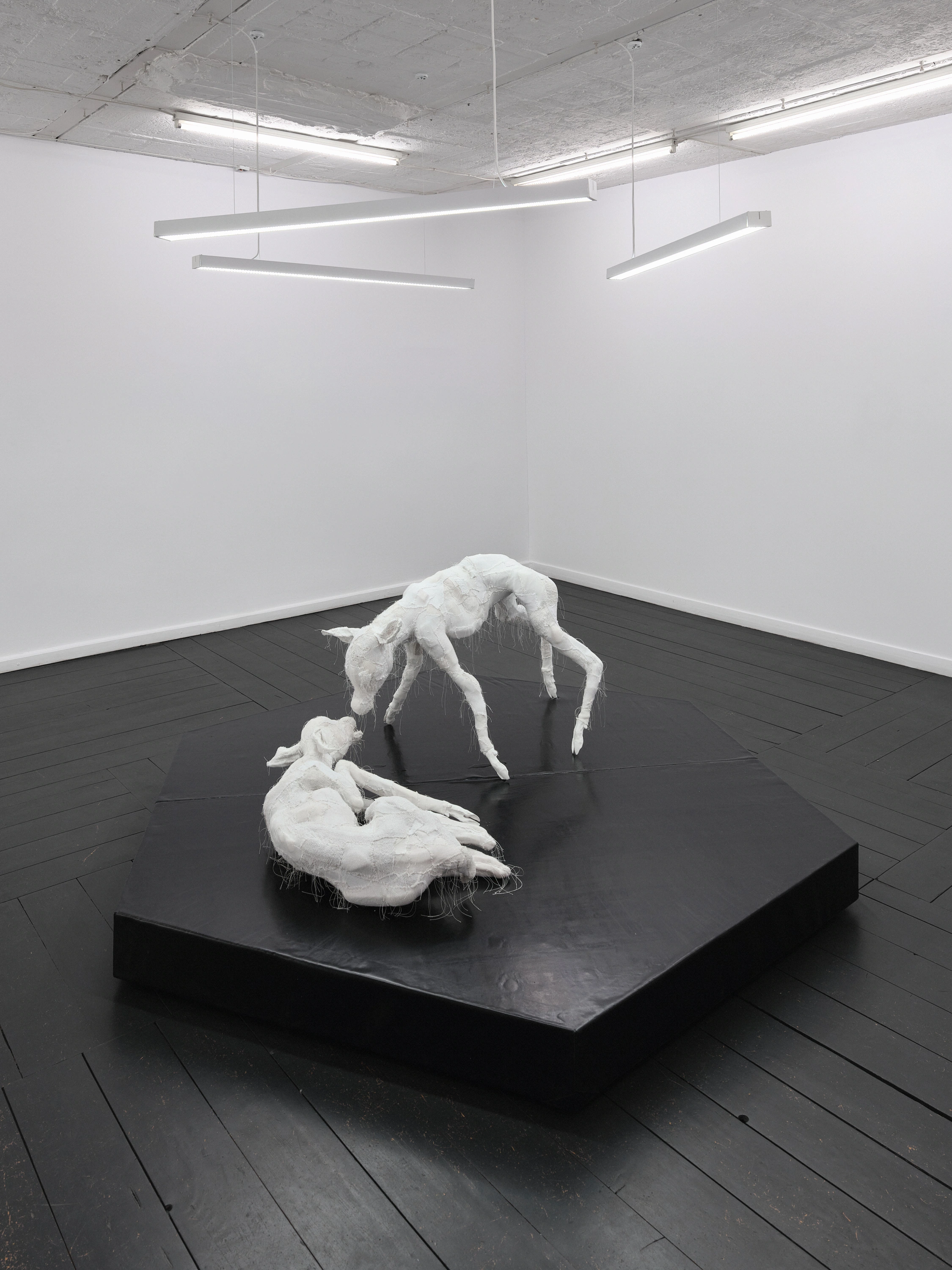
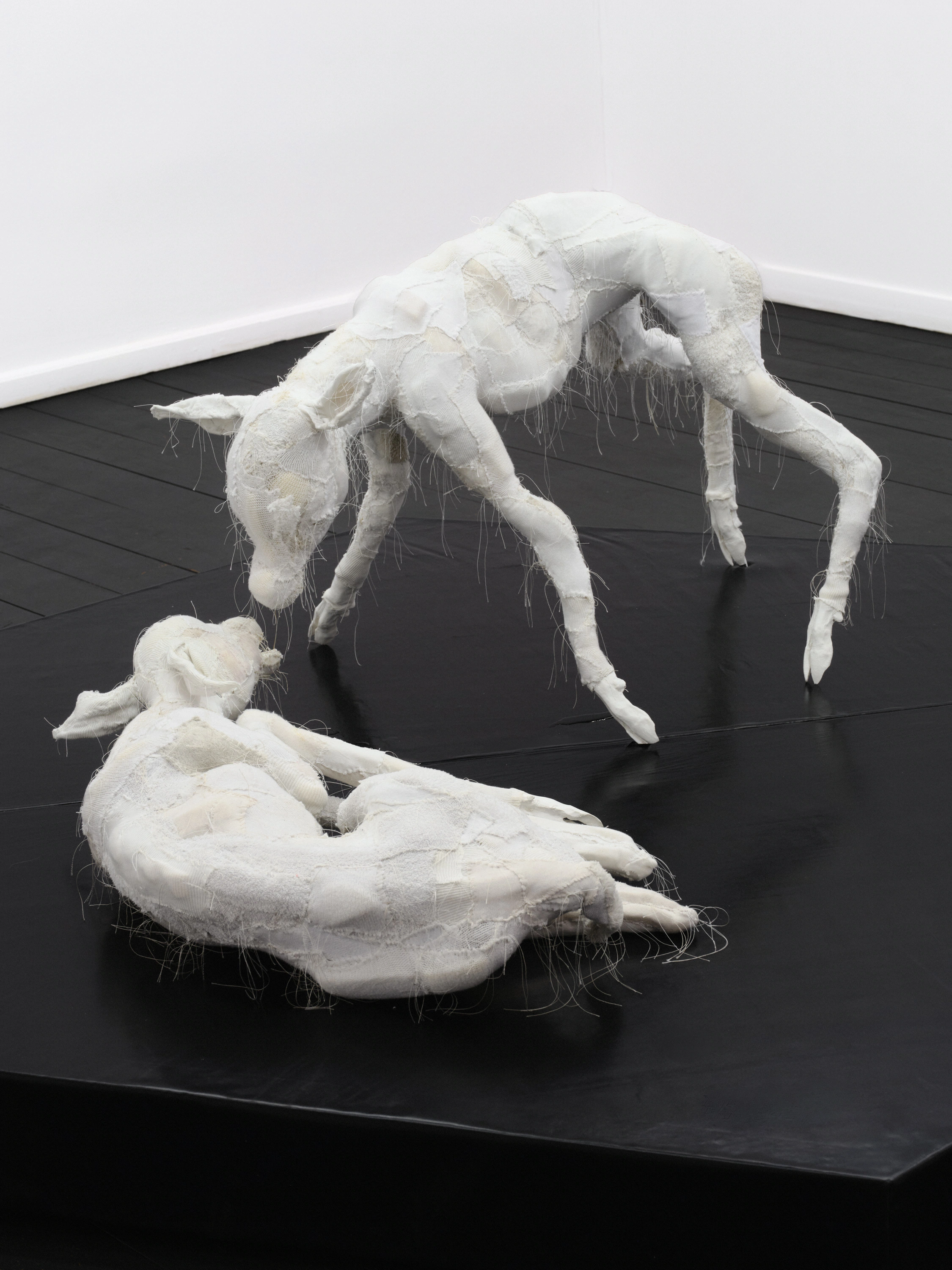
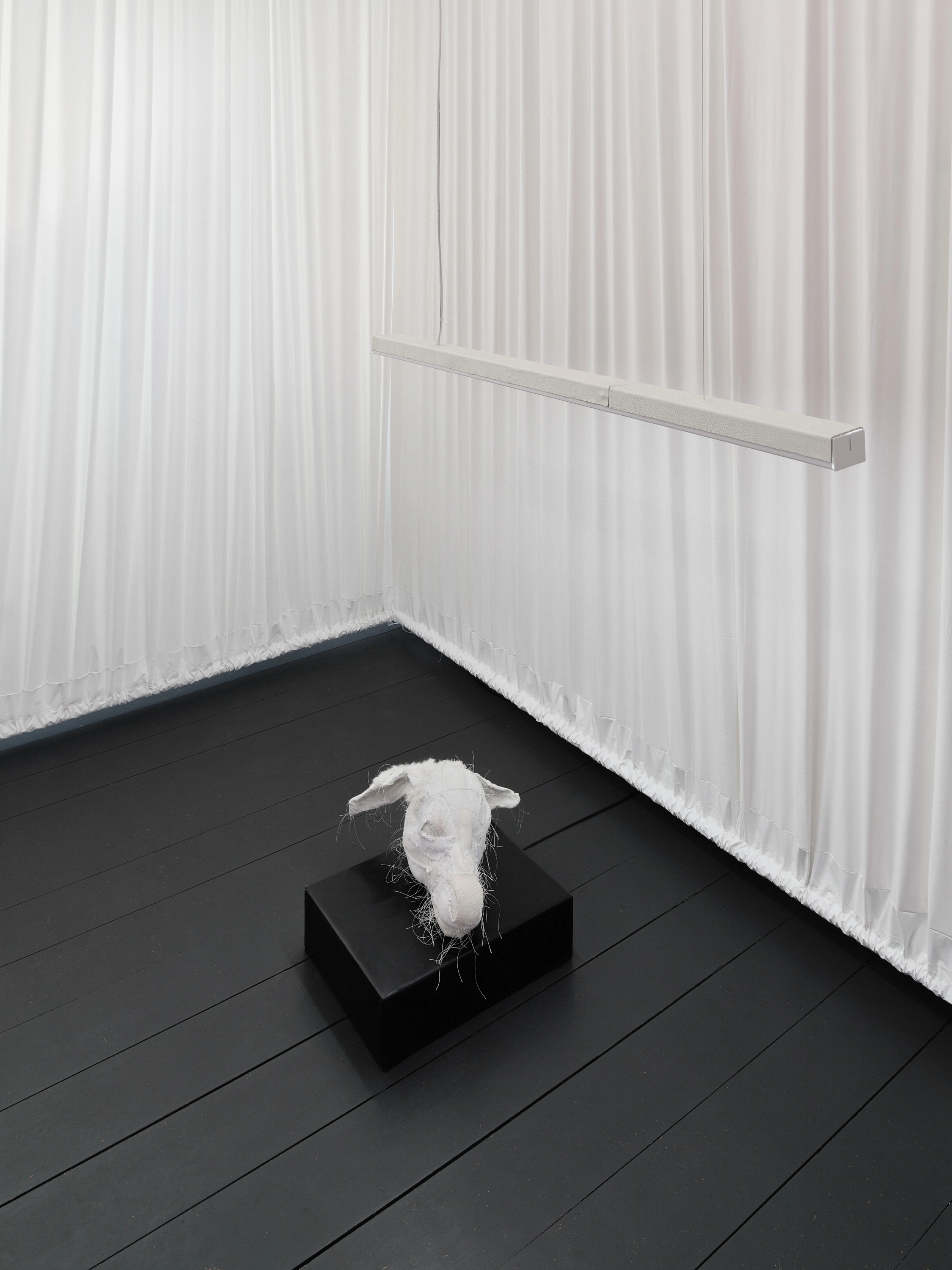
Two albino roe deer joined by synthetic saliva, and a third kept outside the exchange with nothing but a song: at WHOISPOLA in Warsaw, Jan Baszak builds intimacy as a closed circuit and leaves the lament to whoever is left over.
The reciprocal pronoun is an odd piece of grammar. It cannot be the subject of a sentence, it refuses to say who gave and who received, and old usage manuals reserve it for pairs. The exhibition’s title, Within and For Each Other, comes from Part II of Adam Mickiewicz’s Forefathers’ Eve, a drama of the village rite in which the living call up the dead and feed them, and the phrase reads less as a quotation than as a diagram: a preposition of interiority, a preposition of offering, hung on a word with room for exactly two.
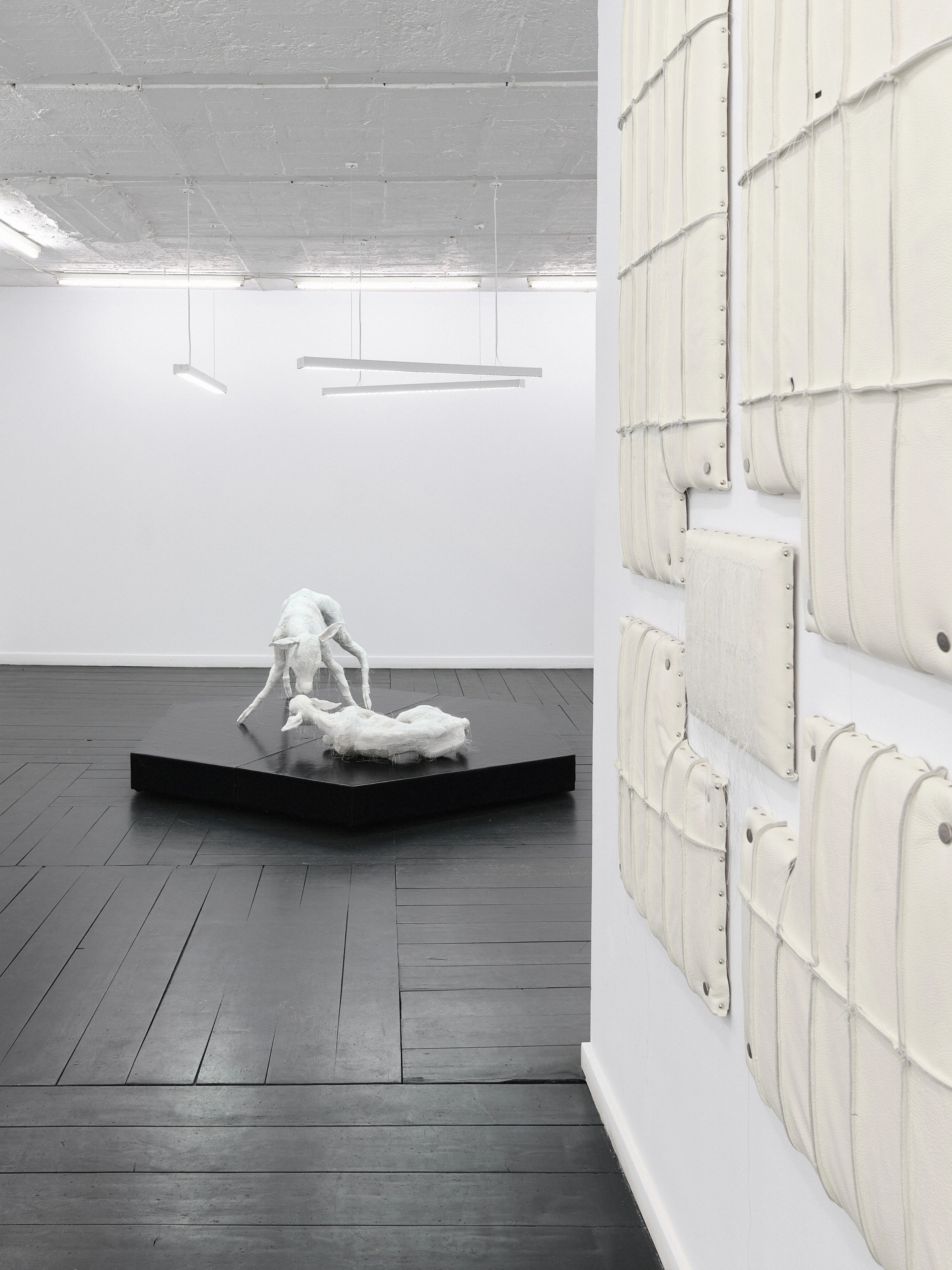
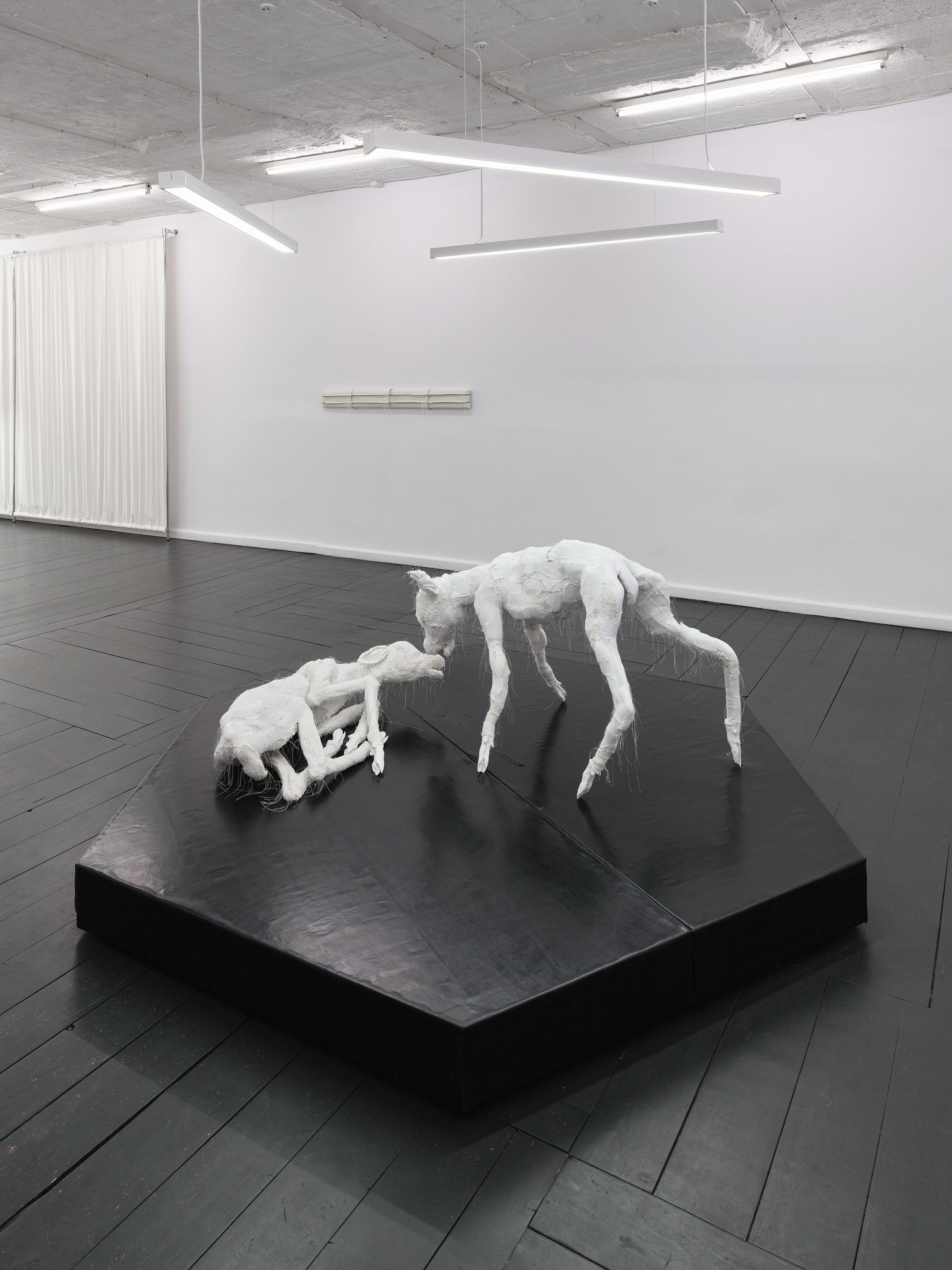
The works start from an observation: two young deer exchanging saliva. In the piece that gives the show its name, the pair returns as albinos in steel, PVC tubes, upholstery foam, cotton, acrylic, polyester, polyester thread and epoxy resin, a vocabulary of scaffolding, plumbing, padding and repair. Last on the list: synthetic saliva, the one substance that ought to be most private and the one thing here no body produced. Intimacy is not found and preserved but manufactured and administered, and the work never pretends otherwise.
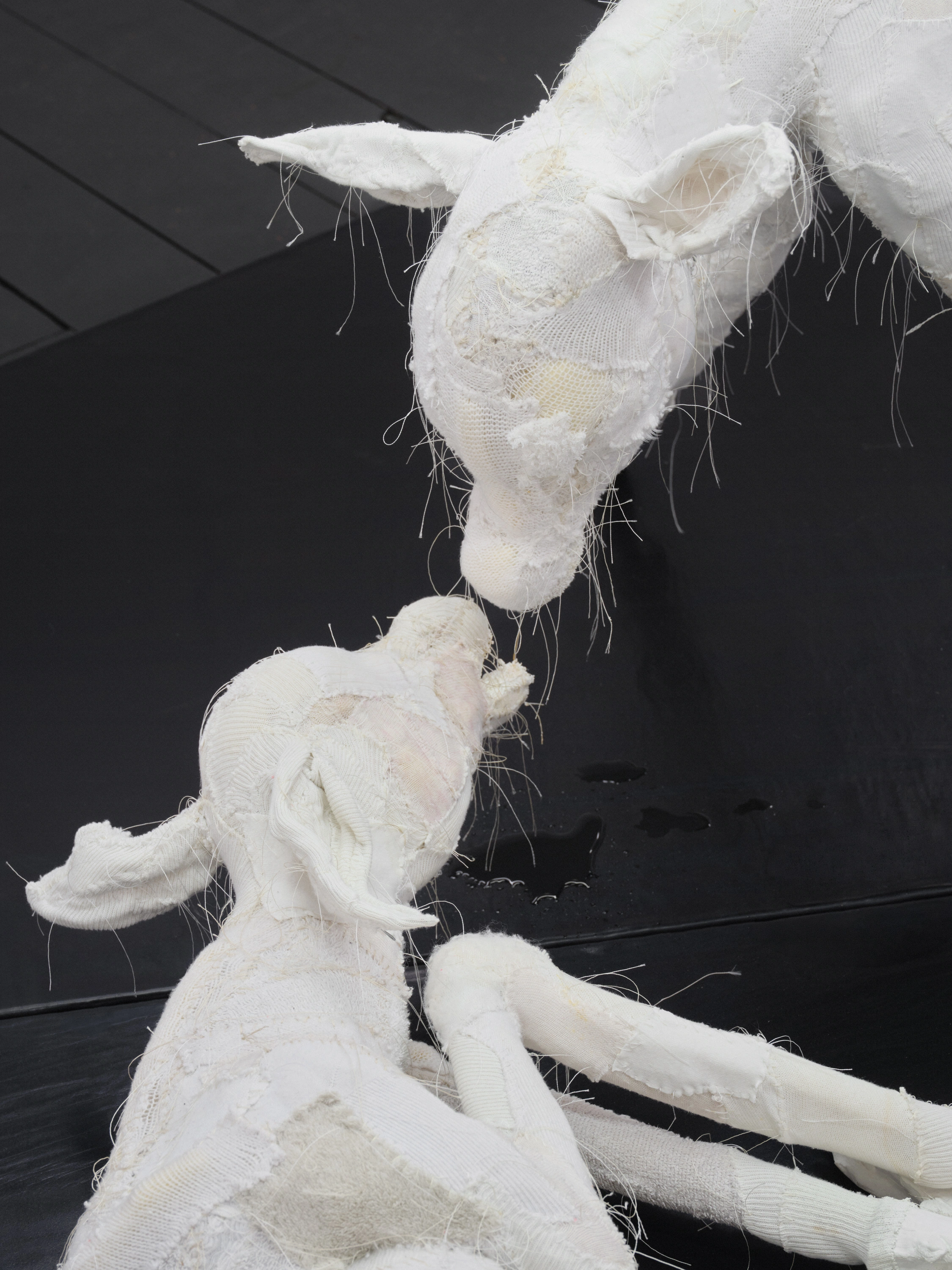
The press text is careful about what the observation means: “While this biological gesture carries no symbolic meaning in the animal world, from a human perspective it evokes intimacy, care, disgust, and the crossing of boundaries.” The sentence is more radical than it looks: it moves meaning out of the act and into whoever stands beside it. Between deer, saliva is only saliva; it becomes tenderness or revulsion once a third party needs it to signify. The pronoun has room for two, and the viewer is not one of them.
Sebastian Cichocki’s exhibition text reads the saliva as ectoplasm, recalling that at séances “ectoplasm served as an esoteric lubricant: it facilitated contact between beings from two worlds.” The comparison holds, with one difference: a séance has sitters, the living who came to hear from the dead, and here there are none. Each deer is medium and apparition at once, and whatever passes between them never leaves the pair: not a channel to the other side but a loop, contact as its own end rather than a service rendered to the living.
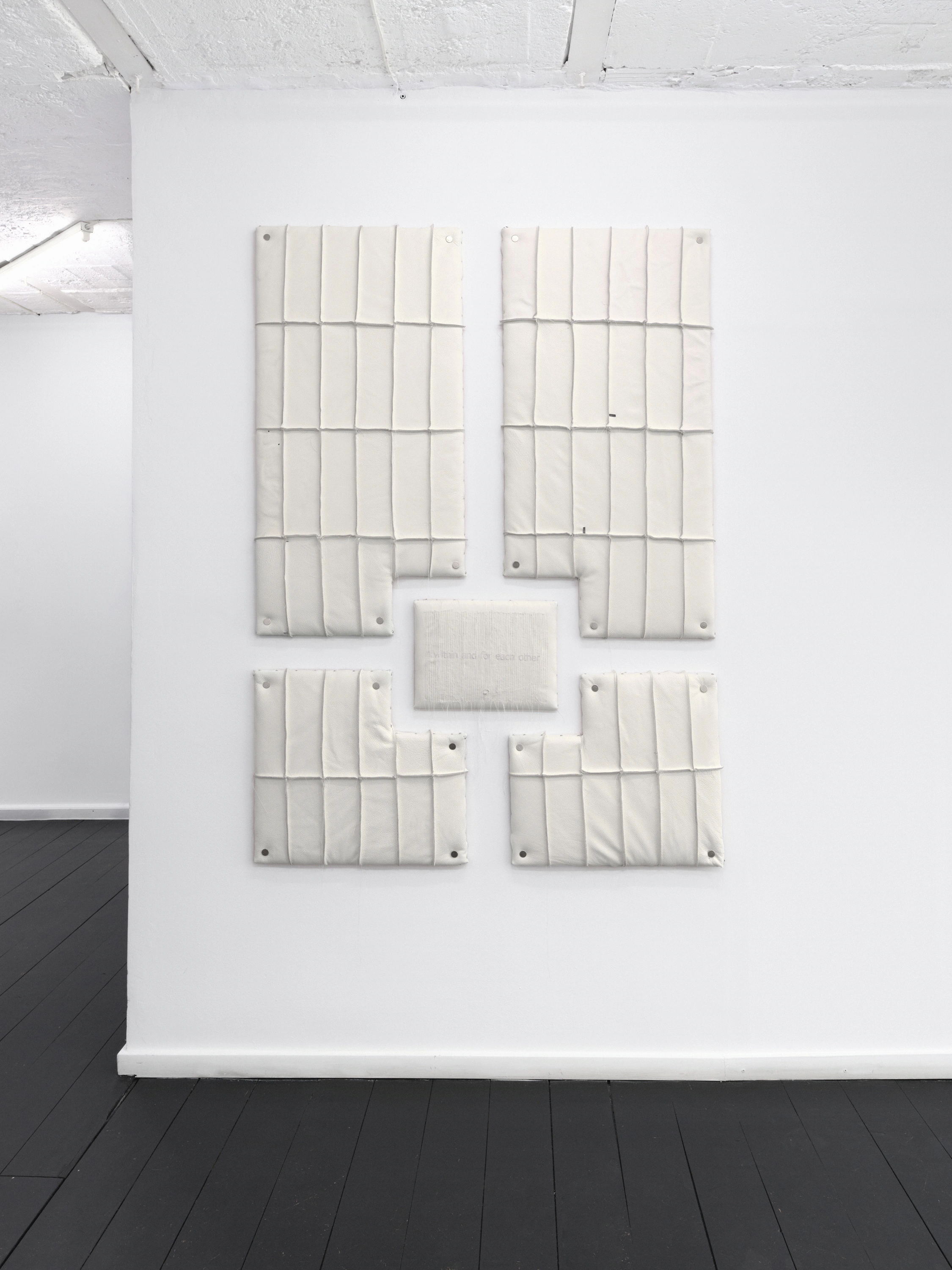
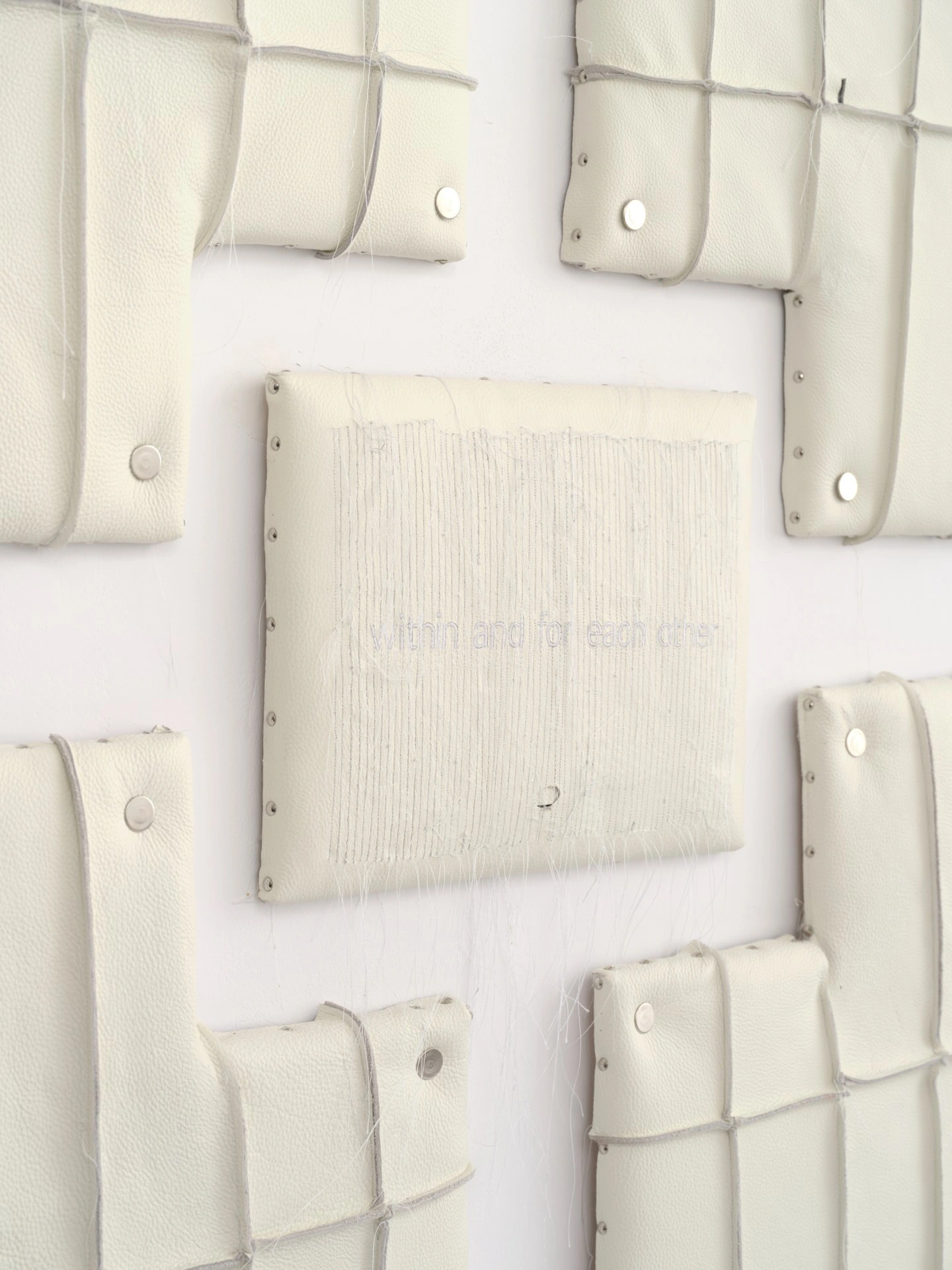
The first preposition is meant literally. Other animals are already inside these bodies: rabbit fur goes into the third roe deer, recycled leather, hide in its second life, into every relief. Tenderness here is underwritten by the most ordinary economy of animal use. To be within is also to be made of someone else’s remainder.

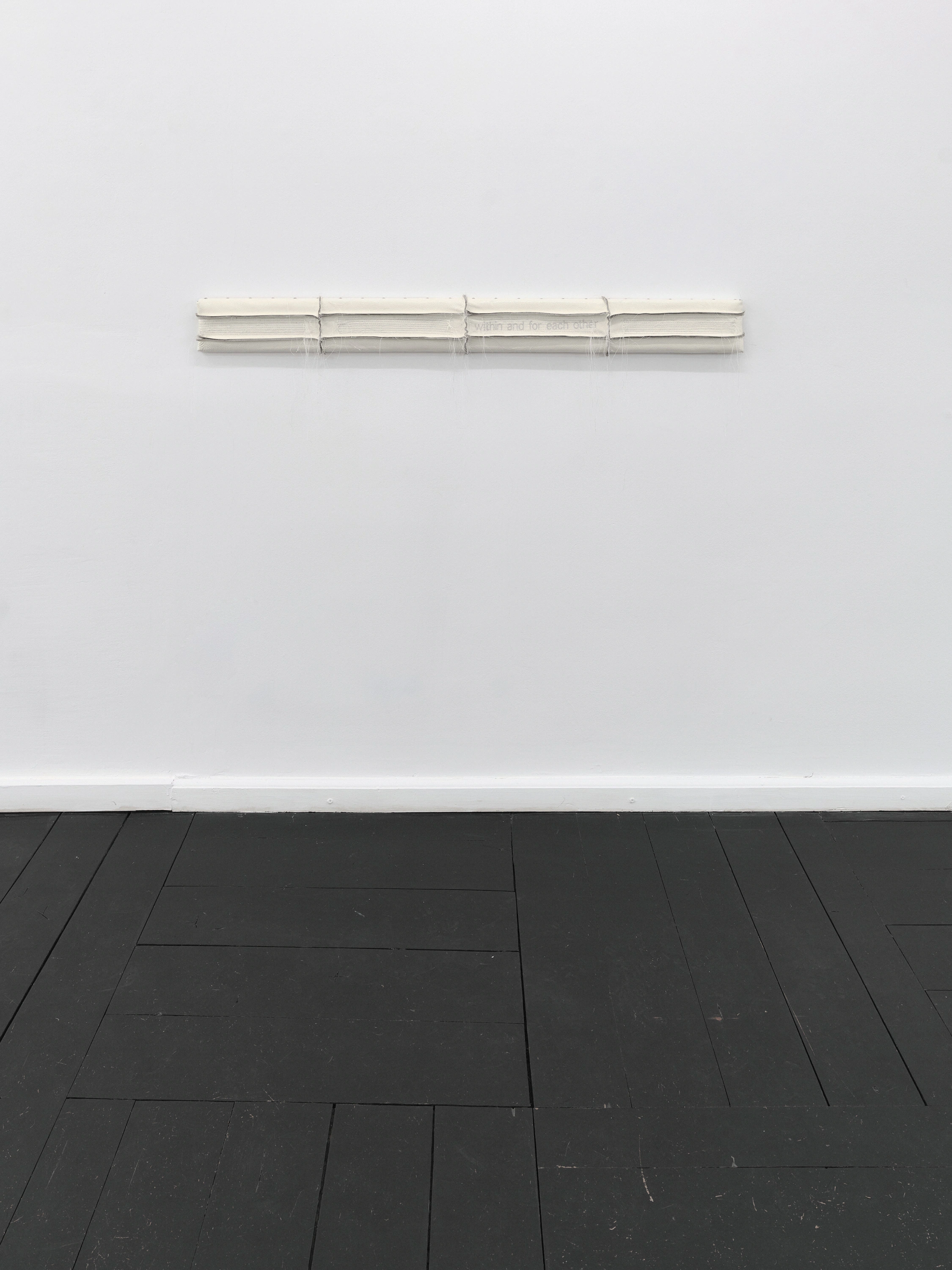
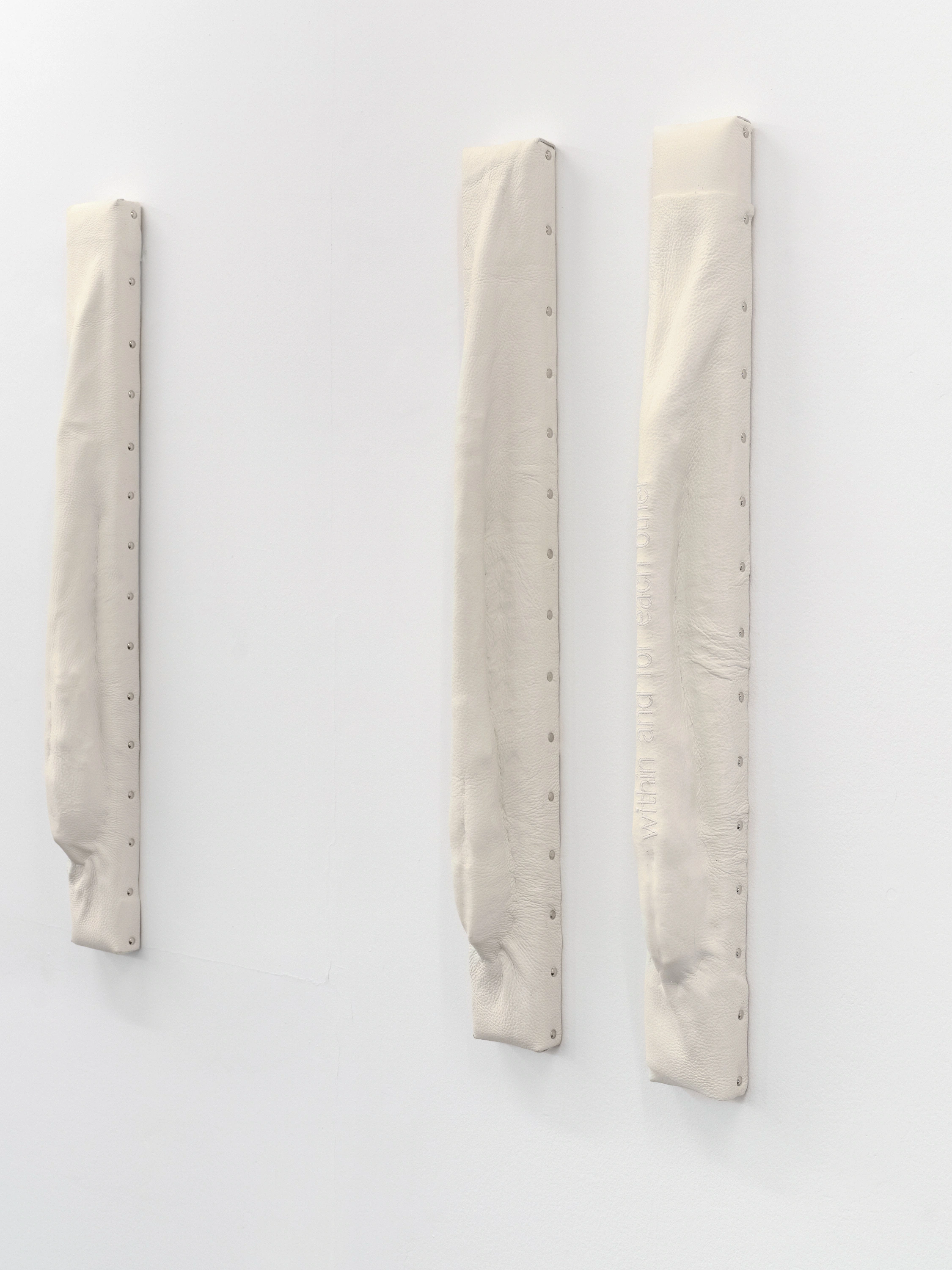
The reliefs are numbered like doses, Relief 01 to Relief 04 I-VI, and the word does double duty: in sculpture, a form that never fully leaves its ground; in the body, what pain waits for. All four combine recycled leather with powder-coated steel, pine wood or OSB board; three add upholstery foam, the stock of the furnished world that makes a hard surface something a body can lean on. They are the title’s second preposition rendered industrial: care as cushioning, comfort as a product. The albino’s white migrates into two of them as white lacquer, as if rarity could be applied as a coat.
The third deer gets no partner. From its head, the exhibition text notes, comes John Dowland’s Flow My Tears, in a sound concept by Klaudia Hartung-Wójciak, performed by Małgorzata Biela; the work, in upholstery foam, cotton, acrylic, polyester, polyester thread, epoxy resin and rabbit fur, takes the song’s title. The pair has saliva; the third has a voice. Saliva is a fluid given to someone. Tears are given to no one, and the lament is the form grief takes when nobody is left to exchange it with.

Baszak’s practice draws on traditional lament songs, the form that has always belonged to whoever stands outside a closed bond. In the final stanza Dowland turns to the shadows with an instruction: “Learn to contemn light.” One work obeys. Boy, oil pastel on paper, is kept behind UV-protective museum glass, shielded from the light the song tells the shadows to scorn. The exhibition text recalls the Brothers Grimm’s Brother and Sister, where a boy becomes a roe deer; whatever the drawing owes that tale, its title names the one term the rest of the show withholds. The human appears once, under glass.

Mickiewicz’s rite runs on the same arithmetic, plus an officiant: the living and the dead act on each other’s behalf, food and prayer travelling one way, lessons the other, while a presiding figure calls each spirit and asks what it lacks. Baszak keeps the economy and dismisses the officiant. Two bodies give and take until giving and taking are the same act; the song comes from the one body with nothing to give back.
Within is the pair’s preposition. For belongs to everyone else: the officiant, the mourner, the viewer, the third deer singing to the shadows. Reciprocity is perfect only where nobody is listening.